
- Product
- Solution for
For Your Industry
- Plans & Pricing
- About us
- Resources

For Your Industry
The 2025 Pricing Review highlights how pricing strategy evolved for retailers and brands amid ongoing volatility, normalization of demand, and rapid adoption of pricing analytics. Throughout 2025, pricing decisions became more data driven, with elasticity modeling, inventory-aware pricing, and automation playing a central role in margin protection and revenue growth. This pricing year in review examines the most important lessons retailers learned in 2025 and how those insights should shape pricing strategy moving forward.
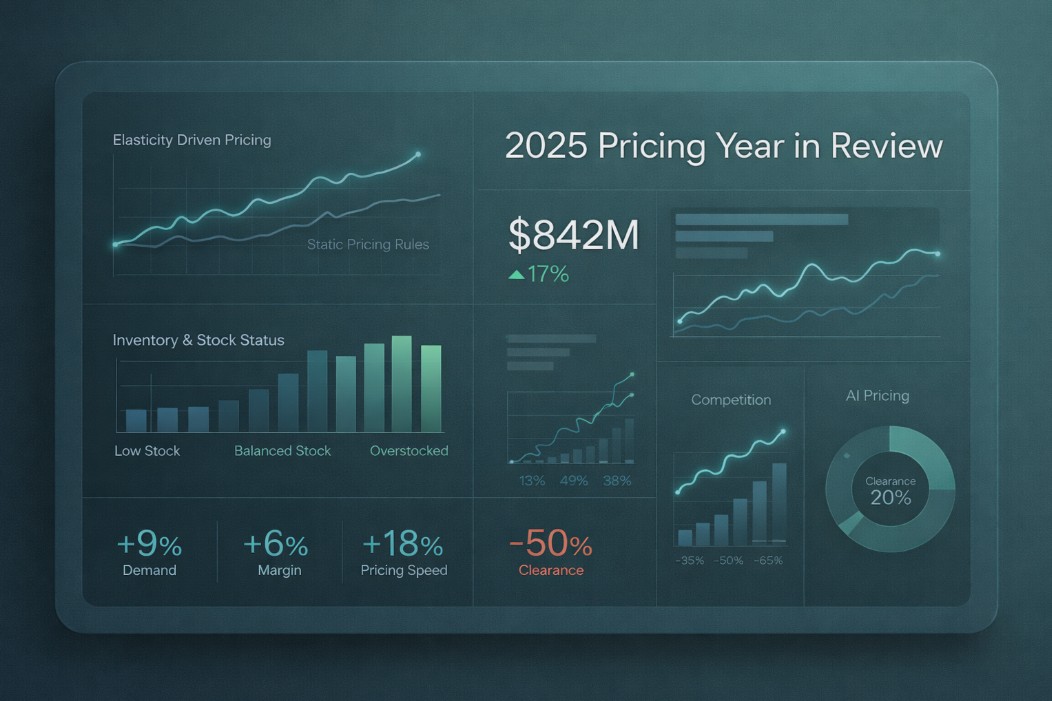
The 2025 pricing year in review reveals a consistent pattern. Pricing success was not defined by aggressive discounting or constant price changes. It was defined by precision, speed, and alignment with real time signals across demand, competition, and inventory. This article reviews the most important pricing lessons from 2025 and explains how retailers and brands can apply these insights to strengthen performance in 2026 and beyond.
One of the most important observations from 2025 is that pricing volatility did not disappear, but it became more structured and predictable for organizations with strong analytics foundations.
While competitive activity remained high, especially in eCommerce and marketplaces, the nature of competition shifted. Retailers moved away from constant undercutting toward more targeted price actions focused on high visibility SKUs. This reduced random price swings and rewarded teams that monitored competitor moves at SKU level rather than category averages.
Some categories returned to pre inflation demand elasticity, while others remained highly sensitive to price. Apparel, discretionary home goods, and mid tier consumer electronics showed continued elasticity, while essential goods and premium branded products demonstrated stronger pricing power.
Rather than persistent daily volatility, pricing pressure peaked around specific moments such as promotional events, holiday windows, and inventory resets. Retailers that planned pricing strategies around these moments outperformed those that reacted late.
The lesson from 2025 is clear. Volatility can be managed when pricing decisions are guided by data and timing rather than fear of competition.
Elasticity modeling became one of the strongest differentiators between pricing leaders and laggards in 2025.
One of the most damaging assumptions in prior years was that consumers were uniformly price sensitive. In 2025, successful retailers used elasticity data to identify where demand was resilient and where discounts actually drove incremental volume.
Retailers that trusted elasticity insights selectively increased prices on low elasticity SKUs without harming conversion. This was especially effective for:
Strong branded products
Items with limited substitutes
SKUs with constrained inventory
Products tied to convenience or fast fulfillment
Rather than defaulting to standard discount ladders, pricing teams used elasticity to apply the minimum effective markdown. This preserved margin while maintaining sell through.
The key lesson is that elasticity data moved from analytical curiosity to operational necessity in 2025.
Stock status emerged as one of the most influential pricing inputs in 2025.
Retailers increasingly tied pricing actions directly to stock levels, days of supply, and sell through velocity. This reduced unnecessary discounting on scarce items and accelerated sell through on overstocked SKUs.
Rather than waiting until products entered full clearance, leading retailers used early inventory risk signals to apply shallow, targeted price adjustments. This often prevented extreme markdowns later in the lifecycle.
Retailers became more comfortable protecting margin when inventory was limited. Low stock indicators and delivery constraints reduced price sensitivity, allowing teams to hold or raise prices responsibly.
In 2025, inventory driven pricing proved essential for balancing margin protection with operational efficiency.
Clearance pricing represented a major opportunity for margin recovery in 2025.
Retailers increasingly avoided uniform clearance discounts. Analytics revealed that many clearance SKUs still had pricing power, especially in specific sizes, regions, or channels.
Instead of large one time price drops, retailers used staged markdowns informed by sell through response. This approach cleared inventory effectively while preserving margin.
Clearance analytics began earlier in the product lifecycle. Pricing teams monitored underperformance sooner and applied corrective actions before products became distressed.
The lesson from 2025 is that clearance does not have to be synonymous with margin loss when analytics guide decisions.
The pace of change in 2025 reinforced the importance of real time pricing intelligence.
Retailers with live competitive monitoring adjusted prices strategically rather than reactively. This prevented unnecessary matching and reduced price wars.
Traffic spikes, conversion shifts, and add to cart behavior increasingly influenced pricing within hours rather than weeks.
Retailers relying on delayed reporting consistently lost margin or volume. The cost of slow reaction was clearly visible in year end performance comparisons.
Real time intelligence transformed pricing from periodic review into continuous optimization.
Manual pricing processes could not keep up with 2025 market conditions.
Automated pricing rules ensured that margin guardrails, brand guidelines, and stock thresholds were applied consistently across large assortments.
Pricing teams spent less time executing updates and more time refining rules, analyzing performance, and planning scenarios.
Rules based execution prevented panic driven discounting during competitive or inventory pressure moments.
The 2025 pricing year confirmed that automation is not optional for large scale retail operations.
As omnichannel retail matured further in 2025, pricing complexity increased accordingly.
Online, store, and marketplace channels often showed different elasticity and inventory realities. Uniform pricing without context led to missed opportunities.
Local demand patterns and inventory availability drove the need for more localized pricing strategies.
Products with fast delivery or convenient pickup options tolerated higher prices, especially during peak demand windows.
Retailers who embraced omnichannel pricing nuance achieved stronger overall performance.
Artificial intelligence moved beyond experimentation and into operational use in 2025.
Predictive demand forecasting improved accuracy
AI models captured non linear demand patterns and improved short term forecasts.
Price recommendations gained trust
As recommendation accuracy improved, pricing teams relied more heavily on AI suggested price points.
Scenario modeling supported confidence
AI enabled rapid evaluation of price scenarios before execution, reducing risk.
AI adoption in 2025 laid the groundwork for more autonomous pricing in the future.
Pricing success in 2025 was not purely technical.
Cross functional collaboration improved outcomes
Retailers that aligned pricing, merchandising, supply chain, and finance teams executed faster and with fewer conflicts.
Clear governance prevented margin erosion
Defined pricing guardrails and escalation paths reduced inconsistent decisions.
Executive sponsorship mattered
Organizations where the pricing strategy had leadership support invested more effectively and delivered stronger results.
Pricing maturity emerged as both a cultural and analytical capability.
Consumer behavior in 2025 reinforced several critical truths.
Value does not always mean lowest price
Customers responded positively to clarity, availability, and convenience even at higher price points.
Transparency increased trust
Clear pricing logic and consistent promotions built long term loyalty.
Fatigue with constant discounting grew
Retailers who reduced promotional noise often saw stronger engagement and margin.
Understanding customer psychology remained as important as analytics.
Retailers tracked a more refined set of metrics.
Margin per unit
Price competitiveness index
Sell through velocity
Markdown efficiency
Inventory turnover
Conversion stability
Revenue per visitor
These KPIs emphasized quality of revenue rather than volume alone.
Based on 2025 performance, several principles stand out.
Precision beats aggressiveness
Targeted, data driven pricing outperforms broad discounting.
Speed matters but accuracy matters more
Fast decisions must still be correct decisions.
Inventory awareness protects profit
Pricing without stock context is incomplete.
Automation enables consistency
Scale demands systems, not heroics.
Analytics must be operational
Insights only matter when they drive action.
These lessons form a clear roadmap for future pricing maturity.
The 2025 pricing year in review shows a decisive shift in how retailers and brands approach pricing. Success was no longer about reacting faster than competitors or discounting deeper than peers. It was about understanding demand, inventory, and competition at a granular level and acting with discipline. Retailers that embraced pricing intelligence, automation, and cross functional alignment turned volatility into opportunity and protected margins in challenging conditions.
As retailers look toward 2026, the lessons from 2025 provide a clear foundation. Pricing excellence is built on data, governed by strategy, and executed at speed.
tgndata helps retailers apply these lessons with advanced pricing intelligence, analytics, and automation platforms designed for modern retail complexity. Contact us to turn your pricing strategy into a durable competitive advantage.





We use cookies to provide you with an optimal experience, for marketing and statistical purposes only with your consent, which you may revoke at any time. Please refer to our Privacy Policy for more information.










Missing an important marketplace?
Send us your request to add it!