
- Product
- Solution for
For Your Industry
- Plans & Pricing
- About us
- Resources

For Your Industry
Pricing is one of the highest-leverage growth levers in ecommerce. A small pricing improvement can outperform months of marketing optimization. Yet most ecommerce companies still treat pricing as static, reactive, or guess-based.
The result: lost margin, missed revenue, and weakened competitive positioning.
Below are the 7 most common pricing mistakes ecommerce companies make, along with practical, data-driven ways to fix them.

Many ecommerce teams set prices once and rarely revisit them unless something breaks, like declining sales or margin pressure.
Markets move constantly. Competitors adjust prices daily. Demand fluctuates. Costs change. Static pricing quickly becomes misaligned with reality.
This leads to:
Shift from static pricing to continuous pricing optimization.
What this looks like:
The goal is not constant random changes, but informed, controlled adjustments based on real data.
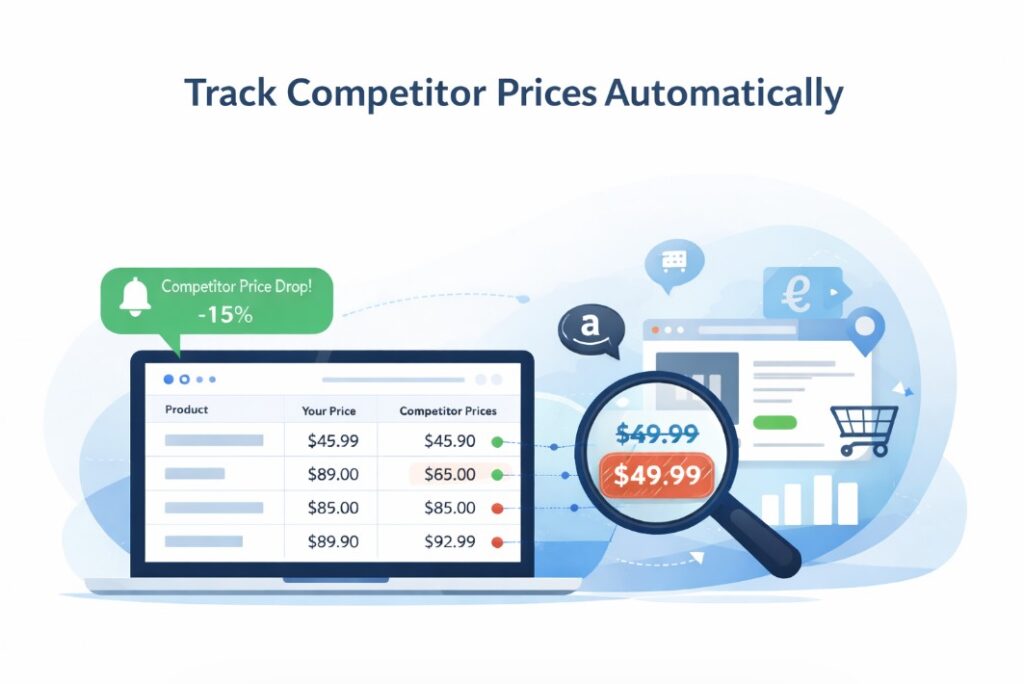
Implement systematic competitor price monitoring.
Focus on:
More advanced teams go further by:
This is where price intelligence platforms become critical, replacing guesswork with structured data.
Pricing does not exist in isolation. Customers compare. Market perception is relative.
Without competitor visibility, you risk:
Many ecommerce companies either:
Dropping prices to win sales without a broader pricing strategy.
Race-to-the-bottom pricing:
It is also unsustainable. There is always someone willing to go cheaper.
Compete on value, not just price.
That means:
A smart approach is strategic price positioning:
Running sitewide discounts (e.g. 20% off everything) as a default growth tactic.
Blanket discounts:
Move toward targeted, data-driven discounting.
Examples:
Even simple segmentation can dramatically improve profitability compared to blanket promotions.
Setting prices without understanding how demand responds to price changes.
Without elasticity insight, pricing decisions are blind:
Measure and model price elasticity.
Start with:
Over time, this allows you to:
Using the same pricing across all channels (website, marketplaces, resellers).
Different channels have different dynamics:
Uniform pricing can:
Adopt channel-aware pricing.
For example:
This requires visibility across channels and the ability to coordinate pricing strategies without creating conflicts.
Managing pricing manually in spreadsheets or disconnected tools.
Manual pricing:
As SKU counts grow, pricing complexity increases exponentially.
Invest in pricing infrastructure.
This includes:
With the right system, teams can:
The companies that win in ecommerce don’t just “set prices.” They operate pricing as a system.
They combine:
This turns pricing into a continuous optimization loop rather than a periodic task.
Fixing these pricing mistakes requires more than intuition. It requires visibility and control.
tgndata helps ecommerce teams:
Instead of reacting late, teams can proactively position their prices in the market.
Ecommerce pricing optimization is the process of continuously adjusting product prices based on demand, competition, and business goals to maximize revenue and margin.
It depends on the category and competition, but high-performing ecommerce companies review and adjust pricing frequently, often daily or weekly for key products.
Price intelligence is the process of collecting and analyzing competitor pricing and market data to inform better pricing decisions.
Yes. Even small pricing improvements can significantly impact revenue and profitability without increasing traffic or acquisition costs.
Pricing is not just a lever. It is a system that directly impacts revenue, margin, and competitive position.
Most ecommerce companies don’t lose because of bad products or weak marketing. They lose because their pricing is misaligned with the market, unmanaged at scale, or driven by assumptions instead of data.
The seven mistakes outlined above all point to the same root issue: lack of visibility and control.
Fixing pricing doesn’t require constant discounting or risky experiments. It requires:
When pricing becomes a continuous, data-driven process, it stops being a reactive task and becomes a growth engine.
The companies that win are not the cheapest. They are the most informed.




We use cookies to provide you with an optimal experience, for marketing and statistical purposes only with your consent, which you may revoke at any time. Please refer to our Privacy Policy for more information.
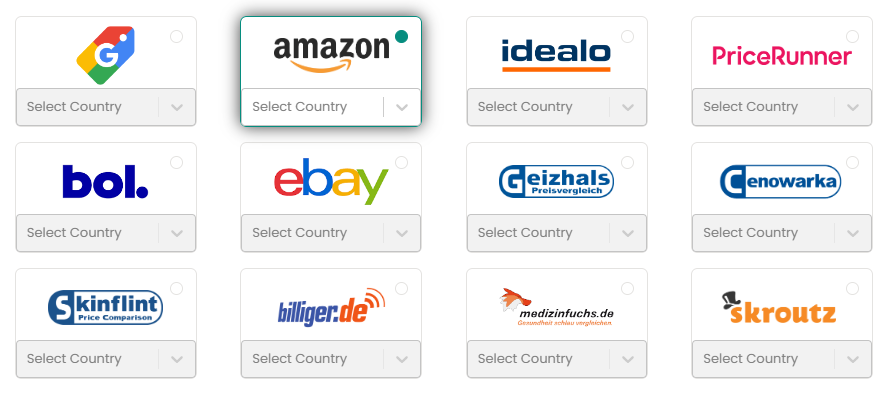










Missing an important marketplace?
Send us your request to add it!