
- Product
- Solution for
For Your Industry
- Partners
- Plans & Pricing
- Resources

For Your Industry
Competitor Price Monitoring is no longer a “nice to have.” If you sell online, your prices are compared in seconds across marketplaces, search results, and category pages. The real challenge is doing it automatically, at scale, with data you can trust, and in a way that stays compliant and stable so you do not get blocked.
This guide breaks down the method, the pitfalls, and the automation blueprint that modern pricing teams use. You will also see where a platform approach can replace fragile scripts with governed monitoring that supports pricing decisions, reporting, and dynamic pricing workflows.
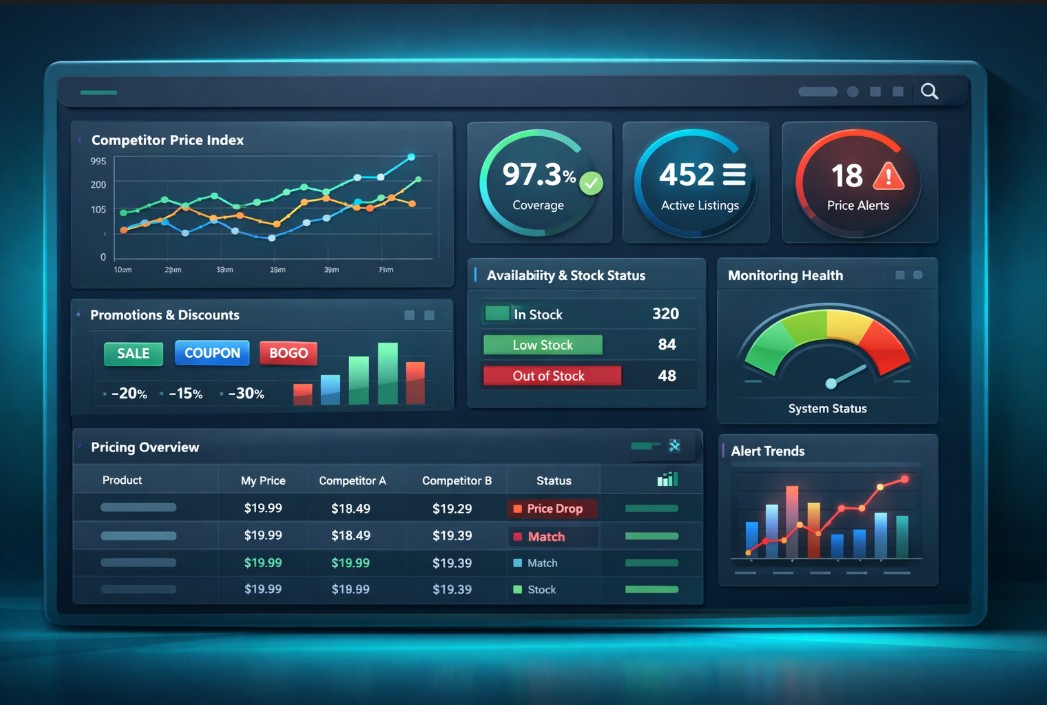
Competitor Price Monitoring breaks when teams treat it as a one-time scraping task. Real retail pricing changes constantly, pages vary by region and device, promos alter final price, and bot defenses flag abnormal traffic. Without SKU matching, QA, and governance, you get noisy comparisons and unstable coverage that cannot reliably drive pricing actions.
The internet is not a clean dataset. Pricing teams run into four recurring failure modes:
False comparisons: same product, different pack size, variant, or seller.
Missing price truth: “from” prices, loyalty prices, coupons, bundles, shipping, taxes.
Coverage collapse: scripts work for a week, then get blocked, layout changes, or CAPTCHA appears.
Action risk: noisy signals trigger repricing that damages margin or violates MAP.
A monitoring program is successful when it produces:
Decision-grade prices (normalized, comparable, contextual)
Stable coverage (predictable monitoring cadence without constant outages)
Traceability (where each price came from, when, how it was processed)
Action outputs (alerts, dashboards, repricing inputs, promo insights)
tgndata treats monitoring as a governed pipeline, not a brittle script. That means configurable sources, normalization rules, automated QA, and workflows that convert raw observations into pricing signals your team can safely use.
To track competitor prices automatically without getting blocked, start with permitted data access methods: official APIs, affiliate feeds, partner exports, and structured datasets. When crawling is necessary, do it responsibly, respect robots.txt (standardized in RFC 9309) and site terms, limit request rates, and build error backoff and caching so you do not overload sites.
You do not win long-term by “outsmarting” bot defenses. You win by building a monitoring system that behaves like a responsible automated client, and by choosing sources that are meant for programmatic access.
Official APIs (best stability)
Marketplaces and platforms sometimes provide product, offer, or price endpoints.
Pros: high stability, clear ToS, structured outputs.
Cons: limited coverage, quotas, sometimes restricted to partners.
2) Affiliate and partner feeds
Many retailers publish product feeds for affiliates or partners.
Pros: designed for automation, rich attributes.
Cons: may not include all pricing nuances like coupon stacking.
3) Licensed third-party datasets
Pros: quick to deploy, broad coverage.
Cons: may require validation, slower refresh depending on provider.
4) Compliant crawling of public pages (use carefully)
If you must crawl, treat it like an operations program, not a growth hack:
Read and honor robots.txt where applicable; it is an advisory standard for automated clients.
Align request volume with a site’s capacity using rate limits and caching.
Implement exponential backoff on 429 and 5xx responses.
Monitor changes and failures like any production system.
Note: Many sites use bot management tools to detect non-human traffic patterns. Cloudflare, for example, distinguishes bot activity and enables blocking or throttling.
tgndata helps teams combine multiple collection methods into one consistent monitoring layer. If a source becomes unstable, you can adjust coverage strategy without rewriting your entire pipeline.
Avoid blocks by behaving predictably and responsibly, not by trying to bypass defenses. Use throttling, caching, consistent identification, and backoff on errors. Spread monitoring across time windows, avoid bursts, and build observability so you detect rising failure rates early. This reduces security flags and keeps automated monitoring stable.
“Without getting blocked” should mean “without triggering defenses through irresponsible traffic” and “without building a system that violates site terms.”
Rate limiting: cap requests per domain and per path.
Caching: do not re-fetch static assets or unchanged product pages unnecessarily.
Backoff and retry discipline: treat 429 as a signal to slow down, not to escalate.
Scheduling: stagger checks across hours, prioritize top SKUs more frequently than long-tail items.
Change detection: if the page structure shifts, fail gracefully and alert, do not loop.
Identity consistency: present a transparent, consistent user-agent and contact channel when appropriate.
Retailers and publishers are increasing bot controls to protect infrastructure and content. Cloudflare has expanded controls for automated crawlers and AI bots, showing how aggressively bot governance is evolving.
For your brand, that means:
Your monitoring must be operationally mature.
Your site should also defend itself from hostile scraping.
Competitor Price Monitoring only works when you compare like with like. SKU matching resolves differences in identifiers, naming, pack size, variant, and seller. Normalization aligns currency, unit price, and availability context. Without matching and normalization, your system produces false undercuts and triggers bad repricing decisions.
Most “price tracking” fails because the hard part is not collection. The hard part is product equivalence.
Identifiers: GTIN, EAN, UPC, MPN, internal SKUs
Pack size and unit price: 6-pack vs 12-pack, 250ml vs 330ml
Variant attributes: color, size, storage, generation, region
Marketplace offer context: sold by retailer vs third-party seller, buy box winner
Availability: in stock, backorder, limited stock, preorder
Currency and geography: localized pricing, VAT inclusion, shipping differences
Situation: A competitor lists the same brand but a different multipack size.
What goes wrong: Your system thinks you are overpriced and auto-drops margin.
Recommended approach: Match by identifier plus pack rules, compute unit price, compare on normalized units.
What tgndata enables: Automated matching workflows, unit normalization, and QA flags for suspect comparisons.
tgndata supports identifier-based matching combined with attribute enrichment and unit price normalization, so pricing teams see comparable offers, not misleading raw prices.
A competitor’s listed price is rarely the customer’s payable price. Promos, coupons, loyalty discounts, shipping thresholds, and taxes change the final amount. Accurate monitoring captures both list and effective price, plus promo context and timestamps. This turns price feeds into real competitive insight for repricing and promotion planning.
If you track only the visible number on a category tile, you miss what actually drives conversion.
At minimum store:
List price
Effective price (after visible discounts)
Promo type (percentage, fixed, bundle, coupon)
Availability status
Shipping cost and threshold
Seller and fulfillment type (marketplace)
Timestamp, location, device context if relevant
Situation: A competitor runs a weekend promo with conditional discounts.
What goes wrong: Your repricer drops prices permanently based on a temporary event.
Recommended approach: Track promo windows, separate “promo price” from “base price,” add anomaly detection.
What tgndata enables: Promo tagging, time-series anomalies, and rule-based alerts to prevent overreaction.
tgndata structures price history with promo context so you can tell the difference between a competitor’s strategic move and a short-lived discount mechanic.
Automated competitor price tracking requires an end-to-end pipeline: ingestion, normalization, validation, storage, and activation. Build schedules by SKU importance, validate against historical patterns, and push outputs into dashboards, alerts, or repricing engines. Treat monitoring like a product with observability, versioning, and governed change control.
A robust architecture looks like this:
Source layer: APIs, feeds, compliant crawling, third-party datasets
Ingestion layer: connectors, parsers, schema validation
Normalization layer: SKU matching, unit price, currency, promo context
QA layer: anomaly detection, completeness checks, duplication checks
Storage layer: warehouse plus time-series history
Activation layer: alerts, dashboards, repricing inputs, reports, webhooks
Governance layer: access control, audit logs, documentation
Situation: A retailer redesigns PDP templates.
What goes wrong: Your scraper returns empty price fields, and you do not notice until sales drop.
Recommended approach: Schema checks, null thresholds, parser versioning, and fail-closed alerts.
What tgndata enables: Monitoring health dashboards, automated QA, and rapid template updates without client rewrites.
tgndata provides a managed pipeline with validation and observability, so you detect failures immediately and keep coverage stable even as sites change.
To choose the right monitoring approach, map capabilities to business outcomes. Strong platforms combine multi-source collection, SKU matching, promo normalization, quality checks, and activation workflows. The best KPI impact comes from fewer false undercuts, faster response to competitor moves, and higher pricing confidence across teams.
| Feature or capability | Business benefit | KPI impact | Who owns it |
|---|---|---|---|
| Multi-source collection (APIs, feeds, compliant crawling) | Higher coverage and resilience | Coverage rate, refresh SLA | eCommerce analyst |
| SKU matching and product normalization | Comparable pricing signals | Fewer false positives, fewer manual fixes | Pricing manager |
| Unit price and pack normalization | Fair comparisons across variants | Margin protection, price index accuracy | Pricing manager |
| Promo and shipping context capture | Real “payable price” insight | Conversion rate, promo ROI | eCommerce analyst |
| Automated QA and anomaly detection | Trustworthy datasets | Lower error rate, fewer firefights | Data or BI lead |
| Alerting and workflow routing | Faster response time | Time to react, fewer stockouts | Pricing manager |
| Dynamic pricing rules integration | Controlled automation | Margin, revenue, price competitiveness | Pricing lead |
| Audit logs and governance | Compliance and traceability | Reduced risk, faster approvals | Ops lead |
tgndata unifies these capabilities into a single pricing intelligence layer, so your team spends time on pricing strategy and execution, not data firefighting.
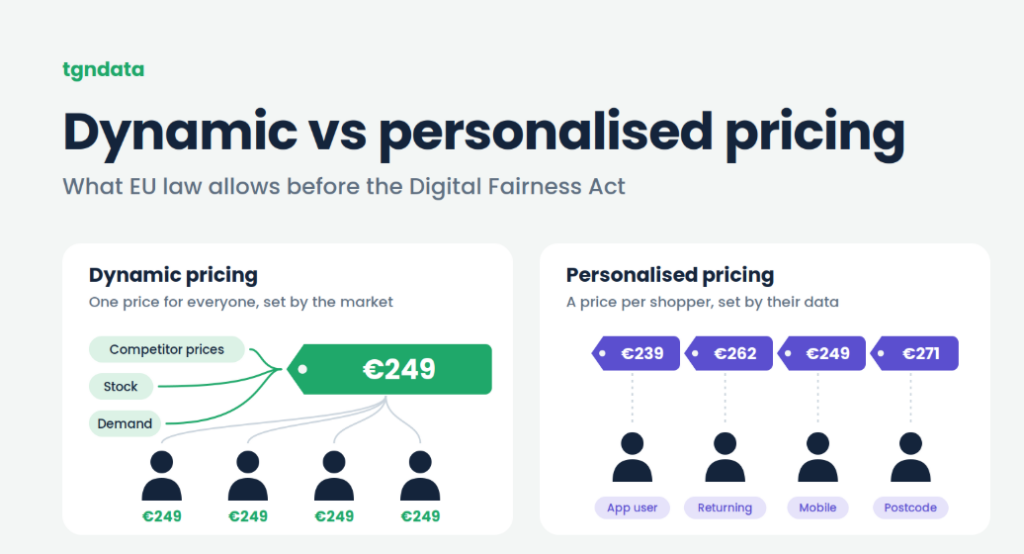
Dynamic pricing automation requires a structured architecture that connects data ingestion, pricing logic, execution, and monitoring.
Data ingestion from competitors, marketplaces, and internal systems
Normalization and product matching
Pricing logic with rules and models
Execution through ecommerce APIs
Monitoring, alerts, and reporting
Competitor prices and availability
Cost and margin data
Inventory levels and forecasts
Traffic and conversion metrics
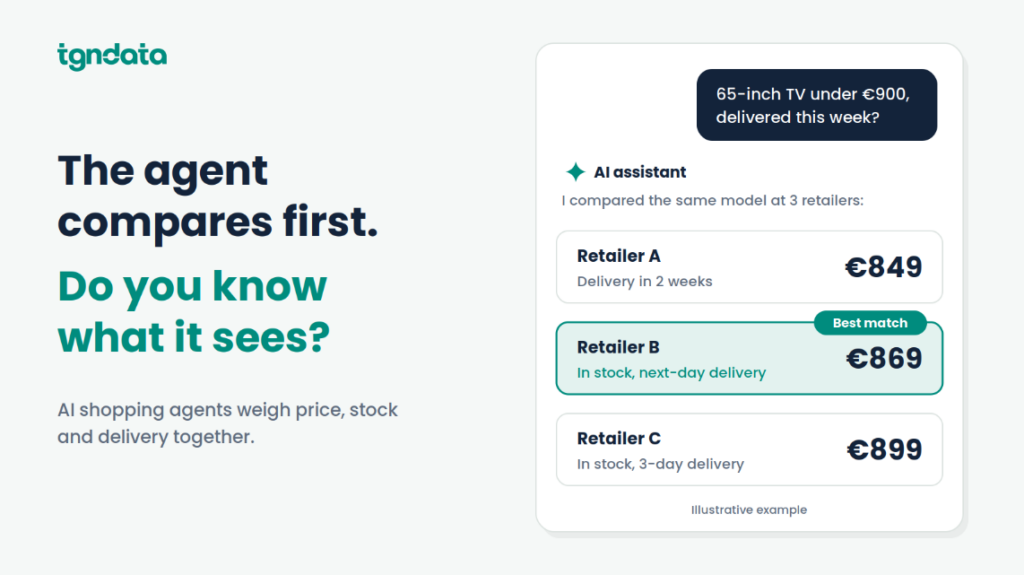
Pricing endpoints are crawled by bots and AI systems. Erratic pricing behavior can signal instability.
tgndata provides a centralized pricing intelligence layer that integrates with e-commerce platforms while maintaining stability and observability.
Real world examples demonstrate how dynamic pricing adapts to different ecommerce scenarios.
Prices increase during peak demand windows while remaining stable outside those periods.
Prices decline gradually as inventory ages, protecting early margin.
Prices respond only to trusted competitors, ignoring low quality sellers.
Scenario testing allows teams to preview pricing outcomes before deployment.
Situation:
A seller loses Buy Box visibility.
What Goes Wrong Without Automation:
Price gaps persist unnoticed.
Recommended Approach:
Competitor aware pricing with stability rules.
What tgndata Enables:
Automated detection and controlled correction.
Dynamic pricing success is measured by margin durability, revenue lift, and controlled price movement.
Gross margin
Revenue per visitor
Price index
Price change frequency
Conversion rate stability
| Feature | Business Benefit | KPI Impact | Owner |
|---|---|---|---|
| Price intelligence | Market awareness | Price index accuracy | Pricing Manager |
| Rule engine | Brand protection | Margin stability | Ecommerce Lead |
| Automation workflows | Scalability | Time to update | Ops |
| Analytics dashboards | Optimization | Revenue per SKU | Analyst |
tgndata ties pricing actions directly to performance outcomes, enabling continuous optimization.
Build works when scope is small and engineering bandwidth is stable. Buy works when you need broad coverage, faster time to value, and managed change handling. Hybrid is common: build internal pricing logic and workflows, but rely on a platform for reliable monitoring, normalization, QA, and data delivery to your stack.
Best for: a narrow set of competitors, low SKU count, strong in-house data engineering.
Risks: maintenance burden, frequent breakage, hidden costs from monitoring failures.
Best for: teams that need scale, stability, and faster activation.
Risks: vendor lock-in if exports, schemas, and governance are weak.
Best for: most mature organizations.
You keep:
pricing rules, margin logic, segmentation, experimentation
You outsource:
data acquisition operations, normalization, QA, and coverage resilience
Coverage transparency: which domains, which SKUs, how often, and success rates
Normalization depth: unit price, bundles, variants, seller context
QA and observability: anomaly alerts, parser versioning, failure dashboards
Activation: exports, APIs, webhooks, and integrations with pricing tools
Governance: audit trails, role-based access, documentation
Compliance posture: clear handling of ToS, robots.txt considerations, and personal data avoidance where applicable
tgndata is designed for hybrid reality. You can export clean datasets to your warehouse and keep your internal pricing logic, while tgndata maintains monitoring reliability and data quality.
Staying unblocked is partly technical, but it is also legal and reputational. Respect site terms, avoid collecting personal data, and document your purpose and data handling. In the EU, scraping can implicate GDPR when personal data is involved, and database rights may apply depending on reuse. Design compliance into your pipeline.
Key principles for a safer program:
Minimize personal data: price monitoring usually does not require personal identifiers.
Document purpose and access method: audits matter when stakeholders ask “is this allowed?”
Respect technical signals: robots.txt is not access control, but it is an established guidance mechanism for automated clients.
Use contractual paths when available: APIs, feeds, partner agreements.
Situation: You expand monitoring across EU markets.
What goes wrong: Teams panic about legality, data retention, and whether monitoring includes personal data.
Recommended approach: Define scope, avoid personal data, add governance, store only what you need, and get counsel for edge cases.
What tgndata enables: Structured datasets with controlled fields, audit trails, and configurable retention.
tgndata supports privacy-aware data design and governance patterns, so compliance becomes a built-in feature, not a last-minute scramble.
Competitor monitoring and technical branding intersect through trust and reliability signals. If your site is fast, secure, and semantically consistent, it reduces brand drift in AI answers and improves retrievability. If your monitoring is governed and respectful, it lowers operational risk. Both reinforce credibility with users, partners, and automated agents.
Technical branding is the infrastructure and governance that makes your brand dependable to humans and machines. Here is how the four layers apply:
Infrastructure hygiene: performance, rendering stability, Core Web Vitals
Bot governance: crawl control, rate limiting, AI crawler management
Security and brand drift prevention: protect against hallucinated URLs, typosquatting, and data exposure
Agentic alignment: deterministic paths, reliable structured data, content integrity
Situation: AI answers cite outdated prices or incorrect product variants.
What goes wrong: Customers distrust your pricing and support teams absorb complaints.
Recommended approach: Publish consistent structured data, keep canonical product identifiers stable, and maintain transparent pricing pages.
What tgndata enables: Consistent identifiers across monitoring and your catalog, plus structured exports that support clean internal truth.
tgndata helps connect external competitive signals to a clean internal product and pricing truth, which reduces mismatch errors and supports more consistent brand messaging.
Operational success comes from defining scope, cadence, and ownership. Start with top SKUs, prioritize key competitors, and measure coverage and data quality daily. Build escalation paths for failures and define how alerts become actions. A clear operating model prevents monitoring from becoming a neglected script that quietly degrades.
Phase 1: Define scope
Top categories and top revenue SKUs
Competitor list by channel (retailers, marketplaces, aggregators)
Refresh needs by SKU tier (hourly, daily, weekly)
Phase 2: Build the data contract
What fields are required for decision-making
What does “effective price” means for your business
Normalization rules and exception handling
Phase 3: Automate QA
Completeness thresholds by domain
Anomaly rules (price drops, price spikes, missing buy box)
Manual review queue for edge cases
Phase 4: Activate
Alerts: undercut thresholds, MAP violations, promo events
Dashboards: price index, competitiveness by category
Integrations: repricing system, BI, inventory planning
Situation: Monitoring generates hundreds of alerts daily.
What goes wrong: Teams ignore alerts and revert to manual checks.
Recommended approach: Tier alerts by business impact, add confidence scoring, route to owners.
What tgndata enables: Configurable alerting, prioritization, and workflow outputs aligned to roles.
tgndata supports tiered alerting and decision workflows so the right people see the right signals at the right time, without noise.
Competitor price monitoring is the process of tracking how much competitors charge for the same or comparable products across websites, marketplaces, and channels. It helps pricing and eCommerce teams understand market positioning and react to price changes.
You can track competitor prices automatically by using APIs, product feeds, licensed datasets, or compliant automated page monitoring. The data is then normalized, checked for accuracy, and refreshed on a schedule so teams do not rely on manual checks.
Avoid blocks by using permitted data sources first, respecting robots.txt guidance, limiting request rates, caching results, and slowing down when errors occur. Stable, predictable monitoring behavior is far more effective than aggressive scraping tactics.
You should monitor the effective price customers actually pay, including discounts, promotions, shipping costs, stock status, and seller or buy box information. Without this context, price comparisons can be misleading.
Competitor price monitoring is generally legal when collecting publicly available pricing data and avoiding personal data. Compliance depends on local regulations, site terms, and data usage. Many companies use APIs, feeds, or licensed data to reduce legal and operational risk.
Competitor Price Monitoring succeeds when it is treated as a governed system: compliant data access, stability practices that reduce blocks, SKU matching that prevents false comparisons, and automation that turns raw prices into actions. The teams that win do not chase scraping tricks. They build a monitoring engine with QA, observability, and clear ownership.
If you want to operationalize this, start with a coverage and benchmark audit across your top SKUs and competitors, then design the pipeline around decision requirements. tgndata can support the monitoring, normalization, and activation layers so your pricing team can focus on strategy, not scraping maintenance.
We use cookies to provide you with an optimal experience, for marketing and statistical purposes only with your consent, which you may revoke at any time. Please refer to our Privacy Policy for more information.










Missing an important marketplace?
Send us your request to add it!