
- Product
- Solution for
For Your Industry
- Partners
- Plans & Pricing
- Resources

For Your Industry
Competitor price monitoring for UK retailers has become essential in 2026 as margins face increasing pressure from inflation, aggressive marketplace competition, and highly price-sensitive consumers. Retailers are operating in an environment where pricing is fully transparent and constantly shifting, making it harder than ever to stay competitive without sacrificing profitability.
In this landscape, relying on intuition or manual checks is no longer enough. Retailers need real-time visibility into competitor pricing to make informed, strategic decisions that protect margins while maintaining market position.

Competitor price monitoring is the process of tracking and analyzing competitors’ prices, promotions, and availability across channels to inform pricing decisions.
In modern retail, this includes:
The goal is not just visibility. The goal is better pricing decisions that protect both competitiveness and margin.
Consumers can now compare prices across dozens of retailers in seconds. Tools like Google Shopping and marketplaces have eliminated pricing opacity.
Implication:
Retailers must stay competitive but cannot afford unnecessary price cuts.
Prices are no longer static. Competitors update pricing frequently, sometimes multiple times per day.
Implication:
Manual tracking is impossible. Automated monitoring is essential.
Retailers face rising:
Implication:
Every pricing decision directly impacts profitability.
Competitor price monitoring for UK retailers plays a direct role in protecting margins by enabling more controlled and data-driven pricing decisions.
One of the biggest hidden margin killers is over-discounting.
Without data, retailers often assume:
“We need to lower prices to compete.”
In reality:
With monitoring, retailers can:
Not all competitors should influence your pricing.
Leading retailers segment competitors into:
This enables rules like:
Result: Smarter pricing decisions with controlled margin impact.
Price wars often start from reactive behavior.
Retailer A drops price → Retailer B matches → Retailer A drops again.
Without control, this leads to rapid margin erosion.
Competitor monitoring helps retailers:
Result: Stability instead of destructive price competition.
Promotions are necessary but often inefficient.
With competitor insights, retailers can:
Example:
If competitors are offering 10% off, there is no need to offer 25%.
Result: Better promotional ROI and margin protection.
Competitor data is not just defensive. It reveals opportunities.
Retailers can identify:
This allows:
Modern pricing strategies combine:
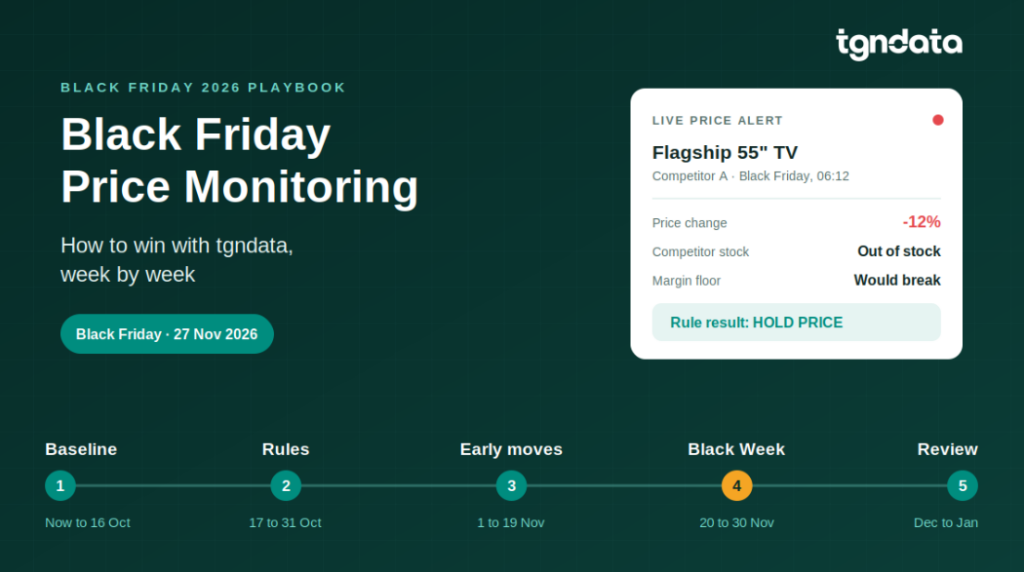
Retailers implement rules such as:
Result: Automated pricing that balances growth and profitability.
A UK electronics retailer monitors competitor pricing across 20 key SKUs.
They discover:
Instead of maintaining low prices, they:
Result:
To execute this effectively, retailers need more than spreadsheets.
A modern pricing stack includes:
This transforms pricing into a data-driven system.
Matching every competitor leads directly to margin loss.
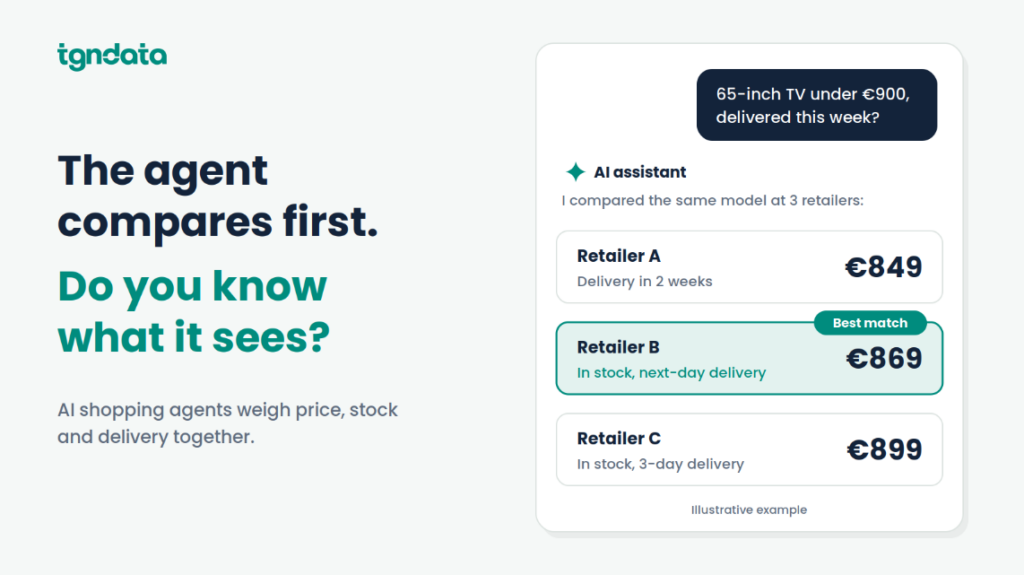
Price alone is not enough. Factors like:
also influence competitiveness.
Short-term discounts should not drive long-term pricing decisions.
Without structured rules, pricing becomes inconsistent and reactive.
The most successful retailers:
They understand that:
The goal is not to be the cheapest. The goal is to be intelligently competitive.
To implement this level of pricing sophistication, retailers need reliable data and actionable insights.
tgndata enables retailers to:
This allows pricing teams to move from: Reactive pricing → Strategic pricing
Price intelligence software tracks competitor prices and helps businesses decide how to price their products.
Repricing tools automatically change prices, while price intelligence tools provide insights and strategy (and may include automation).
Ecommerce retailers, brands, marketplace sellers, and pricing teams managing competitive products.
No. Any business operating in a competitive pricing environment can benefit.
Yes. It improves pricing decisions, leading to higher conversion rates and better margins.
Competitor price monitoring has become a foundational capability for UK retailers operating in a highly competitive and transparent market. It is no longer a “nice to have” but a critical lever for protecting profitability.
The biggest threat to margins is not being too expensive. It is discounting without justification. Retailers without competitive visibility consistently underprice and erode their own margins unnecessarily.
High-performing retailers take a different approach. They do not chase the lowest price. Instead, they use competitor data to make selective, controlled pricing decisions based on relevance, demand, and strategic importance.
The real advantage comes from combining data with structure. Monitoring alone does not protect margins. What matters is how that data feeds into pricing rules, automation, and decision frameworks.
Importantly, competitor price monitoring is not just defensive. It also uncovers opportunities to increase prices, improve positioning, and expand margins when market conditions allow.
Ultimately, pricing maturity is becoming a true competitive advantage. Retailers that invest in price intelligence consistently outperform those relying on manual or reactive pricing approaches.
Stop guessing your pricing. Competitor price monitoring for UK retailers is the key to protecting margins and staying competitive in today’s market.
tgndata helps UK retailers track competitor prices in real time, benchmark their market position, and make smarter pricing decisions that protect and grow margins.
Book a demo to see your competitive pricing position and uncover immediate margin opportunities.
We use cookies to provide you with an optimal experience, for marketing and statistical purposes only with your consent, which you may revoke at any time. Please refer to our Privacy Policy for more information.










Missing an important marketplace?
Send us your request to add it!