
- Product
- Solution for
For Your Industry
- Partners
- Plans & Pricing
- Resources

For Your Industry

Marketing Manager
In this episode of our pricing strategy series, we explore one of the most debated topics in modern commerce: competition data.
Every company talks about it.
Few actually use it correctly.
Should you always match competitors’ prices?
How many competitors should you track?
And how do you avoid falling into a price war?
This episode breaks down how to turn competition data into a strategic advantage instead of a margin killer.
Competition data refers to external market signals such as:
In a world of data-driven pricing, businesses no longer rely on instinct. Pricing decisions increasingly depend on structured data analysis to improve profitability and competitiveness.
But here’s the key insight:
👉 Not all competition data should influence your pricing decisions
Competition data is not equally important for every business.
Why?
Because price sensitivity depends on comparability.
If customers can easily compare your product with others, even small price differences can impact demand.
One of the biggest mistakes companies make is trying to track everyone.
Instead, competitors should be evaluated based on two dimensions:
1. Market Share
2. Resources & Intent
This creates four key groups:
| Type | Strategy |
|---|---|
| High share + high resources | Compete aggressively |
| High share + low focus | Capture market share |
| Low share + high resources | Defend (future threat) |
| Low share + low resources | Ignore |
👉 Trying to match every competitor leads to analysis paralysis and ultimately poor decisions.
1. Strategic (Periodic Analysis)
Used for:
Example:
This helps answer:
👉 Are we really competing for the same customer?
2. Operational (Ongoing Monitoring)
This is where competition data directly impacts pricing.
You should continuously track:
Real-time data enables faster, smarter decisions and keeps pricing aligned with market conditions.
Segment your products:
🔴 Core Value Items (Highly Price-Sensitive)
👉 Rule example:
🟡 Foreground Items (Moderately Sensitive)
👉 Rule example:
🟢 Long Tail (Low Sensitivity)
👉 Rule:
Most companies focus only on competitor prices.
But here’s a missed opportunity:
👉 If competitors go out of stock, you can:
Without this visibility, companies often leave money on the table.
1. Tracking Too Many Competitors
Leads to confusion and no action.
2. Matching Everything
Applying competitor pricing to the full portfolio destroys margins.
3. Wrong Product Matching
Comparing:
👉 Result: false pricing decisions
4. Not Acting on Data
The most dangerous mistake.
Many companies collect data but never use it.
Without action:
Ideal approach:
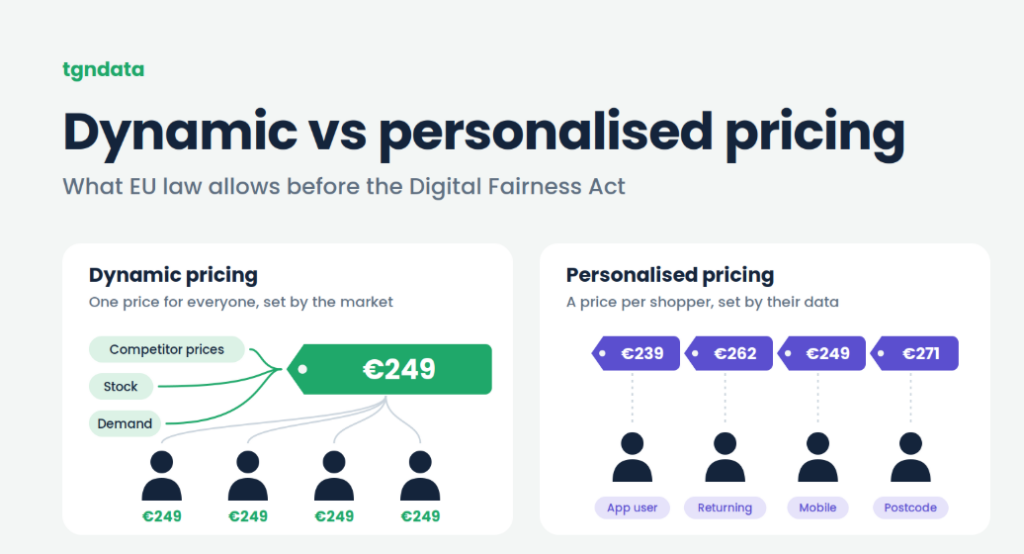
Dynamic pricing is becoming more common as companies adopt real-time data tools and automation.
👉 But don’t overdo it:
Price wars destroy value—for everyone.
To avoid them:
✔ Set Margin Floors
Never go below minimum profitability
✔ Limit Scope
Only adjust prices for key products
✔ Differentiate Beyond Price
✔ Accept Reality
If a competitor is 10x bigger:
👉 You don’t have a pricing problem you have a strategy problem
👉 Most importantly:
Don’t just collect competition data, act on it.
Want to learn how to apply these concepts in real business scenarios?
🎙️ Listen to Part 3: Competition Data and discover:

We use cookies to provide you with an optimal experience, for marketing and statistical purposes only with your consent, which you may revoke at any time. Please refer to our Privacy Policy for more information.










Missing an important marketplace?
Send us your request to add it!