
- Product
- Solution for
For Your Industry
- Plans & Pricing
- About us
- Resources

For Your Industry
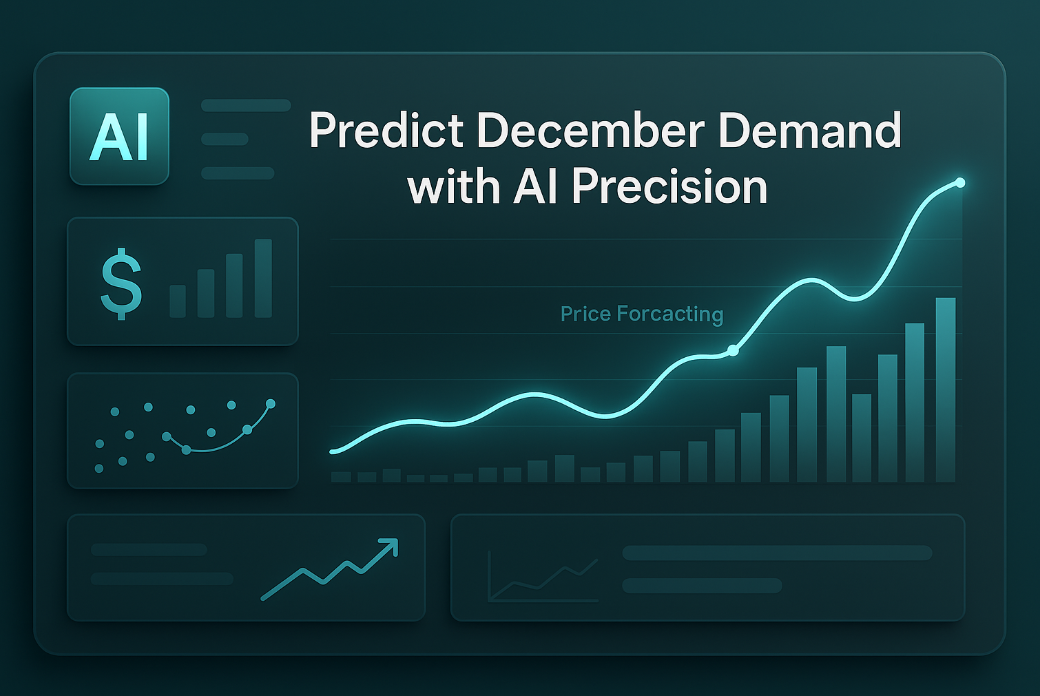
December behaves unlike any other month in the retail calendar. Holiday shopping patterns, inventory cutoffs, and consumer urgency create some of the steepest demand curves of the year. AI price forecasting captures these shifts using historical patterns, real time signals, and predictive analytics that exceed the capabilities of manual or rule based approaches.
Gift driven purchasing behavior
Compressed shopping windows
Competing promotional events
Weather related demand shocks
Final week urgency that lifts prices or accelerates stockouts
Inventory depletion and late season scarcity
Traditional price planning models struggle because they rely on static rules or early season expectations. AI models continuously learn from live data and deliver granular predictions that match the speed and intensity of December commerce.
Legacy forecasting tools often miss December inflection points because they cannot ingest large dynamic datasets or detect nonlinear shifts. December demand surges are influenced by variables such as social behavior, shipping deadlines, and last minute competitor pricing that change minute by minute.
Slow reaction times
Overreliance on historical averages
Inability to detect microtrends
Underestimation of cross category substitution
No real time recalibration
AI price forecasting eliminates these gaps through automated learning loops and continuous data ingestion.
Modern AI forecasting uses ensembles of machine learning models, time series algorithms, causal inference engines, and deep learning architectures. Each component analyzes different layers of data complexity to forecast price elasticity and demand uplift.
Machine learning regression models
These models learn from historical price, promotion, and sales data to identify relationships that drive demand.
Gradient boosted trees
GBTs excel at capturing nonlinear December behavior such as sudden jumps due to weather, viral product trends, or unexpected competitor activity.
Deep learning time series models
RNNs, LSTMs, and Transformers generate multi horizon forecasts that detect complex seasonality, including the rapid acceleration during the final two weeks of December.
Causal impact modeling
These models isolate the effect of promotions versus organic demand so retailers know whether surges are natural or incentive driven.
AI price forecasting integrates all of these signals to produce granular predictions at SKU, store, channel, or region level.
High quality data gives AI models the ability to detect December surges with precision. The most effective models integrate transactional, behavioral, competitive, and operational data.
Historical sales and pricing
Customer behavior and session data
Competitor price intelligence
Search trends and marketplace signals
Inventory availability and aging
Regional weather forecasts
Shipping cutoff dates
Supplier replenishment constraints
The combination of these datasets allows AI to detect December inflection points earlier than manual analysis.
Forecasting is only valuable when paired with automated pricing execution. Retailers use dynamic pricing engines to update prices as conditions shift. During December, this can mean adjusting prices multiple times per day.
Captures peak willingness to pay
Reduces margin leakage during promotions
Prevents stockouts through demand shaping
Ensures competitive alignment without price wars
Supports cross channel price consistency
Pricing automation helps teams manage December scale without manual intervention.
Elasticity fluctuates dramatically in December. AI models continuously recalculate elasticity by observing how consumers react to each price point and how urgency affects demand.
Elasticity drops as shipping deadlines approach
Premium products often experience elasticity compression
Discount sensitivity increases early in the month
Stock scarcity reduces elasticity late in the month
AI price forecasting quantifies these shifts and ensures retailers adjust prices for maximum revenue and sell through.
Flash promotions
Short duration price drops
Category wide discounting
Marketplace seller undercutting
Regional price variations
When competitors make unannounced moves, AI forecasting models update demand expectations instantly. This prevents retailers from being blindsided during crucial shopping windows.
Competitor pricing behavior accelerates in December. Price intelligence tools allow AI models to monitor, extract, and interpret competitive signals instantly.
AI forecasting engines allow retailers to run simulations that predict outcomes under different pricing, promotional, or inventory conditions.
What happens if we reduce promotions during the final week
Expected uplift if we match competitor discounting
Impact of restocking delays
Revenue effects of maintaining higher prices with limited inventory
Scenario planning helps pricing teams prepare December playbooks that guide decision making during high pressure periods.
December surges vary by sector. AI models adjust strategies based on category specific patterns.
Large demand spikes after price drops
Scarcity effects on premium SKUs
Sensitivity to competitor comparison shopping
Rapid last week surge
High risk of stockouts
Elasticity compression due to urgency
Weather driven volatility
Heavy discounting windows
Strong lift during clearance rounds
Event driven purchasing
Highly repeatable seasonal cycles
Low elasticity for holiday staples
Each category benefits from tailored forecasting approaches baked into AI models.
AI does not replace pricing teams. It elevates them by delivering granular insights and automating tactical decisions.
Interpreting forecast outputs
Reviewing price changes for strategic alignment
Overseeing exceptions and guardrails
Managing promotional calendars
Communicating strategies with merchandising and finance
AI forecasting frees professionals to focus on strategic work instead of manual calculations.
Implementing forecasting for December requires a structured rollout.
Consolidate sales, pricing, and competitive intelligence data
Train models to detect seasonal patterns and nonlinear shifts
Validate forecasts using backtesting across previous Decembers
Deploy automated pricing guardrails
Monitor performance and retrain models with live data
Run December scenario simulations
Launch dynamic pricing during peak weeks
A mature system becomes more accurate each season.
Promotions often cannibalize margins if not tightly controlled. AI models detect when lesser discounts can deliver the same demand impact and when additional markdowns actually increase margin loss.
Predicts demand uplift from specific discount levels
Identifies products that do not require deep discounts
Recommends promotion timing
Prevents over discounting due to misread demand
Aligns promotions with inventory constraints
This gives retailers a cleaner margin profile during the most competitive part of the year.
Retailers measure accuracy with metrics such as MAPE, sMAPE, and weighted error metrics. December is often the most challenging month for forecasting accuracy due to extreme variance.
20 to 50 percent reduction in forecast error
10 to 25 percent improvement in promotion ROI
Faster reaction to competitive pricing
Higher gross margin per unit
Lower stockout rates
Organizations with high forecast accuracy outperform competitors that rely on static rules.
Several emerging trends will shape the next generation of December forecasting models.
LLM infused price reasoning
Multimodal forecasting with image and social sentiment
Real time agent based competitor simulation
Autonomous pricing systems that self correct
Unified demand and supply chain forecasting
Together, these technologies will push December prediction accuracy to even higher levels.
December is the most complex and high-stakes month for pricing teams. AI price forecasting, combined with dynamic pricing automation and real time retail analytics, gives organizations a competitive advantage that manual approaches cannot match. By predicting demand surges, modeling elasticity shifts, optimizing promotions, and responding instantly to competitor actions, retailers can protect margins and increase revenue throughout the holiday season.
Pricing leaders who implement AI forecasting today will enter each December with sharper insights, stronger control, and higher profitability.





We use cookies to provide you with an optimal experience, for marketing and statistical purposes only with your consent, which you may revoke at any time. Please refer to our Privacy Policy for more information.










Missing an important marketplace?
Send us your request to add it!