- Product
- Solution for
For Your Industry
- Plans & Pricing
- About us
- Resources

For Your Industry
Retail and eCommerce organizations generate massive amounts of data across pricing systems, marketing platforms, and sales touchpoints. Yet these data streams often operate in isolation, which leads to inconsistent decisions, inefficient spending, and misaligned customer experiences. Aligning pricing data with marketing and sales transforms how teams plan, execute, and measure performance. When pricing data becomes a shared intelligence layer across the commercial organization, it improves acquisition strategies, strengthens sales conversions, and increases customer value throughout the buying cycle.
This article explores how brands align pricing data with marketing and sales. It also explains how pricing intelligence connects promotional planning, customer segmentation, sales enablement, competitive strategy, and margin improvement into a single cohesive workflow. This level of integration supports faster decision making, better forecasting, stronger collaboration, and more profitable growth across the organization.
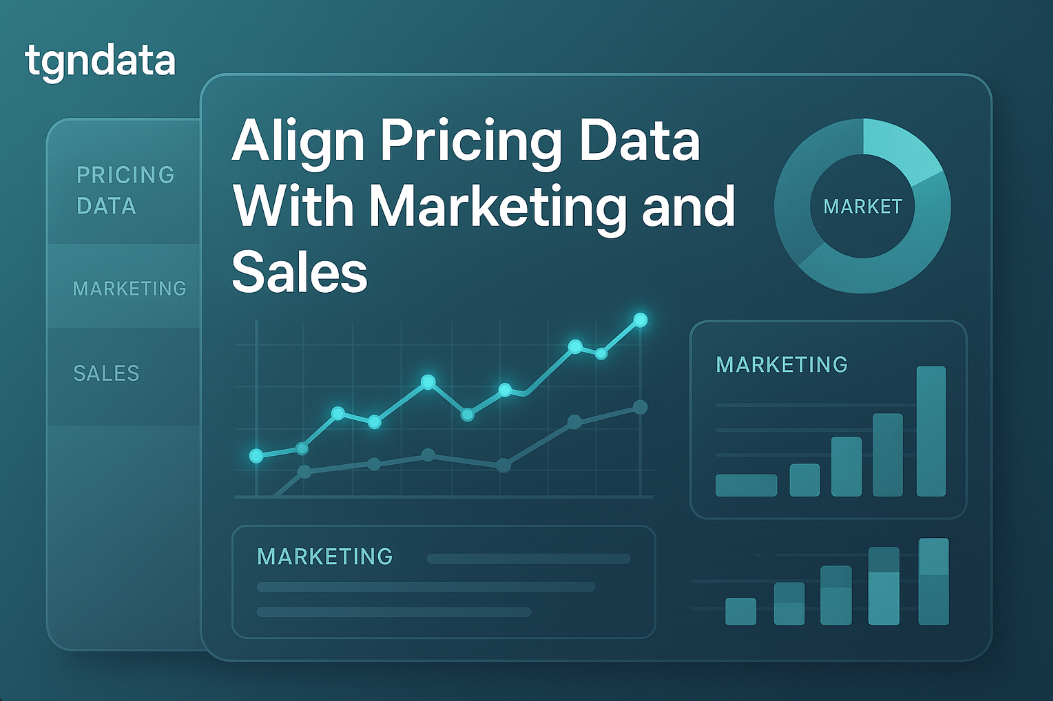
Pricing data influences nearly every customer facing function in modern retail. Marketing teams depend on pricing signals to drive targeted campaigns and efficient ad spend. Sales teams rely on pricing insights to position offers, defend margins, and negotiate effectively. When pricing data remains isolated in pricing teams or legacy systems, marketing and sales lose crucial visibility into market conditions.
Aligning pricing data across teams drives measurable impact.
Pricing data defines value perception for marketing messages
Marketing campaigns need accurate price to conversion relationship data
Sales teams require live competitive intelligence for customer objections
Price accuracy reduces friction across acquisition and retention journeys
Unified data prevents inconsistent messaging across channels
Pricing data alignment allows organizations to operate with shared truths. Marketing, sales, pricing, and product teams can make faster and more consistent decisions.
Most organizations struggle because pricing, marketing, and sales systems evolved independently. Each function holds partial information about customer behavior or competitive pressure.
Marketing campaigns run without visibility into actual market pricing
Campaigns promote discounts or value positioning that do not match competitive realities.
Sales teams negotiate without competitive pricing benchmarks
Reps overspend on discounts or fail to defend margin due to knowledge gaps.
Pricing teams lack feedback loops from marketing and sales
They do not see how campaigns or field conversations influence demand patterns.
Inconsistent value messaging
Marketing promotes premium quality while sales offers unnecessary markdowns.
Promotions designed in isolation
Without pricing data, promotional strategies often reduce profit without increasing volume.
These misalignments reduce efficiency, weaken customer trust, and increase organizational costs.
Organizations create alignment by building a centralized pricing data layer that connects systems, teams, and workflows. This ensures that marketing, sales, and pricing have access to the same competitive intelligence, elasticity insights, and real time market data.
Shared KPIs across pricing, marketing, and sales
Clear visibility into customer response to price changes
Stronger cross functional planning
Better forecasting accuracy for promotions and revenue
Higher ROI across customer acquisition channels
Improved margin performance in sales conversations
This unified approach turns pricing data into a strategic asset across the commercial organization.
Marketing teams depend on accurate pricing signals to run targeted, efficient, and profitable campaigns. When pricing data is integrated into marketing workflows, teams gain real visibility into customer behavior, competitive positioning, and promotional outcomes.
It predicts campaign conversion likelihood based on price sensitivity
It helps allocate budget toward high elasticity customer segments
It improves message framing for value based campaigns
It enhances targeting precision across paid channels
It supports more accurate forecasting of campaign ROI
It aligns promotions with actual competitive conditions
The result is stronger campaign efficiency, higher conversion, and lower acquisition costs.
Most segmentation relies on demographic or behavioral signals. Pricing data adds a powerful layer that reveals value perception and willingness to pay.
Highly price sensitive customers
Customers influenced by competitor pricing
Customers who respond to premium positioning
Customers who respond to seasonal promotions
Long term customers who maintain value perception despite price shifts
Marketers can refine targeting to reflect these price driven behaviors.
Promotional planning becomes more accurate when pricing data guides decisions. Instead of blanket discounts, marketers can build targeted, profitable campaigns.
Identifying products with high elasticity
Reducing unnecessary discount depth
Aligning promotions with competitor moves
Forecasting promotional ROI before launching
Preventing margin erosion without conversion gains
This approach allows marketing teams to reduce promotional waste while increasing revenue contribution.
Messaging has the strongest impact when it reflects real customer value perception. Pricing data shows how customers interpret price as a signal of quality, trust, or competitive advantage.
Revealing which attributes influence willingness to pay
Supporting value framing for premium products
Identifying products where customers require reassurance
Highlighting competitor advantages that must be addressed
Marketers can craft more persuasive storytelling that reflects real customer psychology.
Sales teams need accurate pricing data to negotiate effectively, defend margin, and increase deal velocity. Without live competitive intelligence, sales conversations rely heavily on assumptions.
Pricing data increases sales effectiveness by offering visibility into real market conditions.
They can defend price using competitive benchmarks
They know when discounts are justified and when they are not
They can position offers based on elasticity insights
They can communicate the value story that marketing promotes
They can avoid unnecessary concessions that reduce profitability
This alignment produces more confident reps and stronger outcomes.
Deal desks use pricing intelligence to guide approval workflows, discount thresholds, and margin protection.
Automate discount approvals using rules and thresholds
Provide sales with competitive comparisons
Identify profitable upsell or cross sell opportunities
Reduce excessive discounting in competitive deals
Sales efficiency improves because reps spend less time seeking approvals.
Guided selling uses data driven insights to help reps make better decisions during conversations.
Suggesting optimal pricing within approved ranges
Providing talking points based on competitor price changes
Highlighting product advantages that justify price
Predicting which concessions will increase deal win probability
This leads to more consistent and data informed sales outcomes.
Compensation plans perform better when they reward reps based on pricing accuracy and margin protection.
Identifying reps who sell at profitable levels
Highlighting reps who rely too heavily on discounts
Rewarding strategic sales behaviors that increase lifetime value
Aligning incentives with broader business goals
Sales performance improves because reps focus on profitable deal structures.
Pricing data creates a shared foundation for collaboration between marketing and sales teams.
Shared competitive intelligence dashboards
Joint planning on promotions and campaigns
Unified messaging on value and price
Shared forecasting models
Real time communication about price shifts, promotions, and competitor positioning
This unified approach reduces friction and drives predictable growth.
Pricing data influences every step of the customer journey, from discovery to repeat purchase.
Awareness stage value framing
Consideration stage offer evaluation
Conversion stage pricing clarity
Retention stage promotional frequency
Loyalty stage price perception stability
Retailers who integrate pricing data across the journey deliver more consistent experiences that increase long term customer value.
Organizations need a structured pricing intelligence infrastructure to support alignment at scale.
Competitive price tracking
Assortment matching
Elasticity modeling
Dynamic pricing automation
Unified data layer connecting marketing and sales systems
Cross functional dashboards and alerts
Customer segmentation and targeting integrations
Platforms like tgndata provide these layers in real time with enterprise precision.
When pricing data aligns with marketing and sales, organizations gain advantages across profitability, agility, and customer experience.
Faster revenue growth
Higher campaign ROI
Stronger deal conversion
Reduced discounting
More accurate forecasting
Improved customer satisfaction
Sustainable margin performance
Pricing data alignment becomes a competitive advantage across the commercial organization.
Successful companies discover important lessons during alignment initiatives.
Pricing data must be accessible to all commercial teams.
Marketing and sales need shared visibility into pricing insights.
Price signals influence every touchpoint across the journey.
Promotion planning must be fully data-driven.
Sales teams require competitive intelligence to protect margin.
Dynamic pricing automation improves consistency and speed.
Data alignment improves forecasting accuracy across teams.
Pricing intelligence supports both acquisition and retention.
Cross-functional KPIs strengthen accountability.
Organizations that unify pricing data outperform fragmented competitors.
Aligning pricing data with marketing and sales is essential for modern retail and digital commerce. Pricing intelligence enhances acquisition strategies, strengthens sales conversations, and ensures consistent value messaging across all channels. Organizations that use pricing data to connect marketing, sales, and pricing teams achieve stronger conversion rates, higher margins, more accurate forecasting, and sustainable long term growth.
If your organization is ready to unify pricing data with marketing and sales, tgndata offers the analytics, intelligence, and automation required to build a fully integrated commercial strategy.
Contact tgndata to begin your pricing data alignment strategy and unlock measurable revenue impact.


We use cookies to provide you with an optimal experience, for marketing and statistical purposes only with your consent, which you may revoke at any time. Please refer to our Privacy Policy for more information.
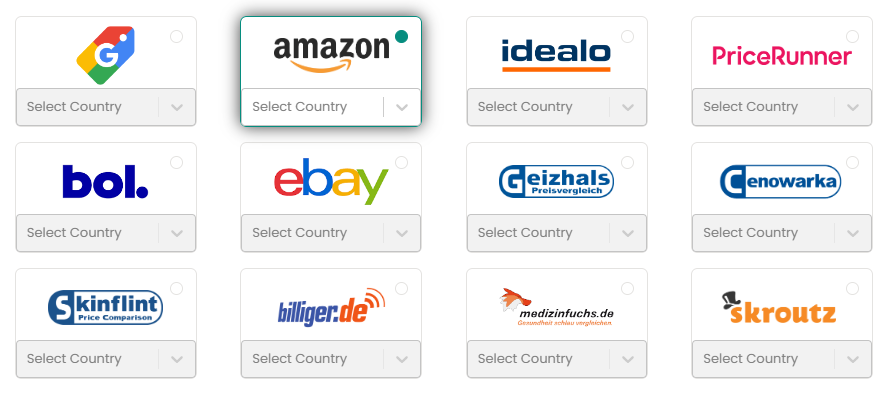










Missing an important marketplace?
Send us your request to add it!