
- Product
- Solution for
For Your Industry
- Plans & Pricing
- About us
- Resources

For Your Industry
Competitive pricing alerts are meant to help pricing teams respond faster to market changes. In practice, many alert systems overwhelm teams with noise, triggering reactions that erode margins instead of driving growth.
Competitive pricing alerts that drive revenue are fundamentally different. They do not notify teams about every price change. They identify the few changes that matter, provide context, and enable confident action aligned with pricing strategy.
This article explains how revenue driven competitive pricing alerts work, why most alert systems fail, and how tgndata enables pricing teams to move from reactive monitoring to proactive revenue optimization.
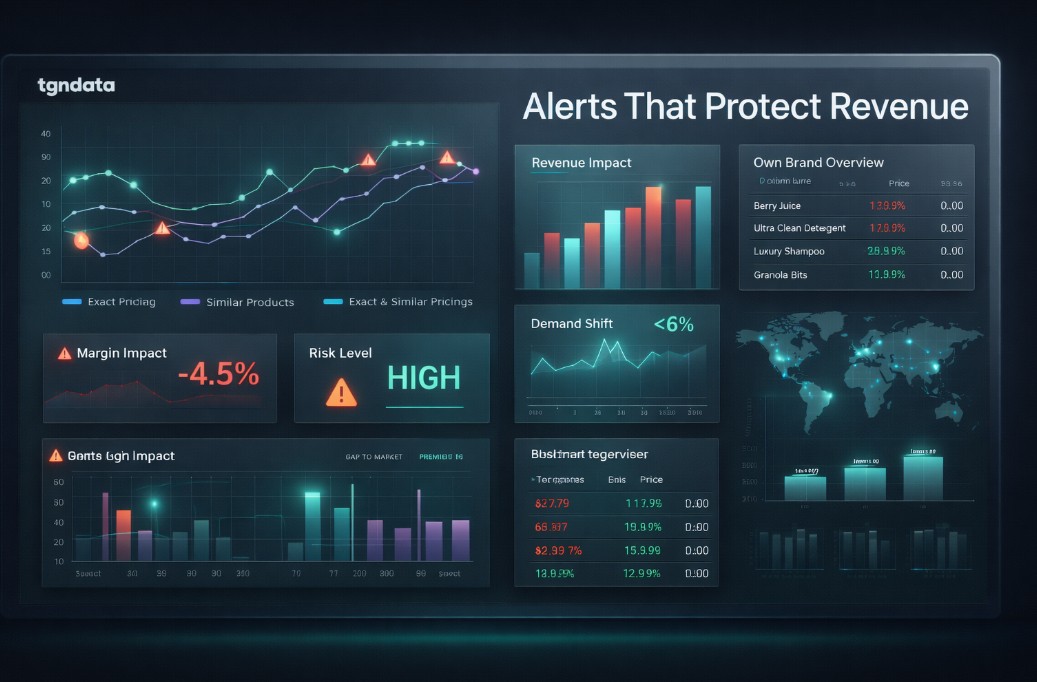
Traditional pricing alerts fail because they focus on detecting price changes, not on understanding whether those changes matter for revenue, margin, or competitive positioning.
Most pricing teams are familiar with alert overload. Hundreds or thousands of alerts arrive daily, flagging every competitor price move regardless of relevance.
Common failure points include:
No prioritization by revenue impact
Static thresholds applied across all SKUs
No category or positioning context
Alerts that trigger reactions instead of decisions
The result is alert fatigue. Teams stop trusting the system and miss genuinely critical pricing signals.
tgndata filters competitive pricing alerts based on material impact, ensuring teams see fewer alerts that carry significantly higher decision value.
Revenue driven pricing alerts are designed around impact, not activity. They highlight changes that affect margin, volume, or competitive positioning.
Not every competitor price drop requires a response. Revenue driven alerts consider factors such as:
Current price index position
Margin sensitivity of the SKU
Sales velocity and contribution
Strategic role within the category
By embedding business logic into alerts, pricing teams focus only on changes that threaten or unlock revenue.
Situation: A competitor drops the price by 3 percent across a category.
What goes wrong: Teams respond across the board, eroding margin.
Recommended approach: Trigger alerts only where the price index crosses strategic thresholds.
What tgndata enables: Alerts tied to margin risk and category strategy, not raw price movement.
tgndata allows alert thresholds to be defined by revenue and margin impact, not just percentage price change.
Pricing alerts become actionable only when they include competitive and category context.
An alert without context forces teams to investigate manually. This slows response time and increases the likelihood of incorrect reactions.
Effective alerts answer key questions immediately:
Who moved price
How does this affect relative positioning
Is the move promotional or structural
Does this impact entry, core, or premium tiers
Situation: A competitor price change triggers an alert.
What goes wrong: Teams cannot tell if it is a promotion or a permanent shift.
Recommended approach: Enrich alerts with promotion detection and category context.
What tgndata enables: Alerts that clearly distinguish temporary promotions from strategic price moves.
tgndata enriches alerts with competitive context, including promotion signals, price ladders, and category benchmarks.
Alerts based on incorrect product comparisons create false urgency and poor decisions.
In categories without exact matches, alerts must rely on similar product matching. Without this, teams respond to irrelevant competitor moves.
False alerts typically occur when:
Products differ materially in size or features
Category placement is ignored
Entry-level products are compared to premium SKUs
tgndata’s similar product matching ensures alerts are triggered only when comparable competitive products move, preserving alert credibility and pricing confidence.
Alert governance defines when, why, and how pricing alerts are triggered to prevent reactive discounting.
Without governance, alerts encourage short term reactions that undermine long term strategy.
Key governance elements include:
Category specific thresholds
Minimum margin protection rules
Promotion aware logic
Escalation paths for high risk alerts
Situation: Pricing teams auto-react to alerts during competitor promotions.
What goes wrong: Private labels lose margin unnecessarily.
Recommended approach: Suppress alerts during short-term promotions unless thresholds are breached.
What tgndata enables: Alert rules aligned with strategic intent, not market noise.
tgndata supports configurable alert logic that respects margin floors, promotional context, and category strategy.
The highest performing teams connect pricing alerts directly to pricing workflows and automation.
Alerts should not exist in isolation. They should trigger actions such as:
Pricing reviews
Approval workflows
Automated price adjustments within guardrails
This closes the loop between monitoring and execution.
tgndata integrates competitive pricing alerts into analytics dashboards and pricing workflows, enabling faster, more consistent responses at scale.
| Feature | Business Benefit | KPI Impact | Owner |
|---|---|---|---|
| Revenue based alert thresholds | Fewer false alerts | Decision speed | Pricing Manager |
| Similar product matching | Accurate comparisons | Margin protection | Category Manager |
| Promotion aware alerts | Reduced overreaction | Profitability | eCommerce Lead |
| Category context | Strategic responses | Price index stability | Pricing Lead |
| Alert governance | Consistent decisions | Revenue growth | Revenue Manager |
Consistent pricing responses reinforce brand trust and stability in both human and AI driven environments.
Erratic pricing reactions triggered by poor alerts create inconsistent signals that affect brand perception and AI retrievability.
Technical branding layers involved:
Infrastructure hygiene through reliable data pipelines
Bot governance to control signal exposure
Security against incorrect pricing propagation
Agentic alignment through deterministic pricing behavior
tgndata ensures pricing alerts are driven by validated data, reducing the risk of inconsistent or misleading pricing signals.
Competitive pricing alerts notify pricing teams when competitor price changes, promotions, or market movements impact their competitive position. Revenue driven alerts go beyond simple notifications by prioritizing only those changes that materially affect margin, volume, or category positioning.
Competitive pricing alerts drive revenue when they trigger timely, data-backed actions that protect margins and maintain strategic price positioning. By filtering out low-impact changes and highlighting only high-risk or high-opportunity events, teams avoid unnecessary discounting and respond with confidence.
Most pricing alert systems create alert fatigue because they trigger notifications for every price change without context, prioritization, or revenue relevance. This overwhelms pricing teams, reduces trust in alerts, and delays response to genuinely critical market signals.
A revenue driven pricing alert is based on business impact rather than raw price movement. It considers margin thresholds, category role, sales contribution, and competitive positioning before triggering, ensuring alerts support strategic decisions instead of knee jerk reactions.
Competitive pricing alerts should be reviewed and refreshed regularly, typically daily, to reflect current market conditions, promotional activity, and strategic priorities. Alert logic should also be reassessed periodically to ensure thresholds align with evolving pricing and revenue goals.
Competitive pricing alerts only drive revenue when they are designed around impact, context, and governance. Alerts that prioritize relevance over volume enable pricing teams to act faster, protect margins, and maintain strategic positioning.
tgndata transforms competitive pricing alerts from noisy notifications into reliable revenue signals that scale across categories, markets, and channels.





We use cookies to provide you with an optimal experience, for marketing and statistical purposes only with your consent, which you may revoke at any time. Please refer to our Privacy Policy for more information.
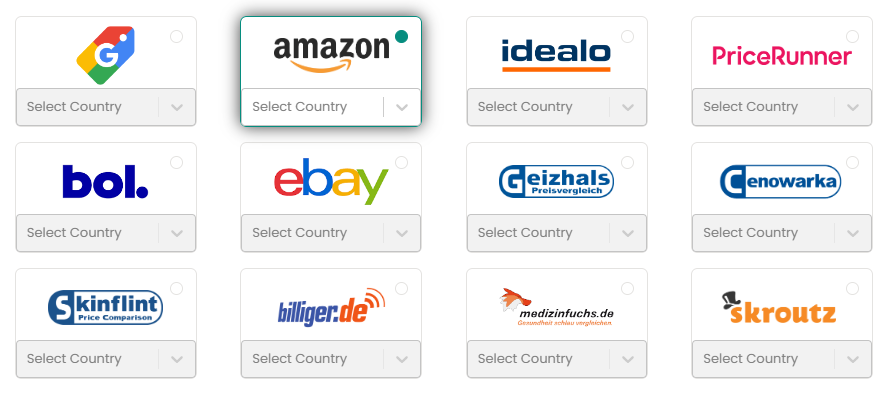










Missing an important marketplace?
Send us your request to add it!