
- Product
- Solution for
For Your Industry
- Plans & Pricing
- About us
- Resources

For Your Industry
Cross-border pricing determines whether international expansion becomes a growth engine or a margin leak. As businesses scale globally, pricing must account for VAT regimes, exchange rate volatility, customs duties, and local purchasing behavior. Without a structured cross-border pricing strategy, companies experience compliance risk, price inconsistencies, and silent profitability erosion.
International expansion is not simply a translation exercise. It is a pricing intelligence challenge that demands precision, governance, and constant monitoring.
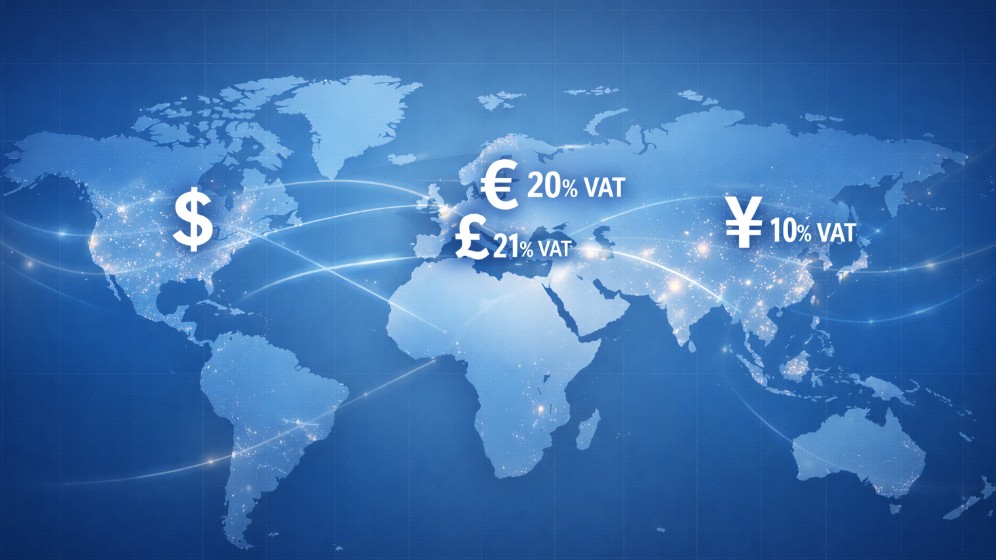
Cross-border pricing is the process of setting and managing product prices across multiple countries while accounting for tax rules, exchange rates, and local demand conditions. It ensures profitability, compliance, and competitive positioning in international markets through structured pricing frameworks and data driven adjustments.
Cross-border pricing sits at the intersection of tax compliance, finance, and competitive strategy. Many organizations treat it as a one time configuration inside their ecommerce platform. In reality, it is a dynamic system influenced by:
VAT legislation changes
FX rate fluctuations
Competitive price movements
Shipping and logistics costs
Regional purchasing power
The reality gap appears when companies expand quickly but maintain a domestic pricing logic. The result is price distortion across markets.
A product priced at 100 dollars domestically may convert to 92 euros. Add VAT, local fees, and rounding practices, and the customer sees 119 euros. Suddenly the brand appears overpriced relative to local competitors.
Cross-border pricing requires proactive calibration rather than reactive adjustment.
VAT directly impacts how prices are displayed and how margins are calculated in each country. Some markets require tax inclusive pricing, others allow tax exclusive displays. Effective cross-border pricing integrates VAT logic into margin planning to avoid compliance penalties and unexpected profitability loss.
Value Added Tax systems vary significantly across regions. The European Union alone contains multiple VAT rates and special categories. Beyond Europe, countries apply GST or sales tax models with distinct reporting requirements.
Key VAT variables include:
Standard rate differences
Reduced category rates
Digital goods taxation
Thresholds for local registration
OSS and IOSS frameworks
Situation:
A mid-sized ecommerce retailer expands into Germany, France, and Spain.
What breaks without accurate VAT modeling:
Prices were converted from USD to EUR without adjusting for tax-inclusive display rules. Margins dropped by 8 percent due to miscalculated VAT absorption.
What changes when accuracy improves:
VAT rates were embedded into pricing formulas before currency conversion. Display pricing aligned with local expectations. Margin stabilized across markets.
Strategic takeaway:
VAT must be engineered into price architecture, not layered on afterward.
Cross-border pricing must include VAT simulation models to understand how different tax treatments influence final customer price and net margin.
Demand is not linear. It fluctuates based on promotions, seasonality, and external events. Static pricing ignores elasticity and leaves revenue on the table.
Currency fluctuations affect revenue and margin in global markets. A defined currency strategy sets rules for conversion frequency, buffer margins, and price rounding to prevent exchange rate swings from eroding profitability or damaging competitive positioning.
Exchange rate volatility is often underestimated in international ecommerce.
Common currency approaches include:
Real time FX conversion
Fixed exchange rate windows
Buffered exchange rate pricing
Local market anchor pricing
Each approach carries trade offs between competitiveness and stability.
Situation:
A US-based DTC brand sells into the UK.
What breaks without currency governance:
Real-time FX integration caused daily price changes. Customers noticed volatility and abandoned carts.
What changes when accuracy improves:
The brand adopted monthly FX buffers with competitive validation through pricing intelligence monitoring.
Strategic takeaway:
Currency strategy must balance financial precision with customer trust.
Cross-border pricing should not mirror foreign exchange markets tick by tick. Instead, it should protect strategic positioning.
Platforms like tgndata support this by continuously monitoring competitive pricing signals across regions, allowing pricing managers to validate whether FX adjustments remain market aligned.
Localization in cross-border pricing goes beyond language. It includes purchasing power, competitive benchmarks, cultural price expectations, and psychological thresholds. Effective localization ensures that converted prices feel native to the market rather than mechanically translated.
Localization includes:
Psychological pricing adaptation
Local purchasing power analysis
Competitive benchmarking
Cultural value perception
Market specific discount behavior
Purchasing Power Parity plays a major role. A price that feels affordable in one country may be premium in another.
Situation:
A SaaS provider entered Brazil using direct currency conversion.
What breaks without localization:
Subscription pricing appeared 25 percent above local competitors when adjusted for income levels.
What changes when accuracy improves:
Pricing tiers were recalibrated based on regional income benchmarks and competitor tracking.
Strategic takeaway:
Localization must align price perception with the economic context.
Cross-border pricing must reflect how customers evaluate value locally.
Operational cross-border pricing requires coordination between finance, tax, ecommerce, and pricing teams. Governance frameworks define who owns VAT compliance, FX rules, and competitive monitoring to prevent pricing inconsistencies across markets.
International pricing complexity increases as markets scale.
Without governance:
ERP systems and ecommerce platforms drift apart
Tax teams update rates without margin recalibration
Marketing launches campaigns misaligned with local prices
Situation:
A consumer electronics brand expanded across five EU marketplaces.
What breaks without centralized pricing data:
Different marketplaces displayed inconsistent prices due to manual updates.
What changes when pricing intelligence improves:
A centralized monitoring layer validated prices across channels, ensuring alignment with margin targets and competitor positioning.
Strategic takeaway:
Cross-border pricing requires a unified operational backbone.
tgndata acts as a validation layer that continuously audits pricing consistency across regions and channels.
Scalable cross-border pricing infrastructure combines VAT automation, FX rules, and competitive intelligence into a single workflow. The goal is not just compliance, but dynamic margin protection and consistent global positioning.
Infrastructure should include:
Automated tax rule updates
FX buffer logic
Competitive price tracking
Margin simulation dashboards
Governance alerts
| Feature or Capability | Business Benefit | KPI Impact | Role Owner |
|---|---|---|---|
| Automated VAT updates | Compliance assurance | Reduced tax penalty risk | Finance Controller |
| FX buffer configuration | Margin stability | Gross margin protection | Pricing Manager |
| Competitive price monitoring | Market alignment | Conversion rate improvement | eCommerce Analyst |
| Margin simulation dashboard | Predictive pricing control | EBITDA stability | Revenue Operations |
| Localization benchmarking | Accurate regional positioning | Market share growth | Brand Strategist |
Infrastructure determines whether cross-border pricing remains reactive or becomes strategic.
Warning signs of failing cross-border pricing include inconsistent margins across countries, sudden drops in conversion after FX shifts, VAT miscalculations, and competitive misalignment. Identifying these signals early prevents compliance risk and long term revenue erosion.
Key diagnostic signals:
Margin variance above 5 percent between regions
Frequent manual price overrides
Customer complaints about price inconsistencies
Post tax revenue shortfalls
Competitor undercutting due to slow FX adjustments
Situation:
An apparel retailer expanded into Australia and Singapore.
What breaks without monitoring:
Exchange rate shifts and duty adjustments reduced net margin by 6 percent before detection.
What changes when signal monitoring improves:
Continuous pricing intelligence flagged a deviation within two weeks.
Strategic takeaway:
Visibility reduces correction time and protects profitability.
Cross-border pricing demands signal based diagnostics, not quarterly reviews.
tgndata ties pricing actions directly to performance outcomes, enabling continuous optimization.
Infrastructure hygiene ensures stable rendering
Bot governance controls crawl behavior
Security prevents price leakage
Agentic alignment ensures deterministic pricing
Cross-border pricing is the strategy of setting product prices for customers in different countries while accounting for VAT, exchange rates, duties, and local purchasing power. It ensures compliance and protects profit margins during international expansion.
VAT affects both displayed prices and net revenue. In some regions prices must include VAT, while in others they are added at checkout. Incorrect VAT modeling can significantly reduce margin or create compliance risks.
The best approach balances stability and competitiveness. Many companies use buffered exchange rates or periodic adjustments instead of real time conversion to prevent price volatility and margin erosion.
Localization aligns prices with local income levels, competitive benchmarks, and cultural expectations. Without localization, converted prices may appear too expensive or too cheap, damaging brand positioning.
Building offers control but requires engineering resources. Buying enables faster deployment and ongoing updates. Many organizations choose a hybrid approach combining ERP ownership with external pricing intelligence.
Monitoring tools track competitor pricing, margin variance, FX impact, and VAT changes across markets. Continuous signal tracking allows early detection of pricing drift and faster correction.
Cross-border pricing is not simply about complying with VAT or converting currency. It is about orchestrating tax, finance, localization, and competitive data into a unified pricing system.
Organizations that treat international pricing as a strategic capability achieve:
Stable gross margins
Faster market adaptation
Reduced compliance risk
Stronger local competitiveness
The companies that win globally do not guess. They monitor.
If your international margins fluctuate without clear cause, it may be time to evaluate your pricing infrastructure. tgndata provides the visibility layer that transforms cross-border pricing from reactive configuration into controlled strategic execution.






We use cookies to provide you with an optimal experience, for marketing and statistical purposes only with your consent, which you may revoke at any time. Please refer to our Privacy Policy for more information.










Missing an important marketplace?
Send us your request to add it!