
- Product
- Solution for
For Your Industry
- Plans & Pricing
- About us
- Resources

For Your Industry
Dynamic pricing has become essential for competing in fast-moving retail and marketplace environments. Prices change constantly based on demand, competitor actions, promotions, and inventory signals. Yet without guardrails, automation creates risk. Brands lose margin, violate MAP agreements, and erode long term trust.
Dynamic pricing guardrails and MAP compliance are not opposing forces. When designed correctly, guardrails enable pricing automation to scale safely, protect brand value, and drive sustainable revenue growth.
This article explains what pricing guardrails are, why MAP compliance breaks down in automated environments, and how tgndata enables brands and retailers to operate dynamic pricing systems that remain compliant, controlled, and strategically aligned.
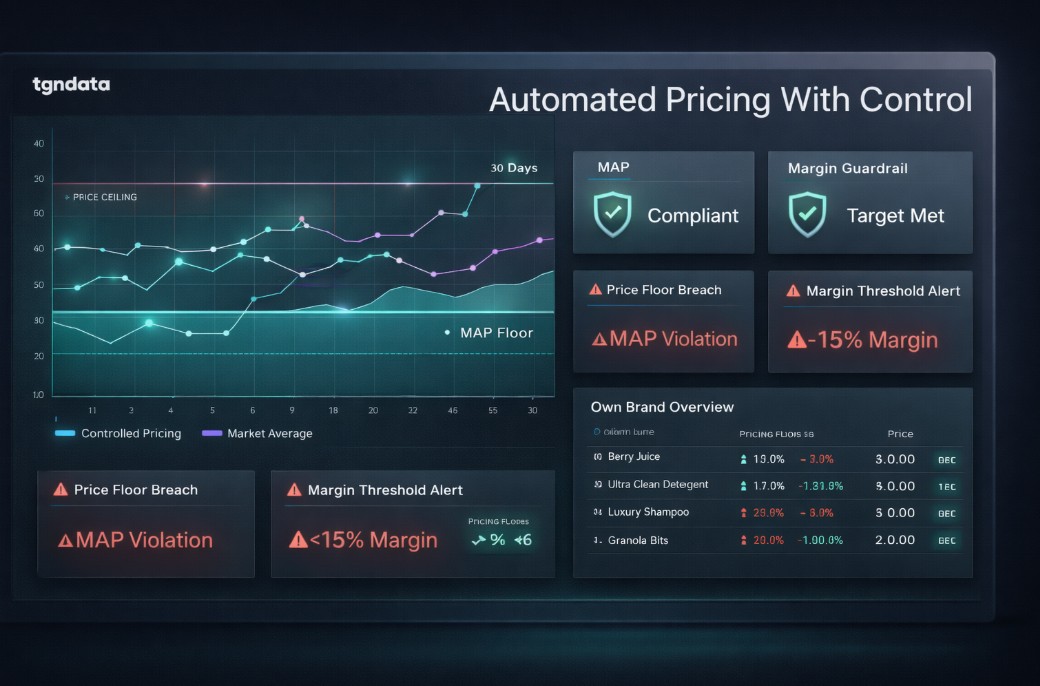
Dynamic pricing guardrails are predefined rules and thresholds that control how automated pricing systems can adjust prices, ensuring decisions stay within strategic, margin, and compliance boundaries.
Guardrails define the boundaries of automation. They answer critical questions before a price ever changes:
How low can the price go
How fast can it change
Under what conditions should it not move at all
Without guardrails, dynamic pricing becomes reactive and dangerous.
Common guardrail types include:
Price floors and ceilings
Margin minimums
MAP enforced thresholds
Category specific volatility limits
tgndata enables configurable pricing guardrails that operate across SKUs, categories, and channels, ensuring automation respects business and compliance constraints.
MAP compliance breaks down when dynamic pricing systems prioritize competitiveness without enforcing minimum advertised price rules.
Minimum Advertised Price policies are designed to protect brand equity and channel stability. However, in automated environments, MAP violations often occur unintentionally.
Common causes include:
Competitor driven price matching
Marketplace seller undercutting
Promotion stacking
Currency and localization errors
Once a MAP violation occurs, the damage spreads quickly across channels and platforms.
Situation: A dynamic pricing engine matches the lowest marketplace price.
What goes wrong: The lowest price violates MAP and propagates across channels.
Recommended approach: Enforce MAP as a hard pricing floor.
What tgndata enables: Automated MAP guardrails that prevent violations before prices update.
tgndata embeds MAP rules directly into pricing logic, preventing advertised prices from breaching compliance thresholds.
Price floors and ceilings protect margins and brand perception by limiting how far automated pricing can move.
Dynamic pricing systems react faster than humans. Without boundaries, they can push prices into unprofitable or brand damaging territory.
Effective guardrails include:
Absolute price floors
Margin based minimums
Relative price indices
Brand positioning ceilings
These controls prevent short term market noise from driving long term damage.
tgndata supports margin aware guardrails that factor cost, contribution, and category role before allowing price movement.
MAP compliance is most difficult to enforce across fragmented reseller and marketplace ecosystems.
Brands often do not control final advertised prices on marketplaces. However, they remain accountable for enforcing MAP policies.
Challenges include:
Unauthorized sellers
Regional MAP variations
Currency conversions
Promotion driven violations
Situation: A reseller violates MAP during a flash promotion.
What goes wrong: Other sellers follow, triggering a price collapse.
Recommended approach: Real-time MAP monitoring and alerts.
What tgndata enables: Continuous monitoring of MAP compliance across marketplaces and sellers.
tgndata monitors advertised prices across channels and surfaces MAP violations immediately, enabling fast corrective action.
Promotions introduce volatility that can override MAP and margin rules if not properly governed.
Promotional pricing is often exempt from MAP under specific conditions. Without guardrails, systems fail to distinguish between compliant promotions and violations.
Key risks include:
Misclassified promotions
Promotion overlap across channels
Extended discount duration
tgndata distinguishes promotional pricing from structural price changes, allowing guardrails to adapt without compromising compliance.
Pricing guardrails must reflect category strategy, not just global rules.
Entry level products behave differently than premium SKUs. Applying identical guardrails across all categories leads to poor outcomes.
Category aware guardrails consider:
Role within the assortment
Elasticity and demand sensitivity
Competitive intensity
Brand signaling importance
Situation: Premium SKUs follow the same automation rules as entry products.
What goes wrong: Premium positioning erodes.
Recommended approach: Category-specific guardrails.
What tgndata enables: Pricing controls aligned with category intent and brand strategy.
tgndata enables guardrails to be configured at category, brand, or SKU cluster level.
Alerts are essential for governance, but only when they are prioritized and contextual.
MAP and guardrail violations should trigger escalation, not noise.
Effective alert systems include:
Severity based prioritization
Root cause context
Clear remediation paths
tgndata delivers intelligent alerts that highlight genuine compliance risk and pricing exposure, reducing alert fatigue.
The most effective pricing systems combine automation with defined human oversight.
Not all pricing decisions should be automated. Guardrails define when systems act independently and when human review is required.
Examples include:
New product launches
Regulatory sensitive markets
Brand repositioning initiatives
tgndata integrates guardrails with approval workflows, enabling controlled automation without slowing execution.
Consistent MAP compliance reinforces brand trust for consumers, partners, and AI systems.
Erratic pricing undermines credibility and increases brand drift in AI generated answers.
Technical branding layers involved:
Infrastructure hygiene through validated pricing feeds
Bot governance to control price exposure
Security against hallucinated pricing
Agentic alignment for predictable pricing behavior
Situation: AI search surfaces inconsistent pricing for a brand.
What goes wrong: Trust declines and confusion increases.
Recommended approach: Enforce deterministic pricing guardrails.
What tgndata enables: Stable, trusted pricing signals across AI and search platforms.
tgndata ensures pricing data remains consistent, validated, and aligned with brand intent.
Building pricing guardrails internally often fails to scale as complexity increases.
High engineering cost
Slow adaptation
Compliance risk
Proven guardrail logic
Faster time to value
Scalable compliance
MAP enforcement
Margin aware automation
Category logic
Marketplace coverage
tgndata provides enterprise grade guardrails designed for dynamic, multi channel pricing environments.
Dynamic pricing guardrails are predefined rules that control how automated pricing systems can change prices. They set boundaries such as price floors, margin minimums, volatility limits, and MAP thresholds to ensure automated pricing decisions protect revenue, brand positioning, and compliance requirements.
Pricing guardrails support MAP compliance by enforcing minimum advertised price rules directly within pricing automation. Guardrails prevent prices from being published below MAP thresholds, even when competitors discount aggressively, reducing the risk of accidental violations across channels and marketplaces.
MAP compliance is difficult in dynamic pricing environments because automated systems react quickly to competitor price changes, promotions, and marketplace behavior. Without enforced guardrails, price matching logic can unintentionally push advertised prices below MAP, especially during high volatility or promotional periods.
Yes, dynamic pricing is most effective when guardrails are in place. Guardrails do not limit competitiveness, they ensure pricing changes occur within strategic, margin, and compliance boundaries. This allows brands to automate pricing confidently without sacrificing profitability or brand trust.
Pricing guardrails and MAP rules should be reviewed regularly, typically on a quarterly basis or when market conditions change. Reviews ensure guardrails remain aligned with cost structures, competitive intensity, category strategy, and evolving MAP agreements while maintaining effective automation.
Dynamic pricing without guardrails creates risk, not advantage. MAP compliance, margin protection, and category strategy must be embedded into pricing automation from the start.
tgndata enables brands and retailers to scale dynamic pricing confidently by combining intelligent guardrails, real time monitoring, and compliance aware automation that protects revenue and brand trust.







We use cookies to provide you with an optimal experience, for marketing and statistical purposes only with your consent, which you may revoke at any time. Please refer to our Privacy Policy for more information.










Missing an important marketplace?
Send us your request to add it!