
- Product
- Solution for
For Your Industry
- Partners
- Plans & Pricing
- Resources

For Your Industry
Ecommerce repricing strategies can increase profit when they are designed around margin protection, competitor visibility, and pricing automation, not just faster discounting.
Many ecommerce teams treat repricing as a race to the lowest price. They track competitors, cut prices, and hope higher sales volume will make up for lower margins. That approach can work temporarily, but it often creates price wars, weakens brand positioning, and reduces profitability.
The smarter approach is different.
Profitable repricing uses market data to decide when to lower prices, when to hold prices, and when to increase prices. It combines competitor price monitoring, product-level margin rules, stock visibility, and dynamic pricing logic so every price move supports a business goal.
For retailers and e-commerce brands, the real objective is not simply to win more orders. The objective is to win the right orders at the right margin.

Ecommerce repricing is the process of adjusting product prices based on market conditions such as competitor prices, demand, inventory levels, marketplace behavior, promotions, and profitability targets.
Repricing can be manual, but at scale it is usually automated through pricing software or dynamic pricing rules.
A repricing strategy may respond to:
In simple terms, ecommerce repricing helps pricing teams avoid static prices in fast-moving markets.
A strong repricing strategy does not blindly undercut competitors. It uses data to make more profitable pricing decisions.
Most ecommerce repricing strategies fail because they optimize for price position instead of profit outcome.
Being the cheapest can increase conversion rate, but it does not guarantee better profit. In many categories, constant undercutting creates a cycle where competitors react, prices fall, margins shrink, and no seller wins.
The most common repricing mistakes are:
Not every competitor deserves a reaction. Some sellers may have lower service quality, different shipping terms, limited inventory, or unsustainable pricing. Matching them can damage your margin without improving your long-term position.
A repricing rule without a margin floor is dangerous. It may win sales while quietly destroying profitability.
Manual price checks cannot keep up with marketplaces, comparison engines, and ecommerce competitors that change prices frequently.
A bestseller, a clearance item, and a premium product should not follow the same pricing logic.
Poor product matching, outdated competitor data, and incomplete marketplace coverage lead to poor repricing decisions.
The goal of ecommerce repricing is not to lower prices. The goal is to improve pricing decisions so the business can grow profitably.
A profitable repricing strategy should help you:
This is where price intelligence becomes essential. tgndata’s platform is positioned around competitor price tracking, ecommerce price monitoring, dynamic pricing, alerts, product matching, and pricing analytics for retailers and brands.
The following ecommerce repricing strategies are designed to help pricing teams improve profit, not just react faster to competitor price changes.
Margin-based repricing is one of the most important ecommerce repricing strategies because it protects profitability before any price change is made.
Instead of asking, “How low do we need to go to beat the competitor?” this strategy asks, “What is the lowest acceptable price we can offer while protecting margin?”
You define pricing guardrails such as:
For example:
A product sells for €100 and has a cost of €65. If your minimum margin requirement is 25%, your repricing system should never reduce the price below the level that breaks that margin rule.
Margin-based repricing prevents the business from winning unprofitable sales. It also gives pricing teams more confidence to automate decisions because the system has clear financial limits.
Margin-based repricing works especially well for:
tgndata’s dynamic pricing positioning includes margin protection and rule-based pricing guardrails, including price floors, ceilings, and MAP or MSRP constraints.
Competitor-aware repricing adjusts prices based on competitor activity, but it does not mean matching every price change.
The best competitor-aware pricing strategies are selective. They prioritize the competitors, products, and channels that actually affect revenue and margin.
A competitor-aware repricing rule may look like this:
Competitor-aware repricing increases profit because it stops unnecessary discounts. Instead of reacting to every competitor move, you respond only when the market signal is meaningful.
A competitor drops the price of a product from €120 to €110. A basic repricing tool might immediately match or undercut that price.
A smarter strategy checks:
If the competitor is low-stock or not a priority seller, the best decision may be to hold price.
Stock-based repricing adjusts prices based on your inventory and competitor availability.
This strategy is powerful because price sensitivity changes when stock availability changes.
You create rules based on stock conditions.
Examples:
Stock-based repricing helps ecommerce teams avoid two expensive mistakes:
First, selling too cheaply when demand is strong.
Second, holding too much inventory when a product needs faster movement.
You sell a popular appliance. Your main competitors are out of stock, but your inventory is healthy. Instead of discounting, you can raise your price slightly while still remaining attractive to customers who need availability now.
This strategy turns stock visibility into pricing power.
Rule-based dynamic repricing uses predefined pricing rules to automate decisions.
This is one of the safest ways to move from manual pricing to automation because pricing teams remain in control of the logic.
You define rules such as:
The system then applies those rules consistently across products and channels.
Rule-based dynamic repricing increases profit because it combines automation with business discipline. It reduces manual work while preventing uncontrolled price drops.
tgndata describes its dynamic pricing solution as rule-based automation that can react to competitor prices, market conditions, stock levels, seasonal trends, and predefined business rules.
Not every product should be repriced the same way.
Product segmentation repricing groups SKUs by role, margin, competition level, demand, or strategic importance.
Among all ecommerce repricing strategies, segmentation is one of the most effective because it prevents every product from being treated the same way.
You can segment products into groups such as:
Segmentation prevents over-discounting across the catalog.
For example, a retailer may choose aggressive pricing for traffic-driving products but protect margin on premium or exclusive SKUs. That way, repricing supports the wider commercial strategy instead of treating every item as a commodity.
For a fashion retailer:
This is far more profitable than using one repricing rule for the entire catalog.
Marketplace-specific repricing adjusts your strategy for each sales channel.
Pricing behavior on Amazon is different from Google Shopping, direct ecommerce, retail marketplaces, or price comparison engines.
Each channel has different dynamics:
A price that works on your own ecommerce site may not work on a marketplace.
On Amazon, a small price difference may affect Buy Box visibility. On your direct ecommerce store, brand trust, delivery terms, loyalty points, or bundled offers may allow you to hold a higher price.
Marketplace-specific repricing ensures that each channel follows its own commercial logic.
Time-based repricing adjusts prices according to predictable demand patterns.
This is useful when demand changes by season, day, campaign period, or event.
Time-based repricing prevents missed opportunities. If demand rises predictably, the business may not need to discount as heavily. If demand falls, targeted repricing can improve sell-through before inventory becomes a problem.
If weekend demand for a category is consistently higher, a retailer may reduce discounts or raise prices slightly during peak demand windows, then apply promotions during slower periods.
Many ecommerce teams think repricing only means lowering prices. That is a mistake.
A strong repricing strategy also identifies when prices can be increased.
You may be able to increase prices when:
Small price increases can create meaningful profit improvement, especially across large catalogs.
For example, raising price by 2% on products with stable demand can improve margin without reducing sales volume significantly. The key is using market data to identify where the increase is safe.
MAP-aware repricing is essential for brands and retailers that sell products with Minimum Advertised Price policies.
A repricing system should not recommend or apply prices that violate MAP rules.
MAP-aware repricing uses pricing guardrails such as:
MAP-aware repricing protects both margin and brand value. It also helps prevent pricing decisions that may damage retailer relationships or violate brand agreements.
tgndata lists MAP and MSRP protection among its product areas and states that dynamic pricing guardrails can include MAP or MSRP constraints.
Profit-based repricing takes margin-based pricing one step further.
Instead of optimizing only for price position or margin percentage, it looks at total profit impact.
A profit-based repricing model considers:
The goal is to find the price point that produces the best total profit, not necessarily the lowest price or highest margin.
product priced at €50 may sell 1,000 units with €10 margin per unit, creating €10,000 gross margin.
The same product priced at €54 may sell 850 units with €14 margin per unit, creating €11,900 gross margin.
Even though sales volume is lower, total profit is higher.
This is the type of thinking that separates basic repricing from real pricing optimization.
| Strategy | Best For | Profit Impact | Risk Level |
|---|---|---|---|
| Margin-based repricing | Protecting profitability | High | Low |
| Competitor-aware repricing | Staying competitive | High | Medium |
| Stock-based repricing | Inventory control | High | Low |
| Rule-based dynamic repricing | Automation at scale | High | Medium |
| Product segmentation repricing | Large catalogs | High | Low |
| Marketplace-specific repricing | Multi-channel sellers | Medium to high | Medium |
| Time-based repricing | Seasonal categories | Medium | Low |
| Price increase repricing | Margin expansion | High | Medium |
| MAP-aware repricing | Brands and protected products | High | Low |
| Profit-based repricing | Advanced pricing teams | Very high | Medium |
Repricing and dynamic pricing are closely related, but they are not exactly the same.
Repricing usually refers to changing product prices in response to competitor prices or marketplace conditions.
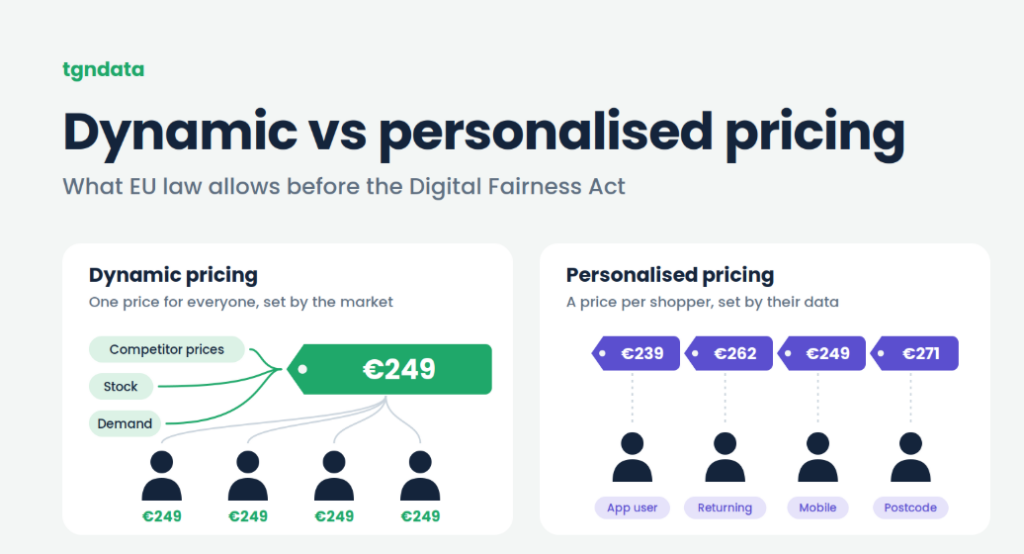
Dynamic pricing is broader. It can include competitor prices, demand, inventory, timing, product performance, and business rules.
| Factor | Repricing | Dynamic Pricing |
|---|---|---|
| Main focus | Price adjustment | Price optimization |
| Common trigger | Competitor price change | Market, demand, stock, and rules |
| Automation level | Manual or automated | Usually automated |
| Business goal | Stay competitive | Maximize revenue and profit |
| Best use | Marketplace and ecommerce pricing | Scalable pricing strategy |
For ecommerce teams, the best approach is often a combination of both. Repricing helps you react to the market. Dynamic pricing helps you optimize decisions with guardrails.
A repricing strategy is only as good as the data behind it.
To increase profit, ecommerce teams need reliable data across:
Bad data creates bad pricing decisions.
For example, if a competitor price is matched to the wrong SKU, your system may reduce price unnecessarily. If stock availability is missing, you may match a competitor that cannot actually fulfill orders. If marketplace fees are ignored, a price may look profitable but lose money after costs.
tgndata’s price monitoring page highlights competitor and marketplace price tracking, ecommerce price monitoring, product matching, alerts, exports, and API access for pricing workflows.
A profitable ecommerce repricing process should follow a clear workflow.
Decide what the repricing strategy should achieve.
Examples:
Group products by pricing role.
Examples:
Do not track everyone equally. Prioritize competitors that influence your sales, pricing position, and customer perception.
Create clear rules for:
Start with high-impact categories, then expand once rules are proven.
Track:
Repricing is not a one-time setup. It should improve as your team learns which rules produce the best outcomes.
To build ecommerce repricing strategies that actually increase profit, follow these best practices:
Never allow automation to reduce prices below profitable levels.
Track the sellers and retailers that actually influence your customers.
Use different rules for bestsellers, clearance items, premium products, and commodity products.
Competitor availability can change the right pricing response.
Historical trends reveal patterns that daily price checks miss.
Some rules will work better in certain categories than others.
Automation improves speed, but pricing strategy still needs commercial judgment.
This is the fastest way to lose margin. Match competitors only when it supports your strategy.
A competitor may look cheaper until shipping costs, marketplace fees, or delivery terms are considered.
Accurate product matching is essential. Wrong matches lead to wrong decisions.
A competitor that is out of stock should not always influence your price.
Markets change. Repricing rules should be reviewed regularly.
Premium products often need pricing discipline, not constant discounts.
Revenue growth can hide margin damage. Always track profitability.
tgndata helps ecommerce teams improve repricing decisions by giving them the pricing data and automation layer needed to act with confidence.
For repricing use cases, tgndata can support:
This matters because profitable repricing depends on accurate, timely data. tgndata positions its platform as a single solution for price monitoring, price intelligence, and dynamic pricing for retailers and brands.
Rather than reacting blindly to competitor price drops, teams can use tgndata to understand the full pricing context: who changed price, which products are affected, whether competitors are in stock, where margin is protected, and which pricing actions are worth taking.
An ecommerce repricing strategy is a structured approach to changing product prices based on competitor prices, stock levels, demand, margins, and business goals. The best strategies use pricing data and automation to stay competitive without sacrificing profit.
The best ecommerce repricing strategy is usually margin-based, competitor-aware, and automated with clear pricing guardrails. This allows retailers to respond to competitors while protecting profitability.
Repricing can increase profit when it uses accurate competitor data, margin floors, stock signals, and product segmentation. Repricing focused only on lowering prices can reduce profit.
Repricing usually focuses on adjusting prices in response to competitor or marketplace changes. Dynamic pricing is broader and can include demand, inventory, seasonality, margin rules, and business goals.
The right update frequency depends on category, competition, and sales channel. Fast-moving ecommerce categories may need multiple updates per day, while slower categories may need less frequent changes.
Useful repricing data includes competitor prices, product matches, stock availability, promotions, shipping costs, marketplace prices, product costs, margins, and historical price trends.
Ecommerce repricing strategies work best when they combine automation, price intelligence, and clear margin protection rules.
The best ecommerce repricing strategies are not built around being the cheapest. They are built around making better pricing decisions faster than competitors.
Profitable repricing requires:
When repricing is done poorly, it creates price wars and margin erosion. When it is done well, it becomes a profit engine.
For ecommerce teams managing large catalogs, multiple competitors, and fast-moving retail channels, manual pricing is no longer enough. A modern repricing strategy needs real-time market visibility, automation, and clear commercial guardrails.
That is where tgndata fits naturally: helping retailers and brands monitor the market, automate pricing logic, and make smarter pricing decisions across ecommerce and marketplace channels.

We use cookies to provide you with an optimal experience, for marketing and statistical purposes only with your consent, which you may revoke at any time. Please refer to our Privacy Policy for more information.










Missing an important marketplace?
Send us your request to add it!