
- Product
- Solution for
For Your Industry
- Plans & Pricing
- About us
- Resources

For Your Industry
Holiday periods trigger extreme volatility in shopper behavior and competitive pricing. Retailers often plan months ahead, yet a significant share of margin risk occurs in the final 72 hours before a major holiday. Holiday Eve Pricing Strategy describes the rapid decisions retailers must make as demand peaks, inventory tightens, and competitors push aggressive last minute promotions. These final hours require precise analytics, real time competitive data, and pricing automation that protects margins without losing conversion. This article explores the most effective last minute pricing actions, why they work, and how retailers can operationalize them with modern pricing intelligence.
Holiday Eve Pricing Strategy is not just a reaction to seasonal chaos. It is a high leverage moment that enables retailers to clear stock, capture surge demand, and lock in year end profitability. When executed with data driven discipline, these last minute moves strengthen both margin and market share.
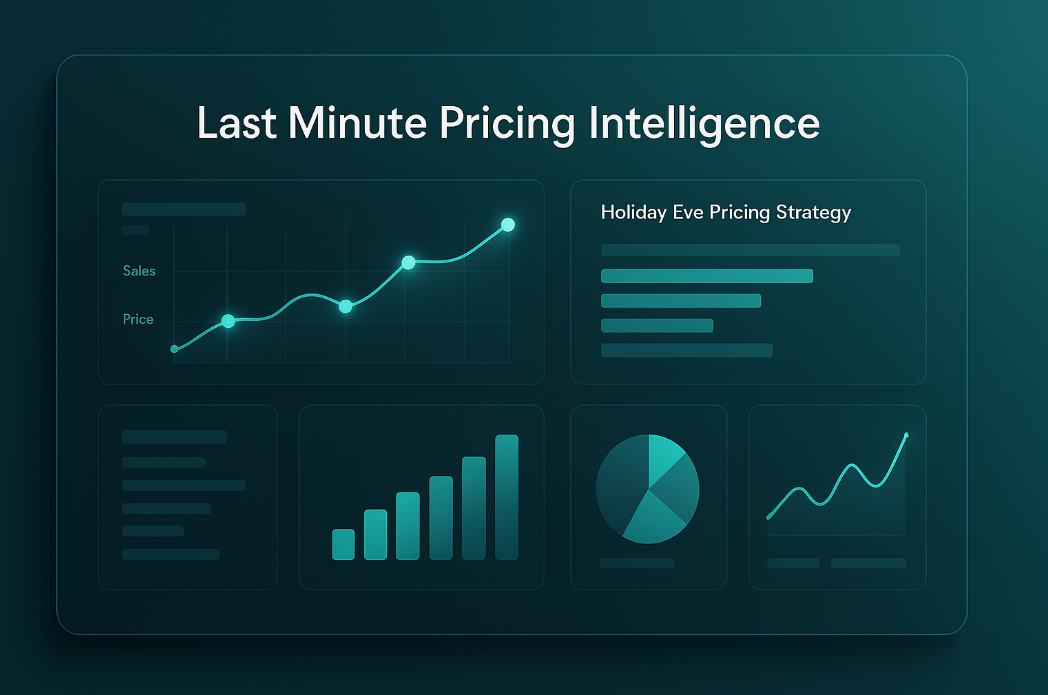
Holiday Eve traffic spikes are predictable, yet shopper intent and price sensitivity are less stable. Multiple market forces collide in a compressed timeframe.
Customers demonstrate reduced price sensitivity when shopping at the last minute. However, this varies by product category, fulfillment promise, and inventory scarcity. Accurate elasticity modeling allows retailers to raise or hold prices where justified without risking conversion.
Rivals often deploy last hour flash discounts that are not part of their long cycle strategy. Without real time competitive monitoring, retailers risk being either overpriced or unnecessarily underpriced.
Low stock amplifies the financial consequences of pricing errors. Optimized last minute pricing protects margin on scarce items, while targeted markdowns accelerate sell through on overstock.
A full quarter of seasonal margin movement can occur in the final holiday window. Precise last minute adjustments ensure retailers capture demand at profitable price points.
Holiday Eve Pricing Strategy builds the analytical guardrails needed to make these decisions with confidence.
Successful last minute pricing execution depends on three foundational capabilities. Retailers who mature in these areas capture more margin, reduce volatility, and outperform competitors in peak periods.
Last minute pricing decisions are only as good as the data behind them. Competitive insights must update continuously across marketplaces, direct to consumer channels, and regional stores. High performing teams depend on:
SKU level price tracking at high frequency
Detection of sudden flash drops or promo stacking
Alerts for price gaps that threaten conversion
Automated recommendations based on competitor behavior
Inventory exposure dictates margin opportunity. Holiday Eve strategies require dynamic thresholds aligned with stock levels. This includes:
Increasing prices gently on low stock items
Accelerating markdowns for excess inventory with high holding cost
Balancing clearance velocity with delivered margin
Avoiding uniform discounts that erode profitability
Manual reaction is too slow once the holiday surge begins. Automation ensures that price updates execute at machine speed and with reduced human error. Capabilities include:
Rule based actions for competitor price gaps
Elasticity informed optimization
Real time testing of alternative price points
Integration with eCommerce platforms and POS systems
Holiday Eve Pricing Strategy thrives when these three capabilities operate together, supported by accurate historical data and predictive analytics.
Shoppers behave differently when time is running out. Retailers who quantify these changes can adjust prices with confidence.
Urgency pushes customers into action. Abandoned cart rates drop, and session length increases as shoppers stop browsing and start purchasing.
When the holiday deadline is imminent, the priority shifts from saving money to getting the product in time. This creates pockets of elasticity that allow for moderate price increases without volume loss.
Shoppers willingly pay more for guaranteed delivery or local pickup. Pricing strategies that incorporate fulfillment speed unlock incremental margin.
Holiday Eve stress and time pressure increase impulsive buying. Retailers who position high margin accessories or complementary bundles can lift average order value.
These behavioral dynamics make Holiday Eve Pricing Strategy one of the best opportunities for strategic margin enhancement.
Holiday Eve windows are short and unforgiving. The following seven tactics enable retailers to make rapid adjustments backed by analytics.
Instead of broad holiday discounts, use narrow price moves that target specific SKUs. For example:
Reduce price only on colors or sizes with excess stock
Apply time-boxed discounts for clearance items
Use elasticity data to determine the minimum viable markdown
Micro markdowns protect the margin by avoiding unnecessary depth and breadth.
Low inventory, high demand items can carry higher price points without harming conversion. Elasticity models should identify:
SKUs with inelastic demand
Items with low substitution risk
Seasonal best sellers with strong urgency signals
Holiday Eve Pricing Strategy focuses on thoughtful upward adjustments, not reckless price hikes.
If a competitor drops price on a key item, rule based automation ensures your price responds strategically. Retailers can:
Match price where critical
Undercut only when needed
Hold price when additional value justifies it
Avoid panicked discount cascades
Gap protection prevents margin erosion that often comes from delayed responses.
Fast delivery becomes a differentiator. Retailers can charge higher prices for:
Same day or next day delivery
Buy online pick up in store
Local courier delivery with guaranteed arrival
This aligns price with service value and protects margin against deep shipping costs.
Bundles are ideal for last minute buyers who want convenience. Use data to identify complementary SKUs with strong attach rates. Examples include:
Add on warranties
Accessory kits
Gift ready bundles
Personalized packaging services
Bundles increase average order value while keeping discount depth low.
Short holiday windows allow rapid experimentation. Use automation to test:
Price variants on top converting SKUs
Flash promotions spaced by hour
Trial discounts on overstock categories
Urgency driven countdown messaging
Testing should be grounded in measurable lift, not guesswork.
Set rules such as:
Apply markdown only when inventory exceeds a specific threshold
Trigger higher discounts as stock approaches risk exposure
Stop discounting once the target sell-through is achieved
Threshold-based logic introduces discipline into last-minute pricing.
Holiday Eve Pricing Strategy works best when each tactic is supported by analytics across elasticity, competitor activity, and inventory forecasting.
The final hours before a holiday are chaotic. Teams cannot manually update prices across thousands of SKUs and channels. Automation becomes a force multiplier.
Machine driven updates execute in seconds, not minutes. This prevents costly lag when competitors move aggressively.
Automation handles large catalogs across every region, marketplace, and store.
Algorithmic rules follow logic consistently, reducing human error and emotional decision making.
Once configured, the system delivers stable performance every year, supporting continuous improvement.
Holiday Eve Pricing Strategy relies on this backbone to operate effectively during compressed time windows.
Different retail segments experience unique last minute dynamics. Tailoring strategy improves accuracy and protects margin.
Strong elasticity differentiation by brand
Higher willingness to pay for fast shipping
Rapid competitor movements that require real time tracking
High SKU volatility with color and size fragmentation
Increased urgency for gifts and event outfits
Must balance clearance goals with profitability
Sharp late surge in demand
Frequent stock outs that justify upward price moves
Emotional buying behavior that increases bundle effectiveness
Strong gifting appeal with predictable last minute spikes
Premium pricing opportunities on limited editions
High margin accessories ideal for bundles
Holiday Eve Pricing Strategy must reflect category specific dynamics to optimize margin outcomes.
Retailers who succeed in last minute pricing treat it as a repeatable discipline rather than a reactive scramble. A predictive framework includes the following components.
Analyze past holiday performance to identify:
Ingest live competitive, demand, and inventory data to detect shifts instantly.
Algorithms evaluate elasticity, margin targets, and inventory exposure to suggest optimal price points.
System updates prices across all channels without delay.
After each season, refine thresholds and rules based on performance data.
Holiday Eve Pricing Strategy becomes more accurate and profitable with each cycle of learning.
Retailers can follow a structured roadmap to deploy a mature last minute pricing model.
Integrate competitive intelligence feeds
Aggregate inventory and sell through data
Capture historical holiday insights
Build elasticity models by category
Set inventory thresholds and business rules
Align margin guardrails with leadership targets
Configure rule based actions
Automate price updates across channels
Deploy alerting for competitive changes
Run controlled experiments
Measure impact with attribution models
Refine rules before peak season
Cross functional coordination between pricing, merchandising, and supply chain
Annual reviews to update strategy
Governance to ensure consistent execution
Holiday Eve Pricing Strategy matures as retailers strengthen their data infrastructure and automation capabilities.
Leaders need clear metrics to assess the impact of last minute pricing actions. Key indicators include:
Margin lift by SKU and category
Price competitiveness index
Inventory exposure reduction
Sell through velocity
Fulfillment attach rate
Bundle adoption rate
Customer conversion rate
AOV changes during holiday window
Holiday Eve Pricing Strategy aligns pricing actions with measurable performance outcomes.
Retailers who want to execute world class last minute pricing need a robust set of tools.
High frequency competitor price monitoring
Real time elasticity modeling
Inventory aware pricing engines
API based price update automation
A centralized pricing command center
Analytics dashboards with recommendation support
A governance framework for discount controls
These investments produce stronger margin outcomes season after season.
Even experienced teams can make costly mistakes in the final hours before a holiday. Avoid these pitfalls.
Excessive discounting
Deep markdowns driven by panic destroy margin unnecessarily. Use data, not gut instinct.
Slow reaction times
Delays expose retailers to competitor advantage. Automation eliminates lag.
Uniform price cuts across categories
Each category has unique elasticity and inventory needs. One-size-fits-all all strategies underperform.
Neglecting fulfillment costs
Fast shipping without pricing adjustments compresses profitability. Charge appropriately for speed.
Lack of cross-channel consistency
Price mismatches across stores, eCommerce, and marketplaces confuse customers and hurt conversion.
Holiday Eve Pricing Strategy must be disciplined, data driven, and tightly managed.
The next generation of last-minute pricing will be shaped by several important trends.
AI copilots for pricing teams
Embedded assistants provide real-time guidance and scenario modeling.
Autonomous price engines
Systems will take end-to-end action with human oversight.
Customer-level price personalization
Offers will reflect individual behavior, loyalty status, and urgency signals.
Integrated supply chain and pricing intelligence
Pricing will adapt dynamically to live logistics constraints.
Predictive competition models
Competitor moves will be anticipated, not just reacted to.
These shifts will expand the strategic value of Holiday Eve Pricing Strategy in the coming years.
Holiday Eve windows represent some of the most profitable and volatile moments in the retail calendar. Retailers who implement a disciplined Holiday Eve Pricing Strategy can defend margin, accelerate sell through, and outperform competitors in the final hours before peak demand. The combination of competitive intelligence, elasticity modeling, and pricing automation creates a resilient framework for confident decision making under pressure.
Retailers who modernize their last minute pricing capabilities are better positioned to capture full seasonal value and strengthen long term profitability.
tgndata helps retailers build these capabilities with advanced pricing intelligence, real time data pipelines, and automation frameworks designed for high velocity environments. Contact us to elevate your holiday and year round pricing performance.





We use cookies to provide you with an optimal experience, for marketing and statistical purposes only with your consent, which you may revoke at any time. Please refer to our Privacy Policy for more information.










Missing an important marketplace?
Send us your request to add it!