
- Product
- Solution for
For Your Industry
- Plans & Pricing
- About us
- Resources
For Your Industry
Retail pricing has become one of the most critical and misunderstood levers in modern commerce. As margins tighten, competition intensifies, and consumer behavior shifts faster than ever, retailers increasingly turn to data driven pricing solutions to stay profitable. Yet many pricing leaders still confuse price optimisation with price intelligence, using the terms interchangeably or prioritizing one at the expense of the other.
This misunderstanding leads to missed revenue, poor execution, and pricing strategies that look sophisticated on paper but fail in the market.
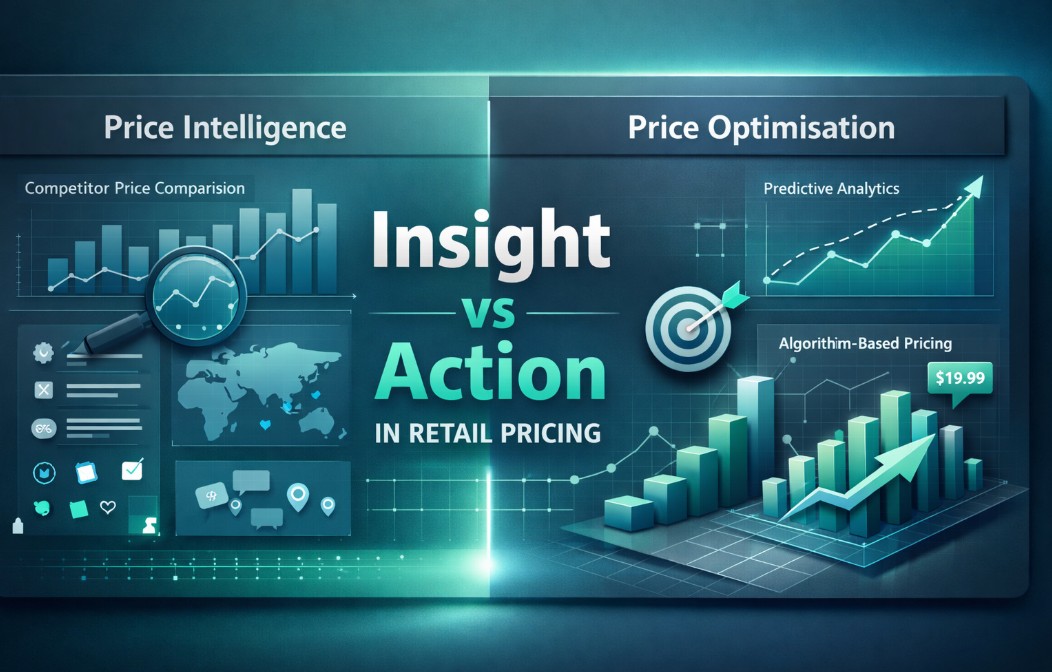
Price optimisation vs. price intelligence is not a question of which tool is better. It is about understanding their distinct roles and how retailers get pricing wrong when they treat them as substitutes instead of complementary systems.
This article breaks down price optimisation vs price intelligence, explains what each really means, where retailers commonly make mistakes, and how leading pricing teams combine both to build scalable, profitable pricing strategies.
Retail pricing used to be relatively static. Prices were reviewed seasonally, competitors were checked manually, and margin targets were set once per year. That world no longer exists.
Today, retailers face:
Real time competitor price changes
Highly elastic online demand
Marketplace driven price transparency
Inflationary cost volatility
AI driven consumer expectations
In this environment, pricing mistakes are amplified instantly. A price that is too high loses volume within hours. A price that is too low destroys margin at scale.
Retailers know they need better pricing systems. The problem is that many adopt the wrong solution first or implement the right one incorrectly.
Price intelligence is the foundation of modern pricing strategy. It focuses on visibility and understanding, not decision making.
Price intelligence is the systematic collection, normalization, and analysis of market pricing data. It answers one core question:
What is happening in the market right now?
Price intelligence platforms typically track:
Competitor prices across channels
Promotions and discounts
Assortment overlap and gaps
Price position and index metrics
Historical pricing trends
Without price intelligence, retailers are pricing blind.
Price intelligence excels at:
Monitoring competitor pricing at scale
Identifying price gaps and inconsistencies
Benchmarking price position by category or brand
Detecting sudden market shifts or price wars
Supporting pricing governance and compliance
It provides factual market context that pricing teams cannot replicate manually.
Price intelligence does not decide prices.
It does not:
Calculate optimal prices
Predict demand response
Optimize margin versus volume
Automate price changes
This is where many retailers go wrong.
Price optimisation focuses on decision making and execution. It uses models, algorithms, and business rules to recommend or automatically set prices.
Price optimisation is the process of determining the best possible price for a product based on multiple variables, such as:
Demand elasticity
Cost structure
Margin targets
Inventory levels
Customer behavior
Competitive position
It answers a different question:
What should our price be to achieve a specific business goal?
Price optimisation models are only as good as their inputs.
Without accurate market data, optimisation can:
Optimize against outdated competitor prices
Overestimate pricing power
Trigger unnecessary price drops
Create margin erosion disguised as growth
This is why price intelligence and price optimisation must work together.
Price optimisation models are only as good as their inputs.
Without accurate market data, optimisation can:
Optimize against outdated competitor prices
Overestimate pricing power
Trigger unnecessary price drops
Create margin erosion disguised as growth
This is why price intelligence and price optimisation must work together.
| Dimension | Price Intelligence | Price Optimisation |
|---|---|---|
| Primary role | Market visibility | Price decision making |
| Key question | What is happening in the market | What should our price be |
| Output | Data, benchmarks, insights | Price recommendations or actions |
| Time horizon | Real time and historical | Forward looking |
| Automation | Low to moderate | High |
| Risk if used alone | No execution | Bad decisions |
Understanding this distinction is critical. Retailers that confuse the two often invest heavily but see limited ROI.
Many retailers believe that tracking competitor prices equals having a pricing strategy.
It does not.
Knowing that a competitor dropped a price does not tell you whether you should follow, ignore, or counter strategically. Without optimisation logic, price intelligence becomes reactive price matching.
This leads to:
Race to the bottom pricing
Margin erosion
Loss of brand positioning
Price intelligence informs strategy. It does not replace it.
Retailers often use price intelligence to monitor only the cheapest competitor. This oversimplifies the market.
Smart price intelligence looks at:
Price dispersion
Brand differentiation
Channel specific pricing
Promotional mechanics
Competing only on lowest price ignores value perception and elasticity differences.
Some retailers invest in price intelligence tools but rely on analysts to interpret data manually.
This creates:
Slow reaction times
Human bias
Inconsistent pricing decisions
Price intelligence should feed directly into pricing workflows, not sit in dashboards waiting for interpretation.
This is one of the most expensive pricing errors.
Retailers implement price optimisation models based on internal data alone, such as historical sales and margins, without real time competitive inputs.
The result:
Prices optimized in a vacuum
Overpricing in competitive categories
Underpricing in differentiated categories
Optimisation without intelligence is mathematically elegant but commercially dangerous.
Price optimisation is not set and forget.
Retailers often assume AI will solve pricing automatically. In reality, optimisation models require:
Strategic constraints
Guardrails
Human oversight
Regular recalibration
Without governance, optimisation can conflict with brand strategy, supplier agreements, or legal constraints.
Retailers sometimes apply a single optimisation objective across the entire assortment, such as margin maximization.
Different categories require different goals:
Traffic drivers prioritize volume
Private label prioritizes margin
Clearance prioritizes inventory velocity
Price optimisation must be nuanced, not uniform.
Price intelligence alone leads to insight without action.
Retailers see problems but cannot fix them at scale. Analysts identify opportunities but lack tools to execute consistently.
Common symptoms include:
Endless pricing meetings
Spreadsheet driven decisions
Delayed reactions to market changes
Inconsistent pricing across channels
Insight without execution is not strategy. It is observation.
Price optimisation without price intelligence creates false confidence.
The model produces a price. The math looks correct. The outcome fails in the market.
This happens because:
Competitor prices changed overnight
Promotions were not captured
Assortment overlap was misunderstood
Optimisation requires continuous market awareness to remain valid.
The most successful pricing organizations treat price intelligence and price optimisation as a unified system.
Price intelligence captures real time market data
Data feeds into optimisation models
Business rules and strategy constraints are applied
Prices are simulated and validated
Optimized prices are executed automatically
Performance is monitored and fed back into the system
This creates a closed loop pricing engine.
Retailers that integrate both capabilities achieve:
Faster reaction times
Higher margin stability
Fewer price wars
Stronger brand positioning
Scalable pricing operations
Pricing becomes proactive instead of reactive.
Technology is not the only problem. Organizational structure often reinforces confusion between price intelligence and price optimization.
Market analysts own price intelligence
Revenue managers own optimisation
Merchandising overrides both
Without alignment, pricing decisions fragment.
If analysts are measured on insights and managers on revenue, collaboration breaks down.
Pricing needs shared objectives and unified governance.
tgndata is built to eliminate the false trade-off between price intelligence and price optimisation.
Our platform combines:
High-fidelity competitive price intelligence
Assortment-aware market mapping
AI-driven price optimisation models
Business rule-based guardrails
Automated execution and monitoring
Instead of choosing between insight and action, retailers get both in one pricing system.
tgndata enables pricing teams to:
Understand the market in real time
Optimize prices with confidence
Align pricing decisions with strategy
Scale pricing without losing control
The debate around price optimisation vs. price intelligence is misguided.
Retailers fail when they choose one instead of the other.
Price intelligence without optimisation leads to paralysis. Price optimisation without intelligence leads to expensive mistakes. Together, they form the foundation of modern, resilient pricing strategy.
Retailers that understand this distinction, and integrate both capabilities into a single pricing workflow, consistently outperform their competitors in margin, growth, and operational efficiency.
Pricing excellence is not about better data or better algorithms. It is about connecting the two.




We use cookies to provide you with an optimal experience, for marketing and statistical purposes only with your consent, which you may revoke at any time. Please refer to our Privacy Policy for more information.










Missing an important marketplace?
Send us your request to add it!