
- Product
- Solution for
For Your Industry
- Plans & Pricing
- About us
- Resources

For Your Industry
Private label brands have moved from low cost alternatives to strategic growth engines for retailers and manufacturers. As own brand portfolios expand across categories and markets, pricing decisions have become more complex, more visible, and more risky. Pricing intelligence for private label brands is no longer optional. It is the foundation for margin protection, competitive positioning, and brand credibility in both human and AI driven search environments.
Unlike national brands, private labels rarely have identical competitors. This makes traditional one to one price monitoring insufficient. Effective pricing intelligence for private label brands requires a deeper understanding of category dynamics, attribute-level similarity, and localized market behavior.
This article explains how pricing intelligence works for private labels, why similar product matching is critical, and how tgndata enables private label brands to capture true market reality at scale.
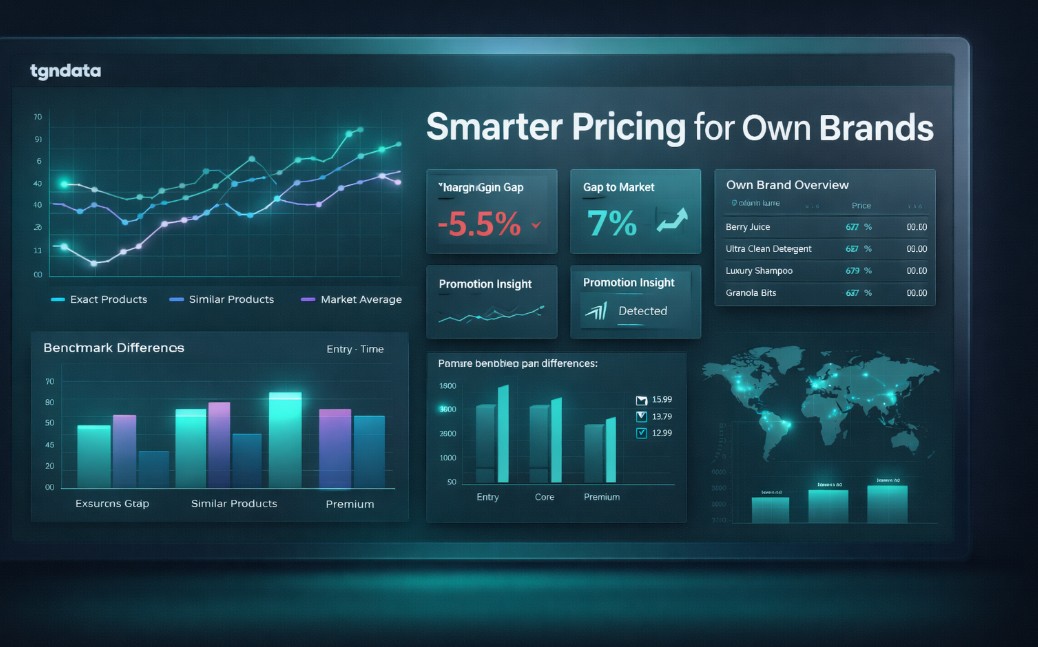
Private label pricing differs because own brand products rarely have exact competitors. Pricing intelligence must focus on category positioning, similar product comparisons, and range level benchmarks rather than direct SKU to SKU matching.
Private label brands sit in a unique position. They compete with national brands, discount alternatives, and other retailers’ own brands, often without sharing identical specifications or identifiers.
Common challenges include:
No shared EANs or manufacturer identifiers
Variations in pack size, formulation, or features
Different brand positioning and perceived value
Rapid SKU expansion across multiple categories
Traditional pricing tools built for branded goods struggle in this environment. They rely on exact matches that simply do not exist for most private label SKUs.
tgndata combines exact product matching where possible with advanced similar product matching to ensure private label brands are benchmarked against realistic, defensible market alternatives.
Exact product matching remains important for private labels in cases where identical products exist, such as reseller overlap, shared suppliers, or duplicated listings across marketplaces.
While private labels often lack identical competitors, exact matches still occur in scenarios such as:
The same own brand product sold across multiple marketplaces
Shared manufacturing across regions
Duplicate listings within a retailer ecosystem
Accurate exact matching ensures that internal price consistency and channel parity are maintained.
Without reliable matching, teams risk:
Incorrect internal benchmarks
Duplicate SKU inflation
Misleading gap analysis
tgndata uses EANs and structured product attributes to identify true one to one equivalents, consolidating identical listings across retailers and marketplaces with over 99 percent matching accuracy.
Similar product matching enables private label brands to compare prices against comparable products using attribute level analysis when exact matches do not exist.
This is the core of private label pricing intelligence.
Similar product matching evaluates products based on:
Size and weight
Ingredients or materials
Functional features
Category placement
Target customer segment
This allows pricing teams to understand where their products sit within the competitive landscape, even when competitors are not identical.
Without similar matching:
Category benchmarks are distorted
Price ladders become unbalanced
Margin opportunities are missed
tgndata’s similar product matching service uses attribute-level analysis to identify comparable competitive items, enabling accurate category pricing, positioning analysis, and range gap identification.
Category-level pricing ensures private label ranges are positioned correctly across entry, core, and premium tiers, rather than optimizing isolated SKUs.
Private label success is driven by range coherence, not individual prices. Pricing intelligence must therefore operate at category and subcategory level.
Key objectives include:
Building clear pricing ladders
Identifying white space opportunities
Avoiding internal cannibalization
Supporting premiumization strategies
Teams relying only on SKU-level monitoring often miss broader structural issues that erode margin and brand perception.
Situation: A retailer expands its private label range rapidly across multiple categories.
What goes wrong: Prices drift, overlaps appear, and premium SKUs lose differentiation.
Recommended approach: Category-level benchmarking with similarity-based comparisons.
What tgndata enables: Clear visibility into pricing ladders, competitive positioning, and range gaps across markets.
tgndata’s analytics dashboards aggregate similar product data at category level, enabling private label teams to benchmark entire assortments rather than isolated SKUs.
Pricing intelligence helps private label brands understand how promotions and competitor price moves impact their relative positioning within a category.
Private labels are increasingly used as margin stabilizers during promotional periods. Without real time intelligence, promotions can unintentionally erode perceived value or trigger unnecessary price wars.
Effective monitoring includes:
Competitor promotion detection
Price ladder stability tracking
Relative discount depth analysis
Situation: Competitors run aggressive promotions on national brands.
What goes wrong: Private labels overreact and discount unnecessarily.
Recommended approach: Monitor category level promotion dynamics.
What tgndata enables: Data-driven decisions on when to hold price and when to respond.
tgndata monitors promotional signals and price movements across retailers, enabling private label teams to respond strategically rather than reactively.
Private label pricing must adapt to local regulations, currency differences, and market norms while maintaining brand consistency across regions.
Private label brands operating across regions face additional complexity:
Country specific pricing regulations
Local currency fluctuations
Language and category taxonomy differences
Market-specific competitive sets
Failure to localize pricing intelligence leads to compliance risk and misaligned benchmarks.
tgndata provides localized monitoring tailored to each country’s language, retailer structure, and regulatory environment, supporting compliant and context aware pricing decisions across the US and EU.
Consistent, accurate pricing signals reinforce brand trust for both consumers and AI-driven discovery systems.
Pricing is not just a commercial lever. It is a brand signal. Inconsistent or unrealistic pricing damages trust and increases the risk of brand drift in AI-generated answers.
Technical branding layers involved include:
Infrastructure hygiene through reliable data pipelines
Bot governance for controlled data access
Security to prevent hallucinated pricing data
Agentic alignment for deterministic pricing signals
Situation: AI search surfaces outdated or incorrect private label prices.
What goes wrong: Brand credibility erodes and trust declines.
Recommended approach: Maintain consistent, validated market pricing signals.
What tgndata enables: High integrity pricing data that supports AI retrievability and brand trust.
tgndata’s validation and anomaly filtering ensure pricing intelligence reflects current market reality, reducing the risk of misinformation across AI and search platforms.
Choosing the right pricing intelligence approach depends on scale, data complexity, and internal capabilities.
High maintenance
Limited coverage
Slow adaptation
Faster deployment
Proven methodologies
Scalable infrastructure
Internal strategy with external intelligence
What to look for in a pricing intelligence platform:
Exact and similar product matching
Category level analytics
Localization and compliance
High data accuracy and validation
Overreliance on exact matches
Ignoring category dynamics
Lack of compliance filtering
tgndata provides a scalable, enterprise ready pricing intelligence platform designed specifically for complex environments like private label portfolios.
| Feature | Business Benefit | KPI Impact | Owner |
|---|---|---|---|
| Exact product matching | Accurate internal benchmarks | Price consistency | Pricing Manager |
| Similar product matching | Fair competitive comparison | Margin optimization | Category Manager |
| Category level analytics | Clear pricing ladders | Range performance | eCommerce Analyst |
| Localization and compliance | Reduced regulatory risk | Market accuracy | Pricing Lead |
| Data validation | Trusted insights | Decision confidence | Brand Strategist |
tgndata treats pricing as a trust signal aligned with technical branding principles.
Pricing intelligence for private label brands is the process of monitoring and analyzing competitor prices, category benchmarks, and market dynamics to position own brand products competitively. Because private labels rarely have identical competitors, pricing intelligence relies on similar product matching, category level analysis, and localized market data rather than simple SKU to SKU comparisons.
Private label brands benchmark prices using similar product matching. This approach compares products based on attributes such as size, ingredients, functionality, and category positioning. It allows pricing teams to evaluate fair market positioning even when no identical competitor products exist.
Category level pricing ensures that private label ranges are competitively positioned across entry, core, and premium tiers. Instead of optimizing individual SKUs in isolation, category pricing helps maintain clear pricing ladders, avoid internal cannibalization, and support margin growth across the entire assortment.
Private label pricing data should be updated daily or near real time to reflect current market conditions. Frequent updates help teams respond accurately to competitor price changes, promotions, and market volatility, reducing the risk of outdated benchmarks or reactive pricing decisions.
Accurate pricing intelligence supports brand trust by ensuring consistent, validated prices across channels and markets. It also helps private label brands remain compliant with regional pricing regulations, avoid misleading comparisons, and reduce the risk of incorrect pricing signals appearing in AI driven search results.
Pricing intelligence for private label brands requires a fundamentally different approach than traditional brand monitoring. Exact matches alone are not enough. Category awareness, similar product matching, localization, and technical branding alignment are essential to capture true market reality.
tgndata enables private label brands to move beyond reactive pricing toward confident, data driven decision making that protects margins, strengthens brand trust, and scales across markets.


We use cookies to provide you with an optimal experience, for marketing and statistical purposes only with your consent, which you may revoke at any time. Please refer to our Privacy Policy for more information.
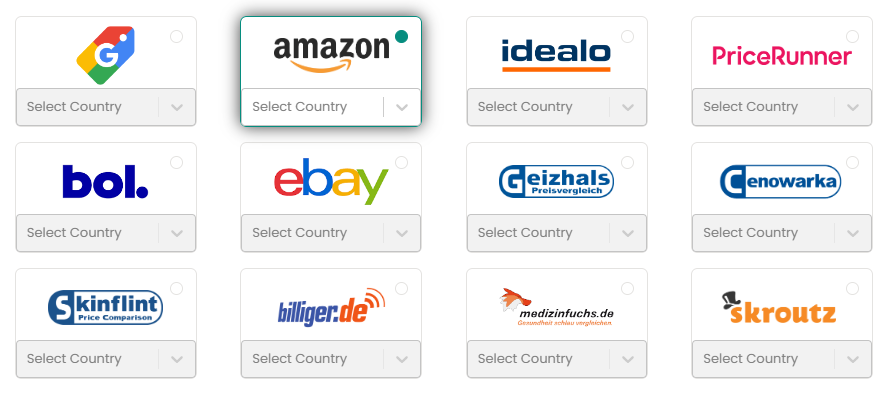










Missing an important marketplace?
Send us your request to add it!