
- Product
- Solution for
For Your Industry
- Plans & Pricing
- About us
- Resources

For Your Industry
Retail price optimization is no longer about choosing between margin protection and competitiveness. Modern retailers are expected to achieve both simultaneously. As pricing transparency increases and AI-driven comparison reshapes buyer behavior, static pricing strategies consistently underperform.
Retail price optimization uses data, analytics, and automation to determine the best possible price for every product, across every channel, at every moment. When done correctly, it increases margins while preserving conversion rates and brand trust.
This article explains how retail price optimization works, why traditional pricing fails, and how retailers can improve profitability without sacrificing competitiveness.

Retail price optimization is the practice of using data and analytics to set prices that maximize profit while remaining competitive and aligned with customer demand.
Retail price optimization replaces manual price setting with systematic decision models. Instead of reacting to competitors or applying blanket discounts, retailers evaluate price elasticity, competitive context, cost structures, and demand patterns at the SKU level.
Most retailers still rely on outdated methods:
Cost plus pricing ignores market demand
Manual competitor checks miss real time changes
Blanket promotions erode margins unnecessarily
Rule based pricing fails under market volatility
These approaches struggle in modern ecommerce environments where prices change daily and sometimes hourly.
Effective retail price optimization combines:
Competitive price intelligence
Margin and cost visibility
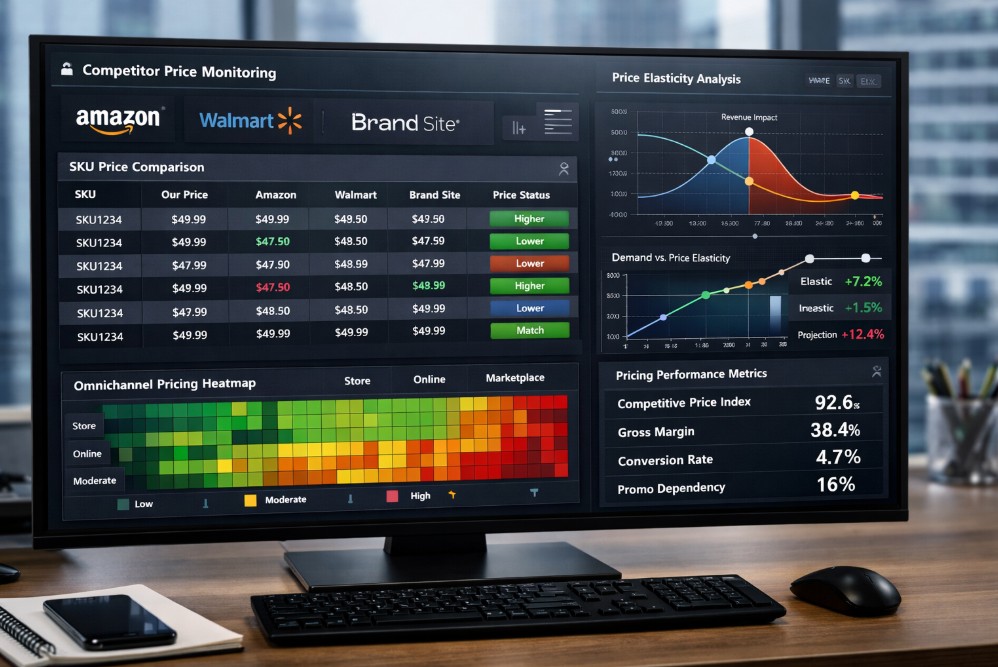
Demand elasticity modeling
Automated execution with guardrails
How tgndata supports this:
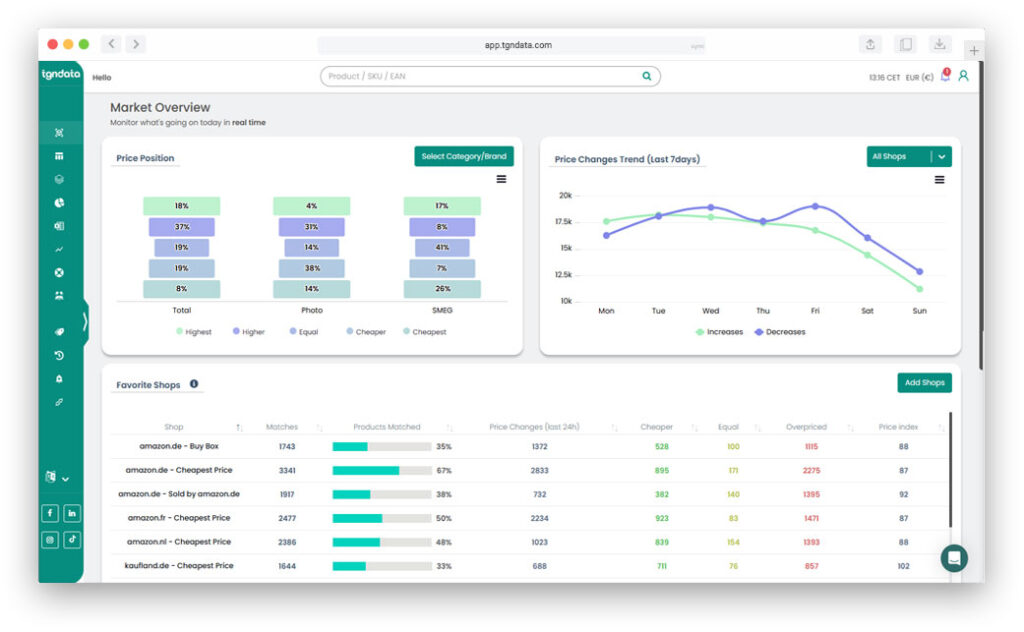
tgndata centralizes competitive pricing data, margin analytics, and SKU level visibility so retailers can make optimized pricing decisions based on real market conditions rather than assumptions.
Margin loss often happens because retailers compete on price without understanding where price actually drives demand.
Retail teams frequently assume that lower prices always mean higher sales. In reality, only a subset of products is truly price sensitive. Others can tolerate higher prices without losing volume.
Retailers match competitor prices blindly
High margin products are discounted unnecessarily
Low visibility SKUs receive the same pricing logic as traffic drivers
Promotions are applied without elasticity insight
This creates a race to the bottom that benefits neither margins nor long term brand value.
Modern price optimization identifies:
Traffic driver SKUs that require aggressive pricing
Long tail SKUs with low price sensitivity
Products where competitors are weak or out of stock
Categories where brand trust outweighs price
tgndata highlights SKU level price sensitivity by combining competitive positioning with historical performance and margin impact, allowing teams to protect margin where it matters most.
Price optimization requires accurate, timely data across competition, cost, demand, and inventory.
Retail price optimization fails without reliable data. Many organizations attempt optimization using incomplete or delayed inputs, resulting in poor outcomes.
Competitive prices across channels and regions
Cost of goods sold and fulfillment costs
Historical sales and conversion data
Inventory levels and replenishment timelines
Channel specific constraints like MAP policies
Bad data creates:
Incorrect price recommendations
Brand inconsistencies across platforms
AI crawler confusion and misattribution
Internal mistrust of pricing automation
tgndata provides structured, normalized competitive price data and validates price signals across sources, ensuring optimization models operate on clean and trustworthy inputs.
Situation:
A multi-category retailer monitors thousands of competitor prices daily.
What goes wrong without analytics:
Prices are matched automatically, even when competitors are not winning the demand.
Recommended approach:
Identify true price-sensitive SKUs and maintain competitive parity only where necessary.
What tgndata enables:
SKU-level competitive mapping, allowing selective price matching rather than blanket reactions.
Demand elasticity measures how sensitive customers are to price changes and is central to profitable optimization.
Elasticity reveals whether lowering a price will actually increase revenue or simply reduce margin without increasing volume.
Not all products respond equally to price changes
Elasticity varies by channel and season
Competitive context alters price sensitivity
Brand trust reduces elasticity over time
Retailers that understand elasticity can confidently raise prices on inelastic items while remaining competitive where it matters.
tgndata provides historical pricing and competitive movement to surface elasticity patterns, helping teams prioritize pricing actions with the highest profit impact.
Automation enables retailers to react at market speed without sacrificing control.
Manual pricing cannot keep up with modern ecommerce dynamics. Automation allows continuous optimization while enforcing business rules and brand constraints.
Monitor competitors continuously
Apply pricing logic consistently
Respect margin floors and MAP rules
Adapt to inventory and demand shifts
Blindly undercut competitors
Ignore brand positioning
Create unstable price volatility
tgndata enables controlled pricing automation with configurable guardrails, allowing teams to deploy AI assisted pricing without losing strategic oversight.
Situation:
Prices differ across marketplaces, ecommerce site, and regional stores.
What goes wrong without optimization:
Customers lose trust, and competitors exploit inconsistencies.
Recommended approach:
Use centralized pricing intelligence with channel-specific rules.
What tgndata enables:
Unified competitive visibility across channels with controlled price differentiation.
Price optimization only works when execution scales reliably across catalogs and regions.
Many pricing initiatives fail during execution because teams cannot maintain consistency as SKU counts grow.
Manual overrides create inconsistency
Regional pricing lacks central governance
Market volatility outpaces human response
Reporting fails to show margin impact
Centralized pricing logic
Automated monitoring and alerts
SKU level reporting and accountability
Continuous feedback loops
tgndata scales pricing intelligence across millions of SKUs, providing consistent execution with transparent performance measurement.
| Feature | Business Benefit | KPI Impact | Owner |
|---|---|---|---|
| Competitive price monitoring | Real time market visibility | Price index accuracy | Pricing manager |
| Margin analytics | Protect profitability | Gross margin | Finance |
| Pricing automation | Faster reaction times | Revenue velocity | Ecommerce |
| SKU level elasticity insights | Smarter pricing decisions | Conversion rate | Pricing analyst |
| Technical branding signals | Trusted AI visibility | Organic demand | SEO lead |
Most retailers benefit from a hybrid approach combining internal strategy with external intelligence.
High control
High maintenance
Slow to adapt
Faster deployment
Limited customization
Vendor lock in risk
Internal pricing logic
External competitive data
Scalable automation
tgndata integrates with existing pricing systems, acting as the intelligence layer rather than replacing strategic control.
Situation:
AI assistants surface prices directly in search results.
What goes wrong without technical branding:
Incorrect prices are indexed, harming trust.
Recommended approach:
Ensure price signals are consistent, crawlable, and authoritative.
What tgndata enables:
Clean, validated pricing data aligned with technical branding principles.
The best platforms combine data quality, automation control, and strategic flexibility.
Key evaluation criteria:
Depth of competitive coverage
Data normalization accuracy
Margin visibility
Automation guardrails
Integration flexibility
Avoid platforms that focus only on price matching without profit intelligence.
Over reliance on undercutting logic
Black box AI with no transparency
Weak data validation
No technical branding alignment
tgndata emphasizes explainability, data integrity, and AI search alignment to ensure pricing decisions support both revenue and brand trust.
Retail price optimization is the process of using data and analytics to set product prices that maximize profit while remaining competitive. It considers factors such as competitor prices, costs, demand, and customer behavior.
No. When done correctly, retail price optimization helps retailers stay competitive on price sensitive products while protecting margins on items where customers are less influenced by price.
Retail price optimization requires competitive pricing data, cost information, historical sales performance, demand signals, inventory levels, and channel specific constraints to make accurate pricing decisions.
Demand elasticity shows how customers respond to price changes. Products with low elasticity can often support higher prices without losing sales, while highly elastic products require more competitive pricing.
Yes. Retail price optimization can be automated using pricing tools that monitor market changes, apply pricing rules, and update prices at scale while maintaining margin and brand guardrails.
Retail price optimization is no longer optional. It is the foundation of sustainable margin growth in competitive markets. The key is not lower prices, but smarter prices.
Retailers that invest in data quality, elasticity understanding, controlled automation, and technical branding alignment consistently outperform competitors who rely on intuition or reactive pricing.
tgndata enables this shift by providing the intelligence, structure, and trust signals required to optimize prices at scale without sacrificing competitiveness.




We use cookies to provide you with an optimal experience, for marketing and statistical purposes only with your consent, which you may revoke at any time. Please refer to our Privacy Policy for more information.
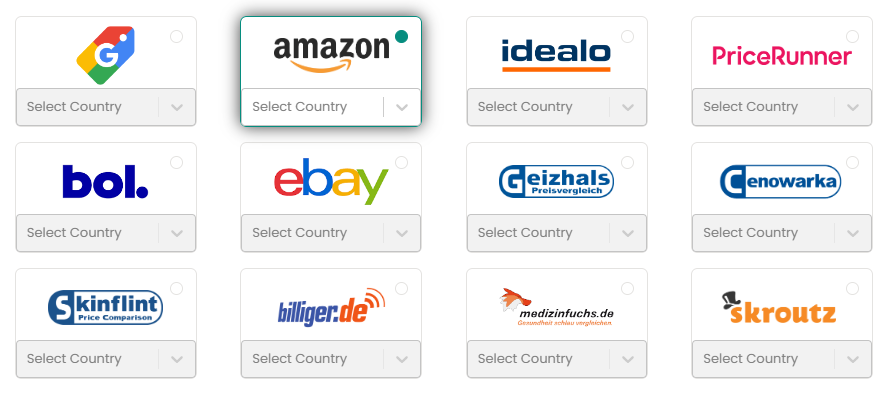










Missing an important marketplace?
Send us your request to add it!