
- Product
- Solution for
For Your Industry
- Plans & Pricing
- About us
- Resources

For Your Industry
Cross channel pricing gaps between a marketplace and an eCommerce storefront are now one of the largest hidden risks in modern retail. This topic is essential for teams that manage pricing automation, retail analytics, and omni channel strategy. A cross channel price gap occurs when the same SKU is priced differently on a marketplace versus the brand’s own online store. These variations can cause lost revenue, reduced margins, suppressed Buy Box performance, and long term erosion of price integrity. This article explores why pricing gaps emerge, how they impact category competitiveness, and what data driven teams can do to eliminate them with intelligent pricing systems.
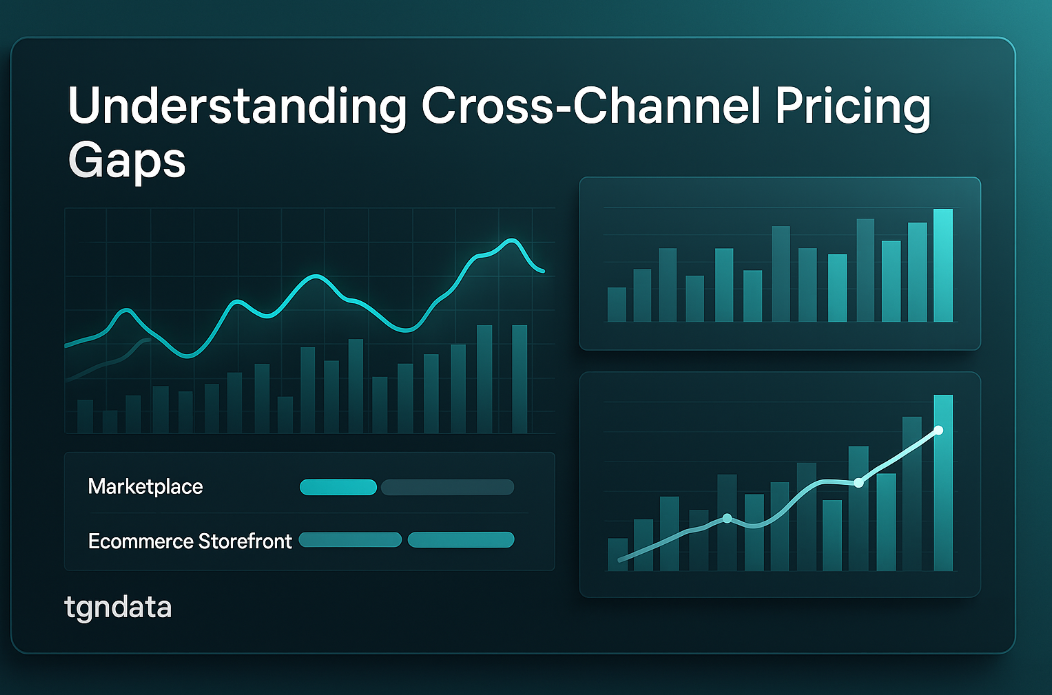
Many brands and retailers now operate across two dominant sales channels. Marketplaces such as Amazon, Walmart Marketplace, eBay or Zalando, and proprietary eCommerce storefronts built on Shopify or Magento. Each channel pulls pricing in a different direction. Marketplaces are algorithmic and competitive. D2C storefronts are margin focused and brand controlled. When these worlds collide, price gaps appear. They are often invisible internally because pricing teams rely on fragmented data. As a result, the brand loses coordinated control of the customer experience and the economic performance of its catalog.
Pricing leaders increasingly treat cross channel gaps as a core KPI. They monitor differential percentages, competitive deltas, discount stack interactions, marketplace repricer behaviors and the effect of shipping rules on total price perception. Understanding these pricing gaps helps organizations unify margin strategy, protect brand value and maintain aligned positioning across all consumer touch points.
Cross channel gaps rarely arise from a single cause. Instead, they emerge from the interplay of internal processes and external marketplace dynamics. The main sources include:
Marketplaces reward price competitiveness. Repricers chase the Buy Box and adjust prices frequently. When a marketplace repricer lowers prices to win share, the gap against the eCommerce storefront widens. Without monitoring, the storefront ends up overpriced compared to the channel that customers check most often.
Internal promotions, influencer codes, seasonal markdowns and marketplace event days operate on different calendars. If the eCommerce team launches a promotion earlier than the marketplace team, customers see misaligned prices that damage trust and compress margins.
Fulfillment fees, SLA differences and shipping thresholds impact marketplace price perception. A marketplace price might appear lower even when the base price is higher because of bundling or FBA efficiencies. Conversely, storefronts with flat rate or free shipping policies sometimes look more expensive unless pricing teams account for total landed cost.
When unauthorized sellers undercut MSRP on a marketplace, they create forced downward pressure on price. Even if a brand maintains pricing discipline on its storefront, the marketplace price becomes a reference anchor for customers. This creates involuntary cross channel gaps and long term price degradation.
D2C channels often target higher contribution margins. Marketplaces aim for volume and Buy Box exposure. These strategic differences can widen gaps unless a unified pricing model aligns them.
Cross channel gaps directly influence commercial outcomes. Their impact spans revenue, margin, brand positioning and customer perception.
If your marketplace price is higher than competitors or unauthorized sellers, your Buy Box share drops. When repricers push prices too low, margins collapse and create negative spillover effects on your storefront.
Once pricing gaps form, they rarely stay isolated. Repricers begin to react to each channel in feedback loops. A storefront discount triggers a repricer response. A repricer drop triggers a storefront markdown request. The end result is a structural margin compression across the catalog.
Consumers compare prices across channels instantly. A large gap causes customers to distrust the higher priced channel. eCommerce teams then lose their advantage as a controlled brand experience hub.
If marketplace prices fluctuate unpredictably, retail media bidding becomes less efficient. Cost per acquisition rises and ROAS declines because customers abandon carts when they see cheaper options elsewhere.
Large gaps signal weak brand control. Distributors or resellers use marketplace pricing as justification to renegotiate cost structures or discounting expectations.
Not all pricing gaps behave the same. Data teams typically classify them into three structures:
Long lasting differences caused by margin policy or channel strategy. These gaps require strategic realignment.
Short lived differences caused by repricing engines or competitor moves. These require monitoring and automated controls.
Differences caused by calendar misalignment, discount rules or voucher stacking. These require operational discipline and cross team coordination.
Understanding which type exists within your catalog determines the correct intervention, whether policy based, technology driven or operationally corrective.
Pricing leaders rely on comprehensive retail intelligence to detect and measure gaps. Key diagnostic methods include:
Track a price index for every SKU across the marketplace and storefront. Calculate differential percentages, frequency of deviation, and directionality.
Compare not just base prices but shipping, taxes and promotional adjustments. Customers anchor on total cost, not listed cost.
Analyze how often marketplace repricers adjust prices in relation to storefront changes. Identify patterns where repricers overreact or chase volatile competitors.
Review historic promotional calendars and identify where gaps emerged due to misaligned discounting logic, coupon stacking or early access timing.
Track rogue listings, MAP violators, and grey market sellers. Determine their contribution to price degradation and gap formation.
Closing pricing gaps requires technology and policy alignment. Modern retailers use a combination of analytics, governance and automation.
Define clear channel specific rules that govern how storefront and marketplace prices relate. Provide boundaries for repricers and ensure storefronts maintain brand aligned positioning.
Create joint calendars for D2C and marketplace promotions. Synchronize discount sequences and set guardrails that prevent large price swings.
Use data driven repricers that incorporate storefront pricing, competitive benchmarks and margin floors. Intelligent repricers avoid race to the bottom behavior and prevent cascading price erosion.
Proactively monitor unauthorized sellers. Use automated violation alerts, structured communication templates and enforcement actions to remove rogue price breakers.
Evaluate margins across both channels in real time. Adjust pricing strategies based on profitability rather than simplistic marketplace competitiveness.
The most successful organizations build a permanent analytics framework to prevent future price misalignments.
SKU level price parity dashboards
Automated gap alerts and tolerance thresholds
Integrated promotional planning tools
Market share and Buy Box monitoring
Competitive landscape visualizations
Daily margin impact scoring
Seller ecosystem mapping
Weekly pricing alignment meetings
Event calendar synchronization
Repricer rule audits
Marketplace catalog health reviews
Seasonal scenario planning
With the correct data foundation and operational cadence, cross channel pricing becomes predictable and controllable, even in complex multi channel environments.
Advanced pricing automation uses AI models to maintain optimal parity across channels. These systems evaluate millions of data points in real time and ensure pricing aligns with strategic goals.
Detecting unnatural price drops before they cause cascading reactions
Recommending unified prices based on elasticity and competitive pressure
Predicting Buy Box outcomes and adjusting prices intelligently
Normalizing prices to maintain brand consistency
Forecasting margin impact of cross channel actions
Aligning storefront prices with marketplace competitive dynamics without sacrificing profitability
AI powered infrastructure is essential for maintaining price integrity at scale across thousands of SKUs.
Cross channel pricing gaps between a marketplace and an eCommerce storefront are no longer minor operational issues. They influence brand trust, margin stability, marketplace competitiveness and long term strategic resilience. By implementing unified analytics, market aligned repricing systems, coordinated promotional calendars and proactive MAP enforcement, organizations can eliminate destructive pricing gaps and build consistent pricing that protects both revenue and brand equity.
tgndata empowers retailers and brands with enterprise grade pricing intelligence, automated gap detection and real time repricing strategies. To strengthen your cross channel pricing architecture, connect with tgndata and transform your pricing operations with data driven precision.





We use cookies to provide you with an optimal experience, for marketing and statistical purposes only with your consent, which you may revoke at any time. Please refer to our Privacy Policy for more information.
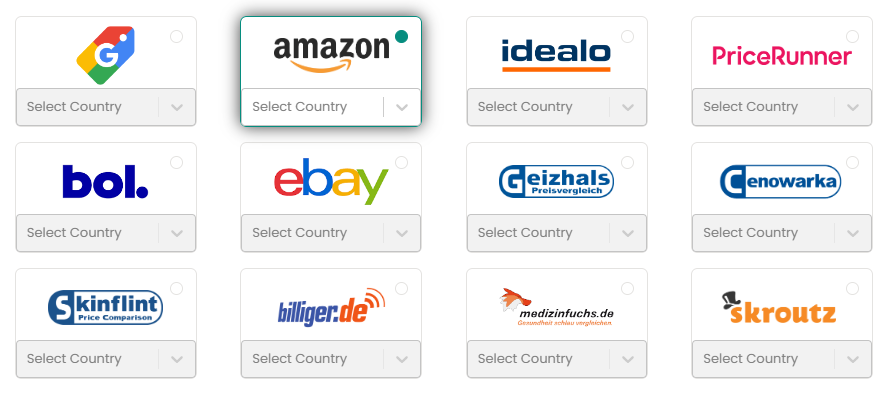










Missing an important marketplace?
Send us your request to add it!