
- Product
- Solution for
For Your Industry
- Plans & Pricing
- About us
- Resources

For Your Industry
Q1 is where retail pricing strategies either stabilize or unravel. After the volatility of Q4, many retailers enter January with exhausted teams, distorted demand signals, and limited visibility into competitor price data. Without clear insight into how competitors are resetting prices, pricing decisions in Q1 are often driven by habit rather than market reality, leading to slow margin recovery and reactive pricing behavior.
This is where competitor price data becomes essential.
Using competitor price data to set your Q1 pricing strategy is not about copying prices or chasing the cheapest offer in the market. It is about understanding where the market is resetting, how competitors are behaving post holiday, and where pricing opportunities exist as demand normalizes.
Retailers that use competitor price data strategically in Q1 outperform those that rely solely on internal sales data or historical pricing rules. They recover margins faster, avoid unnecessary price wars, and establish a clear pricing position early in the year.
This article explains how to use competitor price data correctly in Q1, what data actually matters, where retailers get it wrong, and how leading pricing teams turn market insight into profitable pricing decisions.
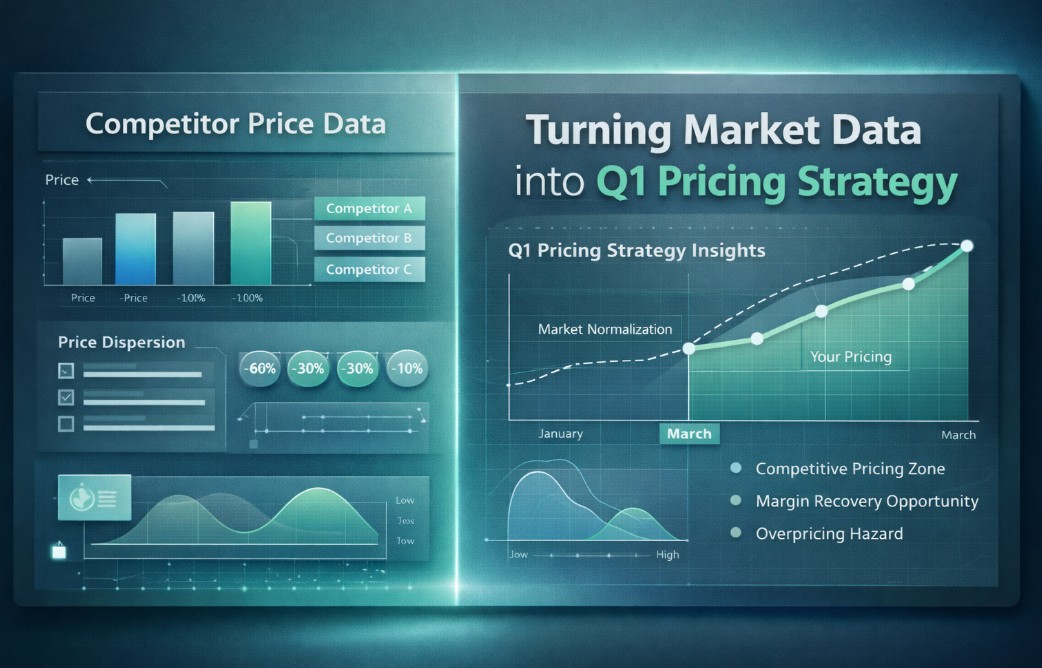
Q1 pricing requires a fundamentally different mindset than peak trading periods.
In Q4, pricing is driven by promotions, traffic acquisition, and inventory liquidation. In Q1, pricing must shift toward normalization, margin recovery, and strategic positioning.
Key Q1 dynamics include:
Demand normalization after holiday spikes
Increased price sensitivity as consumer budgets reset
Reduced promotional noise across the market
Greater price dispersion between competitors
Internal pressure to recover margin early
Because of these conditions, small pricing mistakes in Q1 can have outsized impact across the rest of the year.
Competitor price data provides the external context needed to make confident decisions during this transition period.
Competitor price data is often misunderstood as a single data point. In reality, it is a collection of market signals that together explain competitive behavior.
Effective competitor price data includes:
Current competitor prices by SKU or product group
Promotional flags and discount depth
Historical price movements
Assortment overlap and substitutions
Channel-specific pricing differences
Looking at only one of these in isolation leads to poor conclusions. Q1 pricing decisions require a holistic market view.
Many retailers attempt to set Q1 pricing based on internal data such as:
Last year’s Q1 prices
Historical elasticity models
Margin recovery targets
While these inputs are important, they ignore a critical factor: the market has changed.
Competitors may:
Exit promotions earlier or later than expected
Adjust prices due to cost changes
Shift strategic positioning
Clear inventory aggressively
Without competitor price data, internal models operate in a vacuum. This leads to pricing that looks logical internally but fails commercially.
Competitor price data serves four strategic purposes in Q1.
Q1 pricing strategy starts with understanding what the market actually looks like today, not what it looked like last year.
Competitor price data answers questions such as:
Have competitors normalized prices yet
Which categories remain promotional
Where is price dispersion increasing
Who is investing in price versus margin
This reality check prevents overcorrection or premature margin recovery.
Every retailer has an intended price position, but Q4 often distorts it.
Using competitor price data allows pricing teams to:
Recalculate price index post holiday
Identify drift caused by promotions
Reset pricing to intended position
Without this step, retailers often enter Q1 mispositioned without realizing it.
Not all categories behave the same in Q1.
Competitor price data highlights:
Categories where competitors have raised prices
Products with reduced competitive intensity
Areas where price investment is unnecessary
These opportunity zones are where margin recovery can happen with minimal volume risk.
The biggest Q1 pricing risk is reacting to isolated competitor moves.
One competitor discount does not define the market.
Competitor price data at scale helps pricing teams distinguish between:
Strategic market shifts
Tactical promotions
Inventory driven markdowns
This prevents unnecessary price matching.
Many retailers anchor decisions to the cheapest competitor.
This is dangerous in Q1.
Lowest price often reflects:
Excess inventory
Clearance activity
Temporary promotions
Using it as a benchmark pulls prices down unnecessarily and delays margin recovery.
Competitor price data must be interpreted in the context of assortment overlap.
Comparing prices without understanding:
Product equivalence
Brand differentiation
Pack size or feature differences
Leads to incorrect conclusions about competitiveness.
Not all competitors should influence pricing decisions.
Q1 strategy should prioritize:
Primary competitors
Similar value propositions
Relevant channels
Including irrelevant competitors distorts benchmarks and weakens strategy.
Q1 is noisy.
Competitor price data should be analyzed over time, not reacted to daily without context.
Retailers that overreact create price volatility that confuses customers and internal teams alike.
Raw data is not strategy. Structure matters
Your Q1 competitive set should be narrower than in Q4.
Focus on:
Direct substitutes
Similar price positioning
Comparable customer segments
This improves signal quality.
Different categories serve different purposes.
Segment competitor price data by:
Traffic driving categories
Margin drivers
Seasonal carryover
Clearance categories
This allows differentiated pricing strategies within Q1.
Two metrics matter most in Q1.
Price index shows relative position
Price dispersion shows market uncertainty
High dispersion often signals pricing freedom. Low dispersion signals competitive sensitivity.
Q1 pricing should focus on base price normalization.
Competitor price data should clearly distinguish between:
Temporary promotions
Structural price changes
Failing to separate these leads to incorrect normalization decisions.
These categories anchor price perception.
Competitor price data helps determine:
Minimum price investment required
Whether competitors are holding or raising prices
How sensitive the category is post holiday
In many cases, Q1 allows slight price increases without traffic loss.
These categories often normalize fastest.
Competitor price data typically shows:
Reduced promotional activity
Narrow price dispersion
Stable demand
This makes them prime candidates for early margin recovery.
Competitor behavior varies widely.
Competitor price data helps identify:
Who is clearing aggressively
Who is holding price
Whether clearance pressure is market wide or isolated
This prevents unnecessary discount escalation.
Q1 pricing is not a single decision. It is a sequence.
Assess market reset
Identify ongoing promotions
Avoid premature normalization
Benchmark stabilized competitors
Adjust base prices
Begin margin recovery
Fine tune price position
Prepare for seasonal transitions
Feed learnings into Q2 strategy
Competitor price data should guide each phase differently.
Competitor price data alone does not set prices. It informs optimisation.
Competitor price data defines market constraints
Optimisation models test price scenarios
Business rules apply strategy and guardrails
Prices are adjusted with confidence
This prevents both overreaction and inertia.
Q1 requires speed and consistency.
Manual competitor price analysis fails because:
Data volume is too high
Market changes are frequent
Human bias creeps in
Automation ensures competitor price data is used systematically rather than selectively.
Competitor price data must operate within strategy.
Effective governance includes:
Minimum margin thresholds
Price floors and ceilings
Category specific rules
Override processes
This ensures market awareness does not become market chasing.
Pricing teams often struggle with internal alignment.
Common issues include:
Merchandising pushing aggressive discounts
Finance prioritizing margin recovery
E commerce reacting to competitors
Competitor price data creates a shared source of truth that aligns decision making.
Top performers treat Q1 as a strategic reset.
They use competitor price data to:
Validate pricing assumptions
Identify low risk margin opportunities
Avoid unnecessary price investments
Establish pricing discipline early
They do not chase the market. They understand it.
tgndata helps retailers turn competitor price data into actionable pricing strategy.
Our platform provides:
High frequency competitor price tracking
Assortment aware benchmarking
Promotion detection
Integration with price optimisation models
This allows retailers to move from reactive Q1 pricing to intentional strategy.
Using competitor price data to set your Q1 pricing strategy is not about matching prices. It is about understanding the market well enough to make confident, profitable decisions.
Q1 rewards retailers who:
Normalize pricing deliberately
Recover margin without losing relevance
Use market data as context, not instruction
Competitor price data, when structured and integrated correctly, becomes a strategic asset rather than a reactive tool.
The retailers that get Q1 right set themselves up for success for the rest of the year.






We use cookies to provide you with an optimal experience, for marketing and statistical purposes only with your consent, which you may revoke at any time. Please refer to our Privacy Policy for more information.










Missing an important marketplace?
Send us your request to add it!