
- Product
- Solution for
For Your Industry
- Plans & Pricing
- About us
- Resources

For Your Industry
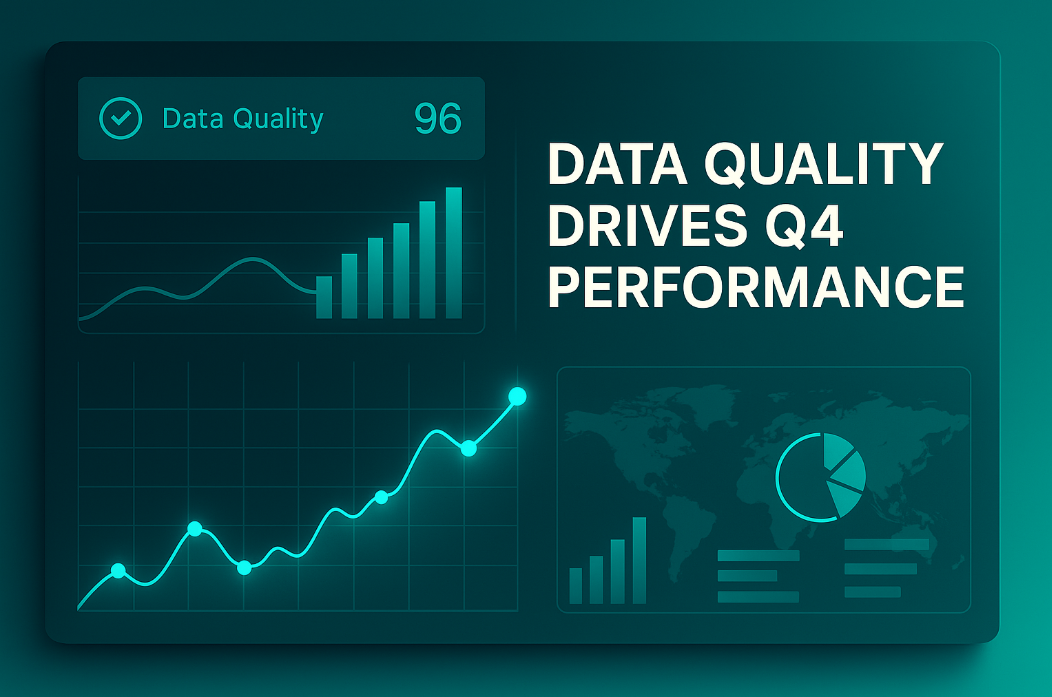
Q4 is the peak period of retail competition. Prices shift rapidly, promotions accelerate across every category, and retailers often measure success by how frequently they can update prices. While price frequency is important, it is far less impactful than the quality and accuracy of the data used to make those price changes. High quality data ensures that every pricing decision is reliable, profitable, and aligned with competitive reality. Low quality data leads to incorrect price adjustments, margin loss, and marketplace instability.
Data quality becomes more important than price frequency in Q4 because the stakes are significantly higher. Retailers face shorter buying windows, more aggressive competitors, and consumers who monitor prices more closely than at any other time of year. In this environment, speed alone cannot win. Retailers need accurate product matching, clean competitive feeds, and validated pricing inputs that support confident pricing decisions.
This article explains why data quality is the foundation of Q4 pricing excellence, how poor data undermines pricing strategy, and how retail teams can build high quality data pipelines that outperform competitors.
Q4 pricing environments are noisy and highly dynamic. Promotions, seasonal launches, marketplace repricing, and competitive shifts happen constantly. Low quality data becomes a liability because it triggers incorrect pricing actions.
Increased volume of competitor price changes
More third party sellers entering marketplaces
Higher frequency of promotional bundles and variants
Faster repricing cycles across retailers
Limited time for manual validation
Higher customer sensitivity to mispriced listings
Larger financial impact for every pricing error
Price frequency matters, but only when powered by accurate data. Incorrect data multiplied by greater frequency creates risk instead of competitive advantage.
Data quality refers to how accurate, complete, consistent, and reliable pricing data is across all channels. It influences every aspect of pricing intelligence and decision making.
Accurate and verified competitor prices
Correct SKU level product matching
Clean marketplace listing data
Real time updates with low latency
Removal of duplicate or irrelevant listings
Reliable stock and availability signals
Clear separation of bundles and variants
Consistent mapping across sellers and channels
High quality data gives retailers a precise view of the market, which leads to confident and profitable decisions.
Some retailers believe that increasing the frequency of price changes automatically improves competitiveness. However, frequently updating prices without verifying data accuracy creates instability and reduces profitability.
Repricing against incorrect competitors
Matching against outdated marketplace listings
Dropping prices unnecessarily due to false violations
Triggering price wars based on inaccurate data
Overreacting to noise in automated systems
Reducing margins on SKUs that are already competitive
Price frequency can improve outcomes, but only when quality controls are in place. Otherwise, retailers move faster in the wrong direction.
Low quality data produces issues that are more damaging in Q4 because mistakes scale quickly.
Margin erosion from unnecessary price drops
Lost sales from overpriced or mismatched SKUs
Higher cart abandonment rates
Increased promotional overspend
Poor inventory sell through due to inaccurate pricing
Analysts are spending more time validating incorrect data
Higher risk of MAP violations
Retailers are losing trust in pricing systems
Increased time spent resolving customer price disputes
Reduced consumer trust when prices fluctuate incorrectly
Lower Buy Box visibility for marketplace sellers
Weak price perception against competitors
Data quality inaccuracies compound during Q4, when error tolerance is lowest and competition is highest.
Accurate product matching is one of the most important factors in data quality. Incorrect matches cause flawed indexing, misaligned repricing, and poor competitive decisions.
Marketplace listings with incomplete product data
Variant confusion on colors, bundles, and region specific SKUs
Duplicate listings created by unauthorized sellers
Promotions applied inconsistently across variants
Seasonal bundles that bypass standard product mapping
A single incorrect match can trigger thousands of incorrect price calculations
Fast repricing multiplies the impact of each error
SKU level mistakes lead to widespread price misalignment
Precise matching ensures retailers compare the right products to the right competitors every time.
Retailers often focus on the frequency of updates. However, the timing of updates matters more than speed alone. Accurate real time data is more valuable than frequent but incorrect updates.
Responds to market changes at the correct moment
Prevents overreaction to expired or invalid data
Aligns price adjustments with true competitive shifts
Supports more stable dynamic pricing rules
Reduces margin leakage from unnecessary discounts
Real time accuracy outperforms high frequency noise because it ensures that every change serves a strategic purpose.
Dynamic pricing systems rely entirely on data quality. During Q4, when volumes spike, even minor inaccuracies can cause system wide pricing disruptions.
Overresponsive rules triggered by incorrect competitor prices
Automated price cuts that reduce profit without need
Misaligned price floors and ceilings
Violations of MAP or brand pricing guidelines
False positives for promotional price changes
Unexpected price swings that reduce consumer trust
High frequency price changes amplify any underlying data quality problems.
Promotional periods are especially dependent on accurate data. Promotions can strengthen conversion, but only if they are timed and priced correctly.
Identifies when competitors launch real promotions
Pinpoints which SKUs require discounting
Reveals safe price floors that protect margins
Highlights promotional cycles across marketplaces
Ensures correct eligibility for bundles and limited time offers
Quality data transforms promotions from guesswork into strategic planning.
Competitive indexing shows how a retailer compares to key competitors. Without accurate data, the index becomes misleading and leads to incorrect decisions.
Correct alignment of comparable SKUs
Removal of non relevant competitor listings
Accurate identification of price leaders and laggards
Reliable comparison across marketplaces
Clean segmentation between premium and standard SKUs
Accurate indexing enables retailers to measure their true competitive position during Q4.
Automated repricers can update prices instantly, yet they rely entirely on input data. Quality dictates performance.
Price instability
Increased MAP violations
Misaligned strategy across channels
Loss of Buy Box visibility
Consumer confusion and reduced trust
Stable and profitable pricing
Strong marketplace visibility
Accurate competitor positioning
Higher conversion and better margins
More reliable forecasting models
Retailers succeed in Q4 when pricing systems make fewer but smarter decisions.
A mid market electronics retailer enters Q4 with a dynamic pricing system that updates every ten minutes. Their competitors update every thirty minutes. At first glance, higher frequency seems advantageous.
However, competitor data reveals:
Twenty percent of matches are incorrect variants
Ten percent of listings show expired sale prices
Several marketplace sellers are unauthorized
Promotions for bundled products are incorrectly mapped
After improving data quality, the retailer reduces pricing frequency but increases performance.
Conversion rises by twelve percent
Price accuracy increases across all channels
Margin improves due to fewer unnecessary price drops
Buy Box share increases because prices stabilize
Violations drop across all MAP sensitive categories
Data quality, not speed, becomes the key differentiator.
Fast price changes help retailers stay competitive, but high frequency is meaningless without accurate and reliable data. Q4 increases competitive intensity and leaves no room for pricing errors. Data quality protects margins, improves conversion, stabilizes dynamic pricing, and ensures retailers make confident decisions.
Brands and retailers that prioritize data quality outperform competitors who rely solely on speed.
tgndata delivers enterprise-grade pricing intelligence, data quality scoring, product matching, and high-accuracy competitive feeds designed for Q4 scale. Contact us to strengthen your pricing systems.





We use cookies to provide you with an optimal experience, for marketing and statistical purposes only with your consent, which you may revoke at any time. Please refer to our Privacy Policy for more information.
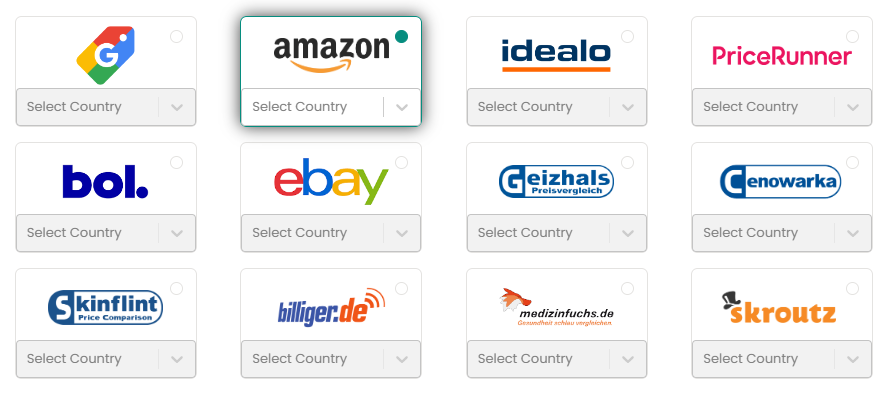










Missing an important marketplace?
Send us your request to add it!