
- Product
- Solution for
For Your Industry
- Partners
- Plans & Pricing
- Resources

For Your Industry
Q4 is the most competitive and margin sensitive period of the retail calendar. Promotions accelerate, demand surges, and competitors change prices rapidly across channels. Price volatility analysis helps retailers understand how market movements shape conversion, profitability, and competitive positioning. This article explains how to analyze price volatility, how it reveals competitor behavior, and why reliable pricing intelligence is essential for Q4 revenue performance.
Price volatility analysis provides retail teams with data clarity during crowded shopping periods. By monitoring competitor pricing tactics, promotional timing, and SKU level adjustments, retailers can make precise pricing decisions that increase revenue while protecting margins.
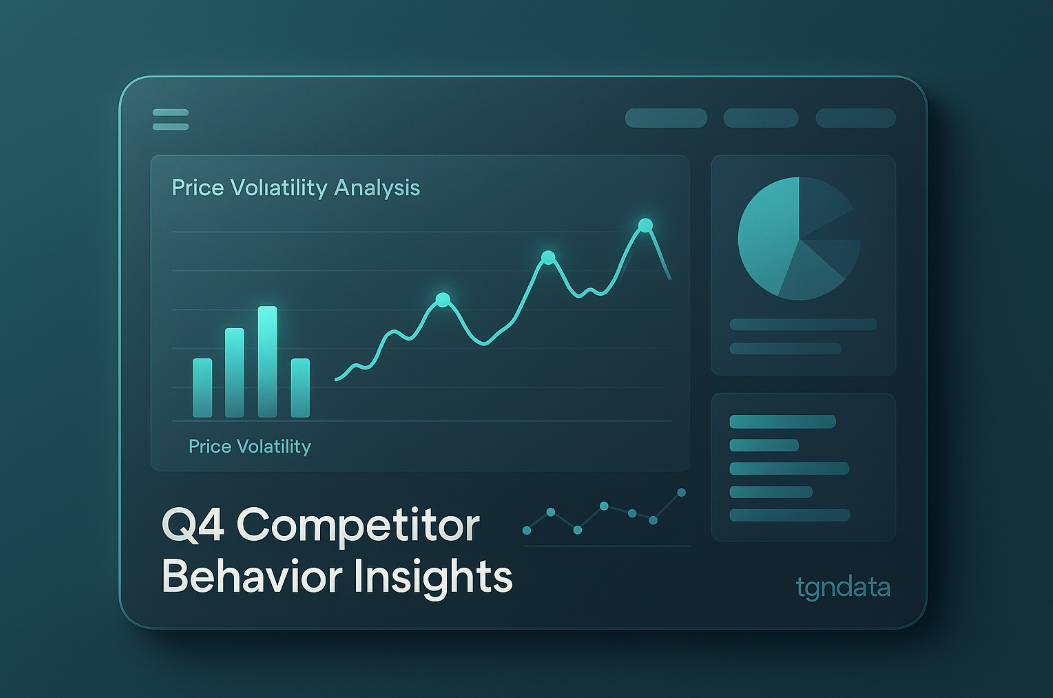
Q4 compresses the entire competitive landscape into a short and intense timeframe. Consumer demand peaks and competitors fight to capture wallet share through aggressive pricing strategies.
Large promotional events like Black Friday, Cyber Monday, and Holiday Week
High inventory turnover rates
Market wide discount escalation
Hourly price changes by leading marketplaces
Increased shopper price sensitivity
Seasonal product launches
Supply chain constraints that influence stock driven pricing decisions
Retailers that operate without price volatility analysis are often blindsided by rapid competitor moves. This leads to missed revenue opportunities and lower conversion rates.
Price volatility analysis is the measurement, tracking, and interpretation of pricing fluctuations within a market. It identifies how often prices shift, how sharply they change, and what competitive patterns or triggers create those movements.
Frequency of competitor price changes
Magnitude of each price adjustment
Duration of specific price points
Promotional cadence and discount depth
Seasonal elasticity patterns
Price indexing against key competitors
SKU level competitive pressure scoring
When layered with pricing intelligence and dynamic automation, volatility analysis becomes a strategic advantage during Q4.
Retailers behave differently during Q4 because the stakes are higher and consumer expectations shift. Competitor strategies often accelerate in order to drive peak conversions.
Hourly price updates on top selling SKUs
Dynamic promotional layering across channels
Aggressive discounting early in the season
Price matching during high intent shopping windows
Deep last minute promotions to move inventory
Selective discount removal once supply drops
Category wide price drops followed by sharp increases
Price volatility analysis detects these behaviors within minutes. Retail teams can respond intelligently instead of reacting late or applying blind discounts.
Promotions create the most visible signals within Q4 price volatility. Retailers often use flash discounts, tiered promotions, and bundle pricing to disrupt competitors.
Timing clusters when multiple competitors drop prices
Specific SKUs that anchor promotional traffic
Discount depth variations based on stock levels
Patterns where competitors raise prices after a peak demand window
Cross category promotions used to boost accessory sales
Weekend price cycles created by shopper intent trends
When retailers map promotional patterns, they gain a clearer understanding of competitor strategy and can plan promotions with higher accuracy.
Price mapping reveals how a retailer compares to key competitors throughout Q4. It identifies when a product is priced appropriately, overpriced, or underpriced relative to market leaders.
Prevents overpricing during high intent periods
Detects opportunities to increase prices when competition rises
Aligns promotional pricing with market momentum
Reveals SKU level competitive pressure
Identifies comp sets driving the strongest volatility
Highlights mismatched product matches from automated systems
With Q4 bringing more noise, price mapping keeps retailers grounded in real market conditions.
Underpricing top SKUs by small increments to manipulate price perception
Hourly changes on fast moving categories
Artificial price hikes before major promotional drops
Loss leader pricing to drive category traffic
Marketplace algorithmic price suppression
Flash price drops designed to trigger competitor automation
Retailers that detect these tactics early can protect margin by avoiding unnecessary price drops while still maintaining a competitive index.
In Q4, price volatility analysis must identify aggressive competitor behaviors quickly. These tactics influence conversion and often signal strategic intent.
Consumers track prices more intensely during Q4. They compare more retailers, watch promotions closely, and react quickly to price drops.
Consumers expect rapid price changes
Small price differences can cause immediate shifts in purchasing
Price history tracking influences perception of deal quality
Early price drops anchor consumer expectations
Cart abandonment increases when price volatility is high
Consumers wait for predictable promotional cycles
Price volatility analysis enables retailers to anticipate shopper behavior and set pricing strategies that maximize conversion.
Elasticity bends dramatically during Q4 because demand spikes and promotions distort pricing signals.
Higher demand reduces price sensitivity on must have categories
Steep discounts increase conversion but compress profit margins
Elasticity varies by week, not by season
Bundled products behave differently than standalone products
Discount expectations shift as major holidays approach
Retailers that combine elasticity models with volatility data unlock more accurate pricing strategies.
Price volatility analysis does more than describe past activity. Pairing volatility with AI driven forecasting provides retailers with predictive visibility.
Expected timing of competitor price drops
Probability of early season aggressive discounting
Forecasted post promotion price rebounds
Estimated promotional saturation dates
Price ranges for top SKUs across peak shopping windows
Forecasting competitor behavior enhances readiness and prevents reactive deep discounting.
Margin optimization is especially difficult in Q4 because aggressive competition forces retailers to balance profit protection with competitive pricing.
Categories with unnecessary discounting
Price floors that protect profitability
Optimal thresholds for dynamic price adjustments
Safe periods to raise price without losing conversion
Overstock driven volatility that enables controlled discounting
Margin intelligence is essential for sustainable Q4 pricing performance.
No retailer can manually respond to Q4 volatility. Automated pricing systems translate volatility insights into real time actions.
Faster reaction to competitor price changes
Continuous index alignment
Precision pricing during peak traffic hours
Reduced analyst workload
Less risk of human error under time pressure
Accurate multichannel pricing synchronization
Volatility analysis powers dynamic pricing with data that drives conversion lift and margin control.
A structured approach ensures team alignment throughout the season.
Focus on real competitors, not the entire market.
Track frequency, magnitude, and timing of price changes.
Identify patterns and repeated behaviors.
Stockouts influence pricing pressure.
Automate decisions to match real-time volatility.
Q4 shifts too quickly for weekly analysis.
Q4 retail performance depends on more than promotional strength. It depends on understanding how competitors behave, how fast they move, and how volatility shapes consumer decision making. Price volatility analysis gives retailers the clarity they need to optimize prices with confidence, protect margins under pressure, and outperform competitors during the busiest shopping season of the year.
tgndata equips retailers with advanced pricing intelligence, volatility monitoring, and dynamic pricing automation built for Q4 scale. Contact us to strengthen your pricing strategy and stay competitive throughout peak season.
We use cookies to provide you with an optimal experience, for marketing and statistical purposes only with your consent, which you may revoke at any time. Please refer to our Privacy Policy for more information.










Missing an important marketplace?
Send us your request to add it!