
- Product
- Solution for
For Your Industry
- Partners
- Plans & Pricing
- Resources

For Your Industry
Holiday shopping periods place intense pressure on pricing strategy. Competitors discount aggressively, marketplaces move quickly, and retailers search for every advantage to capture traffic and conversion. For brands, this surge in promotional activity creates a significant challenge. They must protect pricing consistency, preserve brand value, and ensure that retail partners follow established Minimum Advertised Price policies. MAP enforcement becomes the foundation of price integrity during the holidays, helping brands maintain trust, control channel behavior, and defend long term profitability.
MAP enforcement is essential because holiday volatility amplifies the risks of unauthorized discounting. When sellers advertise below MAP, brands experience weakened margins, eroded brand perception, and channel conflict that damages strategic relationships. A strong MAP monitoring and enforcement framework allows teams to identify violations quickly, correct retailer behavior, and maintain stable pricing across marketplaces and eCommerce channels.
This article explains why MAP enforcement becomes more challenging during the holidays, how brands can improve monitoring accuracy, and which strategies are most effective for protecting price integrity at scale.
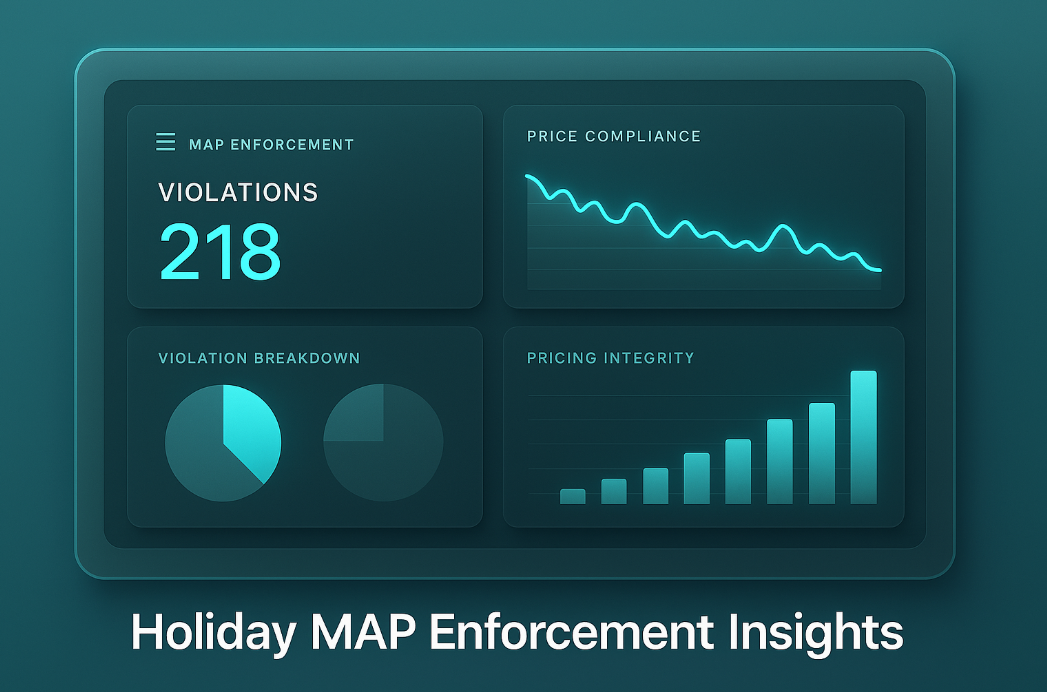
The holiday retail environment is fast, crowded, and extremely competitive. Retailers attempt to capture demand through rapid promotions, and some may run unauthorized discounts to attract customers or win the Buy Box on major marketplaces.
Higher volume of promotional pricing across every category
Increased participation from non authorized sellers and gray market sellers
Large marketplace events that encourage aggressive discounting
Limited oversight from retailers due to high operational workload
Short term price drops used to capture traffic spikes
Automated repricing systems that ignore MAP logic
Retailers attempting to match competitors who are already violating MAP
Holiday periods compress the entire competitive cycle, turning small pricing deviations into widespread violations if not addressed quickly.
MAP enforcement helps brands maintain consistent price floors across all advertising channels. This protects both brand equity and channel relationships.
Preserves price value across digital and physical retail
Reduces margin erosion caused by unauthorized discounts
Protects premium product perception
Stabilizes retailer relationships with clear expectations
Ensures fair competition across authorized sellers
Prevents race to the bottom discounting
Aligns marketplace pricing with brand expectations
Brands that maintain strong MAP enforcement during the holidays avoid the long term consequences of uncontrolled discount cycles.
Holiday price violations can have an outsized impact on brand health because consumer traffic is significantly higher. When shoppers see inconsistent prices, brand credibility weakens.
Reduced sell through at authorized retailers
Lost marketplace visibility due to algorithmic repricing
Devaluation of new releases and seasonal bundles
Increased retailer complaints about channel fairness
Damage to brand value and perceived quality
Loss of retailer trust over repeated MAP violations
Difficulty maintaining price floors in future seasons
Increased reliance on promotions to move inventory
MAP enforcement is not only a pricing policy. It is a brand protection strategy.
Marketplaces introduce the highest level of pricing uncertainty. Sellers operate independently, new listings appear daily, and pricing tools update automatically.
Unauthorized third party sellers listing below MAP
Automated repricers undercutting other sellers
Cross border sellers using foreign MSRP logic
Duplicate listings without proper product matching
Sellers who intentionally break MAP to gain Buy Box advantage
Because of this complexity, brands require strong MAP monitoring systems that track all marketplace listings and identify violations in real time.
Brands cannot police holiday pricing manually. MAP monitoring technology automates oversight across thousands of SKUs and multiple channels.
Real time price tracking across marketplaces and retailer websites
Automated screenshot capture for evidence collection
Price deviation alerts triggered instantly
Product matching to group identical SKUs under one listing
Violation trend reporting across sellers and categories
Seller identification and correlation with authorized partner lists
Customizable tolerance thresholds for MAP variance
Holiday speed requires automation. Without MAP technology, violations often go unnoticed until they impact sales performance.
MAP enforcement fails when product matching is inaccurate. During the holidays, retailers often bundle products, rename SKUs, or create variant listings.
Duplicate product pages
Bundles priced in ways that bypass MAP
Slight SKU variations to avoid MAP rules
UPC inconsistencies across sellers
Third-party sellers mislabeling products
Accurate matching ensures all versions of a product are monitored. Brands can then enforce MAP with confidence and consistency
MAP policies must be flexible enough to support holiday promotions while still preserving price integrity. Many brands allow promotional exceptions, provided they follow approved guidelines.
Coupon based promotions that apply at checkout, not in advertised price
Channel wide promotional agreements for peak dates
Category specific temporary MAP discounts
Instant rebates funded by the brand
Minimum advertised price exceptions for bundles only
Discounted gift with purchase models
Clear communication and structured promotional guidelines reduce accidental MAP violations.
Response speed is critical. During the holidays, a MAP violation that lasts one hour can influence thousands of price impressions and spark widespread matching.
Detect violation with MAP monitoring alerts
Capture screenshot and store evidence
Identify seller and verify authorization status
Send automated or templated MAP violation notice
Escalate to account managers for authorized partners
Remove unauthorized sellers when possible
Track repeated offenders for future policy review
Verify that price correction has occurred
Brands that close the violation loop quickly prevent downstream price erosion.
Effective MAP enforcement depends on policing all sellers equally. During the holidays, unauthorized sellers attempt to capitalize on peak demand.
Create structured agreements outlining MAP requirements
Require repricing tools to follow MAP floors
Provide promotional calendars in advance
Conduct weekly compliance reviews during Q4
Issue takedown requests when marketplace policy allows
Investigate sourcing channels and potential leakage
Track rogue sellers for patterns and repeat behavior
Work with marketplace compliance teams for removal
Unauthorized seller cleanup significantly reduces holiday MAP violations.
MAP enforcement improves when brands use data to refine policies and identify systemic problems.
Violation frequency by seller
Violation frequency by SKU
Average duration of violation
Price deviation severity
Marketplace versus retailer violation ratios
Category level trends
Correlation between violations and sales fluctuation
Data driven MAP enforcement protects pricing more effectively during Q4.
Retailers expect brands to create fair and stable pricing environments. Strong MAP enforcement builds positive relationships that improve long term collaboration.
Reduced need to participate in price matching
Higher confidence in shared promotional strategy
Safer inventory investments
Better sell through performance
Stronger negotiation leverage for future programs
Holiday periods amplify tension in the channel, so MAP enforcement provides stability for all partners.
Brands should update MAP policies early, ideally in Q3, to ensure compliance during the holiday rush.
Review outdated MAP language
Audit authorized sellers and update listings
Clean up marketplace presence
Test monitoring tools for accuracy
Provide holiday promotional guidelines to retailers
Set tolerance thresholds for holiday MAP exceptions
Preparation prevents confusion and reduces enforcement disputes during peak traffic periods.
Holiday seasons bring higher traffic, aggressive promotions, and increased pricing pressure. MAP enforcement helps brands maintain price integrity, protect brand value, and support retail partners during the most chaotic period of the year. Effective MAP monitoring, automated alerts, accurate product matching, and fast enforcement workflows ensure that brands stay in control of their pricing and avoid race to the bottom discounting.
Brands that prioritize MAP enforcement during the holidays create long-term stability across channels and strengthen their competitive position.
tgndata supports brands with world-class MAP monitoring, seller identification, product matching, and enforcement workflows designed for high-speed holiday environments. Contact us to protect your pricing strategy and preserve brand value this season.


We use cookies to provide you with an optimal experience, for marketing and statistical purposes only with your consent, which you may revoke at any time. Please refer to our Privacy Policy for more information.










Missing an important marketplace?
Send us your request to add it!