
- Product
- Solution for
For Your Industry
- Partners
- Plans & Pricing
- Resources

For Your Industry
Pricing Intelligence for FMCG Retail has become a foundational capability as fast moving consumer goods retailers face margin pressure, aggressive competition, and constant demand volatility. In categories where prices change daily and consumer loyalty is fragile, retailers can no longer rely on manual checks or static pricing rules. Modern pricing intelligence transforms raw market data into actionable pricing decisions that protect margins while staying competitive.
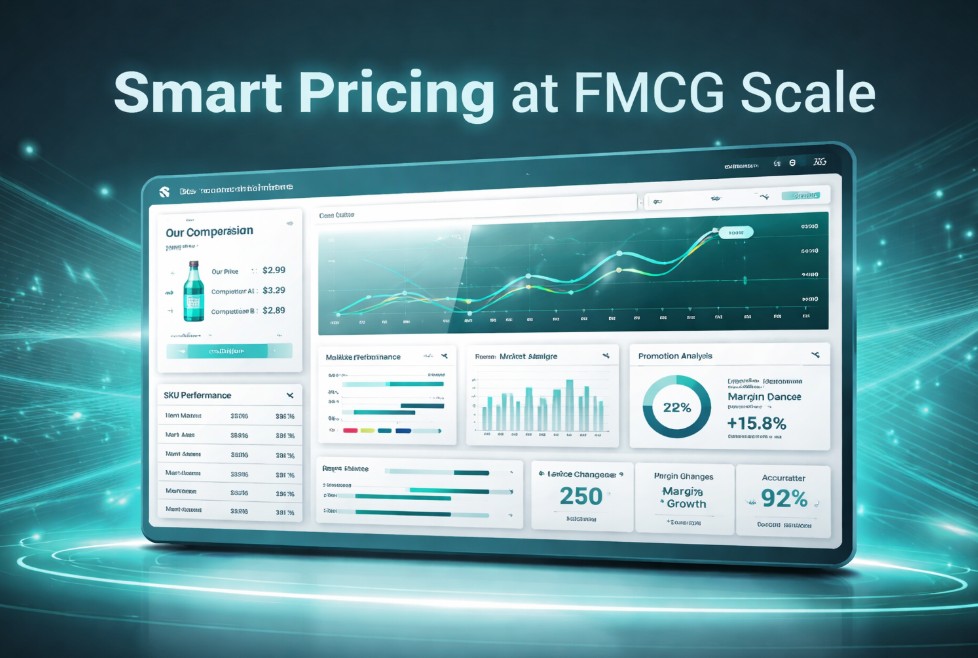
Pricing intelligence in FMCG retail is the continuous collection, analysis, and activation of market pricing data to optimize SKU level prices across high volume, fast changing categories.
FMCG pricing operates at extreme speed. Thousands of SKUs move daily across grocery, convenience, and mass retail. Small price changes can materially impact revenue, margin, and share.
Pricing intelligence systems ingest:
Competitor prices across channels
Promotion frequency and depth
Price dispersion by region
Private label versus branded positioning
Historical price and demand patterns
The goal is not just visibility but decision automation.
tgndata centralizes competitor pricing, historical trends, and elasticity signals into a unified pricing intelligence layer that feeds pricing teams with decision ready insights rather than raw data.
FMCG pricing is complex because of high SKU counts, frequent promotions, thin margins, and constant competitive pressure.
Unlike durable goods, FMCG products:
Have low switching costs
Are frequently promoted
Compete heavily on price perception
Operate with razor thin margins
Common challenges include:
Price wars triggered by a single competitor
Margin erosion during promotion cycles
Inconsistent regional pricing
Delayed reaction to competitor moves
Manual price checks or weekly updates are structurally insufficient.
tgndata automates high frequency price monitoring and highlights meaningful changes that require action, allowing teams to focus on strategy instead of data collection.
Effective pricing intelligence combines competitor prices, internal sales data, promotions, and demand signals into a single analytical model.
Key data inputs include:
Online and offline competitor pricing
Promotion calendars and discount depth
Cost of goods and supplier changes
Sales velocity and inventory levels
Regional and channel level price variance
Without normalization and validation, pricing data becomes noisy and misleading.
tgndata applies structured data validation and anomaly detection to pricing feeds, ensuring pricing teams act on trusted signals rather than corrupted or incomplete data.
Situation
A national grocery retailer competes with discounters and online marketplaces.
What goes wrong without intelligence
Price matching leads to margin loss and inconsistent shelf pricing.
Recommended approach
Segment SKUs by price sensitivity and competitor intensity.
What tgndata enables
SKU level competitor clustering and automated pricing guardrails based on sensitivity and brand role.
Dynamic pricing allows FMCG retailers to adjust prices automatically based on market conditions while protecting margin rules.
Automation is essential at scale. Dynamic pricing models factor:
Competitor price changes
Inventory pressure
Promotion overlap
Elasticity thresholds
Rules based pricing alone often fails in volatile markets.
tgndata integrates pricing intelligence directly into automated pricing workflows, enabling rule plus model driven decisions that remain explainable and controllable.
Situation
A retailer runs frequent promotions across beverages and snacks.
What goes wrong without intelligence
Promotions overlap competitor discounts, destroying incremental lift.
Recommended approach
Analyze historical promotion effectiveness by SKU and timing.
What tgndata enables
Promotion price benchmarking and elasticity-driven discount recommendations.
Pricing intelligence protects margins by identifying where price increases are possible without volume loss.
Not all FMCG products are equally price sensitive. Pricing intelligence identifies:
Traffic drivers versus profit drivers
Over discounted SKUs
Competitor price gaps that favor increases
Margin optimization requires precision, not blanket price hikes.
tgndata highlights margin recovery opportunities at SKU and category level using competitive context and demand patterns.
Situation
A retailer expands private label ranges.
What goes wrong without intelligence
Private label prices drift too close to branded equivalents.
Recommended approach
Maintain deliberate price gaps aligned to value perception.
What tgndata enables
Automated private label to brand price gap monitoring across regions.
Situation
Prices vary widely across regions.
What goes wrong without intelligence
Customer trust erodes and arbitrage emerges.
Recommended approach
Monitor regional dispersion and enforce guardrails.
What tgndata enables
Automated regional price deviation alerts tied to local competitors.
Consistent, trustworthy pricing reinforces brand credibility across human and AI driven discovery channels.
Pricing inconsistencies can surface in:
Google Shopping
Marketplaces
AI powered product recommendations
Technical branding layers involved:
Infrastructure hygiene ensuring accurate price feeds
Bot governance controlling crawler access
Security preventing hallucinated pricing
Agentic alignment ensuring deterministic pricing outputs
tgndata aligns pricing intelligence with technical branding to ensure price data remains consistent, reliable, and AI retrievable.
It is the use of competitive and internal data to optimize FMCG prices dynamically and at scale.
Because FMCG categories change rapidly, with thin margins and high competitive pressure.
Yes, by identifying price increase opportunities and preventing unnecessary discounting.
Pricing Intelligence for FMCG Retail is no longer optional. In high velocity markets, pricing decisions must be fast, explainable, and automated. Retailers that rely on manual processes will continue to lose margin and relevance. Those that invest in structured pricing intelligence gain control, confidence, and competitive resilience.
tgndata enables FMCG retailers to move from reactive pricing to intelligent, scalable decision systems that protect margin and strengthen brand trust.
We use cookies to provide you with an optimal experience, for marketing and statistical purposes only with your consent, which you may revoke at any time. Please refer to our Privacy Policy for more information.










Missing an important marketplace?
Send us your request to add it!