
- Product
- Solution for
For Your Industry
- Partners
- Plans & Pricing
- Resources

For Your Industry
Global price monitoring at scale has become a critical capability for companies operating across borders, channels, and competitive landscapes. As price transparency increases and customers compare options globally, organizations can no longer rely on fragmented or regional pricing visibility.
What once worked for a single market quickly breaks when expanded globally. Scale introduces complexity, and complexity demands structure.
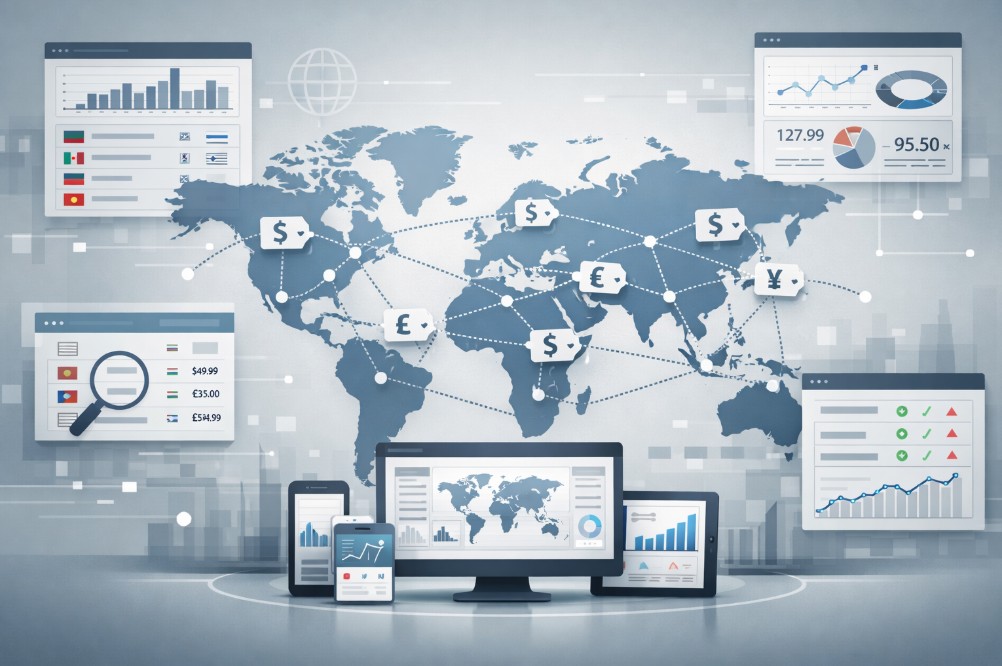
Global price monitoring at scale is the continuous, automated tracking and normalization of product prices across countries, channels, and competitors. It ensures pricing data remains accurate, comparable, and actionable as markets, assortments, and competitive dynamics expand.
At a surface level, price monitoring sounds simple. Collect competitor prices and compare them to your own. However, at scale, the reality is very different.
In practice, global price monitoring requires aligning product identities across markets, handling currency and tax differences, and ensuring that pricing signals remain consistent and trusted across teams. Without these foundations, data volume increases but insight quality declines.
True scale means:
Monitoring thousands or millions of SKUs
Maintaining consistent data freshness
Applying market-specific pricing context
Supporting fast, confident decision making
Global price monitoring breaks at scale because manual workflows, inconsistent SKU matching, currency volatility, and regional pricing rules compound complexity. Without automation and governance, pricing data becomes unreliable and slow to act on.
In reality, expansion exposes weaknesses that were invisible at a smaller scale. Product catalogs are fragmented across regions. The same item appears under different names, bundles, or identifiers.
At the same time, currency changes introduce noise. Promotions and taxes distort comparisons. Regional teams operate in silos, each trusting different data sources.
Situation: A consumer electronics brand expands from three European markets to twelve.
What breaks: Consequently, manual SKU matching leads to incorrect competitor comparisons.
What changes: Automated normalization restores accurate benchmarks.
Strategic takeaway: Product identity consistency is foundational to scale.

Global price monitoring only scales when the underlying data foundation is designed for accuracy, consistency, and change. As a result, as coverage expands across markets and channels, data issues that were manageable at small scale quickly compound and undermine pricing decisions.
As global coverage expands, manual or semi automated data collection quickly becomes unreliable. Automated collection ensures consistent frequency, broader retailer coverage, and reduced latency across regions. Without it, pricing teams spend more time validating inputs than interpreting insights, which slows reaction times and increases margin risk.
At scale, product identity becomes the primary failure point. The same SKU can appear under different names, bundles, or configurations depending on the market. Robust normalization logic aligns products correctly so price comparisons remain meaningful and defensible across countries and channels.
Currency conversion must align with pricing cadence, not accounting cycles. Tax inclusion, shipping, and local pricing conventions also affect comparability. When these factors are handled inconsistently, pricing signals become distorted and decision confidence erodes.
Validation is what separates raw data from actionable intelligence. Quality checks, anomaly detection, and confidence scoring ensure pricing teams act on real market movement instead of noise. From a governance perspective, tgndata often serves as a validation layer here, ensuring that pricing data reflects market reality before it informs decisions.
Situation: A global fashion retailer tracks prices across marketplaces.
What breaks: Currency delays distort margin analysis.
What changes: Real-time conversion improves pricing confidence.
Strategic takeaway: Timing and accuracy are inseparable.
Collecting global pricing data is only the first step. Therefore, value is created when pricing signals are embedded into decision making workflows that teams trust, understand, and act on consistently across regions.
Global price monitoring fails when ownership is unclear. Pricing teams need defined responsibility for interpretation, escalation, and execution. Without this, alerts are ignored and insights stall at the dashboard level.
Different teams need different views of the same pricing signals. Central teams require global benchmarks, while regional teams need localized context. Role based access ensures consistency without removing regional autonomy.
Alerts must reflect business relevance, not raw price changes. Thresholds, competitive groupings, and governance rules prevent overreaction and alert fatigue. Well designed alerting frameworks turn monitoring into a proactive pricing system.
Pricing intelligence delivers value only when it integrates into tools teams already use. Dashboards alone are not enough. Signals must flow into pricing reviews, merchandising planning, and revenue operations so action becomes routine, not reactive.
Situation: Regional pricing teams receive conflicting competitor data.
What breaks: Pricing actions diverge across markets.
What changes: Centralized monitoring aligns execution.
Strategic takeaway: Governance enables consistency without rigidity.
Trust is the limiting factor in global price monitoring. However, automation enables scale, while accuracy builds confidence. Both are required to support fast, reliable pricing decisions.
Automation without validation creates noise. Validation without automation creates bottlenecks.
High-performing pricing teams balance:
Automated pipelines
Quality checks and anomaly detection
Human review for strategic exceptions
Situation: A marketplace seller reacts late to competitor price drops.
What breaks: Manual checks delay response time.
What changes: Automated alerts enable faster reactions.
Strategic takeaway: Speed protects margin.
| Feature or Capability | Business Benefit | KPI Impact | Role Owner |
|---|---|---|---|
| Automated price collection | Reduced manual work | Time to price update | eCommerce analyst |
| SKU normalization | Accurate comparisons | Pricing accuracy | Pricing manager |
| Currency handling | Consistent benchmarks | Margin stability | Finance lead |
| Alerting rules | Faster response | Revenue protection | Pricing manager |
| Central dashboards | Global visibility | Decision confidence | Brand strategist |
Global price monitoring delivers the greatest value in industries with high competition, broad assortments, and cross-border price transparency.
Situation: A CPG brand enforces MAP globally.
What breaks: Inconsistent enforcement creates channel conflict.
What changes: Central monitoring flags violations early.
Strategic takeaway: Visibility enables policy enforcement.
Situation: A SaaS company expands internationally.
What breaks: Competitor comparisons lose relevance across regions.
What changes: Normalized benchmarks restore clarity.
Strategic takeaway: Contextual pricing requires contextual data.
tgndata supports global price monitoring at scale by acting as a validation and operational layer between raw pricing data and pricing decisions. It helps organizations trust their pricing signals, normalize complexity across markets, and move from fragmented monitoring to governed, scalable execution.
As global price monitoring matures, the limiting factor is rarely access to data. It is confidence in what the data represents and whether it can be acted on consistently across regions.
tgndata is typically used when organizations reach a point where:
SKU matching accuracy becomes business critical
Regional pricing teams rely on shared benchmarks
Automated alerts must reflect true market conditions
Pricing data needs governance, not just visibility
Rather than replacing internal pricing logic or downstream decision systems, tgndata functions as an enabling layer that strengthens accuracy, consistency, and trust across global pricing operations.
This positioning allows pricing teams to scale monitoring coverage without scaling confusion, rework, or manual validation overhead.
Choosing between building, buying, or combining solutions depends on scale, internal expertise, and speed. Global price monitoring often benefits from specialized platforms.
Pros: Full control
Cons: High maintenance, slow scaling
Pros: Faster deployment, proven accuracy
Cons: Less customization
Pros: Balance of speed and control
Cons: Integration complexity
Global coverage depth
SKU matching sophistication
Transparency in data validation
Workflow integration
Global price monitoring at scale is the automated, continuous tracking and normalization of prices across countries, channels, and competitors so pricing teams can rely on accurate, comparable data.
It becomes difficult due to inconsistent product identifiers, currency differences, regional pricing rules, and the limitations of manual workflows.
Most competitive categories require daily or near real time monitoring, while slower moving categories may rely on weekly updates.
Retail, eCommerce, CPG, electronics, fashion, and SaaS benefit most due to competition and cross border expansion.
Automation increases coverage, improves speed, reduces errors, and allows teams to focus on strategy instead of data collection.
No. Mid market companies expanding internationally also benefit by avoiding pricing blind spots early.
Global price monitoring at scale is no longer optional. It is a core capability that protects margins, accelerates decisions, and enables confident expansion.
Organizations that treat pricing data as infrastructure rather than reporting gain a durable advantage. tgndata supports this shift by providing the accuracy, validation, and operational structure required to scale pricing intelligence globally.
We use cookies to provide you with an optimal experience, for marketing and statistical purposes only with your consent, which you may revoke at any time. Please refer to our Privacy Policy for more information.










Missing an important marketplace?
Send us your request to add it!