
- Product
- Solution for
For Your Industry
- Partners
- Plans & Pricing
- Resources

For Your Industry
Pricing intelligence in 2026 is the strategic capability that transforms live market pricing data into revenue decisions. It is no longer limited to tracking competitor prices. It now functions as a continuous, AI-enabled decision layer that connects ecommerce platforms, marketplaces, ERP systems, and pricing engines into one coordinated revenue infrastructure.
In fast moving digital markets, pricing changes ripple instantly across Amazon, Google Shopping, Shopify stores, and B2B portals. Organizations that rely on weekly reports operate blindly. Those that implement modern pricing intelligence operate with precision.
This guide explains what pricing intelligence means in 2026, how it works, how it differs from basic monitoring, how leading companies operationalize it, and how to evaluate the right platform.

Pricing intelligence in 2026 is the continuous collection, validation, analysis, and operational deployment of market pricing data to guide revenue decisions. It integrates competitor price tracking, AI modeling, elasticity forecasting, and automated workflows to enable real-time pricing strategy across digital channels.
The definition of pricing intelligence has expanded significantly over the last decade.
In the past, it meant pulling competitor prices into spreadsheets. Analysts reviewed them weekly. Leadership made reactive adjustments.
• Real-time competitor price visibility
• Stock and availability tracking
• Promotion and discount detection
• Elasticity modeling
• Channel-specific pricing signals
• AI anomaly detection
• Automated repricing integration
The reality gap is clear. Many companies believe dashboards equal intelligence. In truth, dashboards without execution are reporting artifacts.
• Which competitor price changes materially affect our revenue?
• Are price shifts temporary promotions or structural strategy changes?
• How does Amazon Buy Box behavior respond to competitor movement?
• What is the margin impact of matching versus holding?
• How does elasticity vary by region or channel?
In 2026, pricing intelligence is a decision system, not a visibility tool.
Competitor price monitoring collects and displays market prices. Pricing intelligence goes further by validating data, analyzing patterns, modeling demand impact, and connecting insights to execution systems. Monitoring observes changes. Intelligence converts those changes into strategic action.
The confusion between these terms leads to underinvestment.
Daily price scraping
• Basic product matching
• Static dashboards
• Manual reporting
• Data validation and anomaly filtering
• Historical trend analysis
• Elasticity modeling
• Promotion detection
• Margin simulation
• Automated pricing triggers
Situation: A mid-market electronics brand monitors competitor prices weekly across Amazon and Walmart Marketplace.
What breaks without intelligence:
A competitor launches an aggressive 48-hour discount. The brand reacts three days later. Buy Box share declines. Sponsored ads performance drops. Revenue falls 9 percent for the week.
What changes when pricing intelligence improves:
Real-time alerts detect the shift within hours. AI models forecast revenue impact. Select SKUs are temporarily adjusted while premium models hold price.
Strategic takeaway: Monitoring informs awareness. Intelligence protects margin and revenue simultaneously.
The difference compounds over time. Weekly monitoring creates a lag. Continuous pricing intelligence compresses reaction cycles to near zero.
Pricing intelligence matters in 2026 because digital markets move in real time. Marketplaces, paid media platforms, and ecommerce engines respond instantly to price shifts. Without structured intelligence, companies lose margin, visibility, and competitive positioning before they can react.
Three structural forces drive urgency.
Marketplace Algorithm Sensitivity
Amazon Buy Box algorithms react to competitiveness and fulfillment metrics. Even small price deltas influence visibility.
Paid Media Coupling
Google Ads and Meta Ads optimize toward conversion. Pricing changes alter conversion rates instantly, impacting cost per acquisition.
Consumer Transparency
Comparison engines expose inconsistencies across channels. Omnichannel retail requires alignment.
Cause and effect at scale:
Delayed detection → Lost visibility → Traffic decline → Revenue erosion → Margin compression.
Organizations that embed pricing intelligence into workflows reverse the pattern:
Immediate detection → Strategic adjustment → Stable visibility → Revenue continuity.
Situation: An apparel brand sells via Shopify, Amazon, and wholesale partners.
What breaks without coordinated intelligence:
Wholesale partners discount earlier than planned. Shopify pricing remains higher. Customers abandon carts after comparison shopping.
What changes when intelligence improves:
Real time monitoring flags deviations. Teams coordinate campaigns. MAP compliance enforcement activates.
Strategic takeaway: Visibility enforces channel discipline and protects brand equity.
In 2026, margin volatility is not random. It often reflects signal blind spots.
Modern pricing intelligence systems include automated data collection, SKU level product matching, validation layers, AI analytics, alert prioritization, and integration into ERP or ecommerce systems. These components convert raw market data into actionable pricing strategy.
A robust architecture includes six core layers.
Accurate SKU and variant mapping across competitors prevents false comparisons. Bundle detection and pack size normalization are critical in consumer goods.
Outlier detection removes erroneous prices. Anomaly filters prevent fake alerts. This layer builds trust.
tgndata emphasizes data validation as a foundational principle, ensuring pricing signals are reliable before they influence automation.
Not every price change requires response. Systems rank events by revenue impact.
Integration with Shopify, Magento, Amazon Seller Central, ERP systems, and AI pricing engines ensures intelligence translates into action.
Without integration, pricing intelligence remains theoretical.
Situation: A distributor manages 25,000 SKUs with fluctuating supplier costs.
What breaks without automation:
Manual updates lag weeks. Sales teams discount inconsistently. Gross margin varies unpredictably.
What changes with integrated intelligence:
Competitor tracking informs rule-based repricing. Margin guardrails prevent undercutting below thresholds.
Strategic takeaway: Scale requires automation plus validated data infrastructure.
Architecture determines reliability. Reliability determines adoption.
Advanced pricing intelligence uses AI and statistical modeling to estimate price elasticity, forecast competitor reactions, and simulate revenue outcomes before executing changes. It shifts pricing from reactive adjustments to predictive revenue strategy.
Elasticity modeling answers a critical question:
How sensitive is demand to price changes?
In 2026, organizations combine:
Historical transaction data
Competitor price history
Promotion timelines
Inventory signals
Advertising spend data
This allows simulation of scenarios such as:
• Match competitor discount
• Hold price and increase advertising
• Reduce price selectively by region
• Adjust bundles instead of base SKU
Operationalizing pricing intelligence means embedding price signals into daily workflows for pricing managers, ecommerce analysts, marketing teams, and leadership. It requires automation, ownership clarity, and KPI alignment.
Data without workflow is noise.
Signal based diagnostic:
If alerts are ignored, the problem is not technology. It is prioritization and ownership.
High maturity organizations implement:
Situation: The brand receives thousands of competitor price changes daily.
What breaks without prioritization:
Alert fatigue. No one distinguishes material threats from noise.
What changes with structured intelligence:
AI scoring ranks events by revenue exposure. Only high-impact shifts trigger immediate action.
Strategic takeaway: Signal quality determines decision velocity.
tgndata supports operational frameworks where validated signals integrate into business intelligence systems, creating shared visibility across pricing, ecommerce, and leadership teams.
Pricing intelligence becomes cultural when it aligns with revenue KPIs.
Beyond 2026, pricing intelligence will evolve into predictive and autonomous systems that integrate pricing, inventory, advertising, and supply chain signals into unified revenue orchestration platforms.
Three macro trends are shaping the next phase.
AI systems will operate within predefined margin thresholds and brand positioning constraints.
Pricing, inventory, advertising performance, and logistics data will merge.
Before executing changes, systems will simulate revenue and margin impact under multiple competitive responses.
Companies that treat pricing intelligence as reporting will struggle. Those that embed it into infrastructure will adapt fluidly.
| Feature or Capability | Business Benefit | KPI Impact | Role Owner |
|---|---|---|---|
| Real time competitor tracking | Faster competitive response | Revenue retention | Pricing Manager |
| SKU level product matching | Accurate comparisons | Pricing accuracy rate | eCommerce Analyst |
| AI anomaly detection | Reduced margin erosion | Gross margin stability | Revenue Director |
| MAP compliance alerts | Brand protection | Channel consistency score | Brand Manager |
| Elasticity modeling | Smarter pricing tests | Conversion rate lift | Growth Lead |
| API integrations | Automated repricing | Operational efficiency | Data Engineer |
This table illustrates the cross functional impact of pricing intelligence in 2026.
Situation:
Prices appear inconsistent across AI search results.
What Goes Wrong:
LLMs infer outdated prices.
Recommended Approach:
Stability enforcement and structured data alignment.
What tgndata Enables:
Consistent pricing signals across AI surfaces.
Pricing intelligence in 2026 refers to the continuous collection, validation, analysis, and operational deployment of competitor and market pricing data. It integrates AI modeling, elasticity forecasting, and automated workflows to guide revenue decisions in real time.
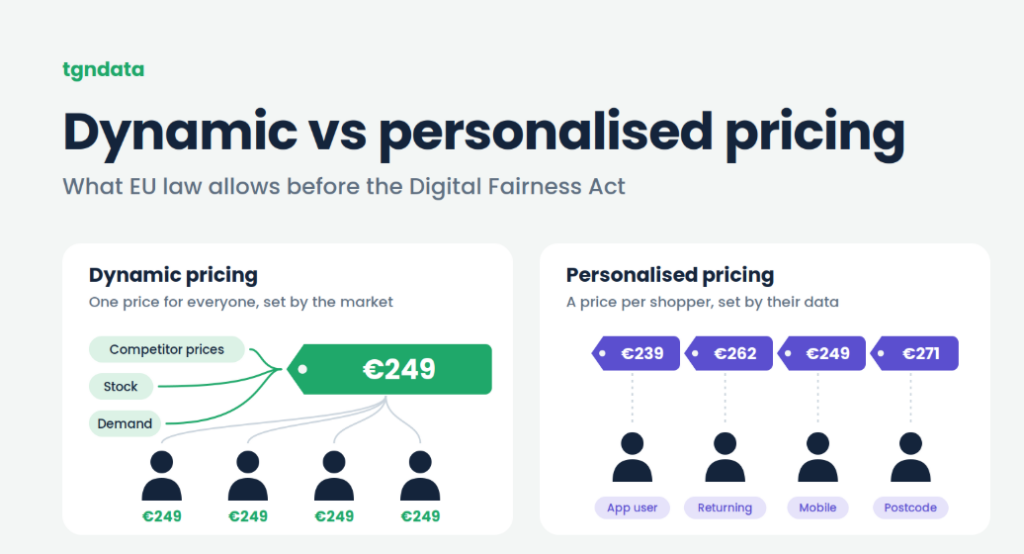
Pricing intelligence provides the data, validation, and insights that inform decisions. Dynamic pricing is the execution mechanism that automatically adjusts prices based on predefined rules or AI algorithms. Intelligence guides. Dynamic pricing implements.
Incorrect competitor data can trigger harmful pricing decisions. Validation layers filter out anomalies, detect outliers, and ensure accuracy before insights influence automation, protecting margin and brand positioning.
Ecommerce retailers, omnichannel brands, SaaS companies, B2B distributors, consumer goods manufacturers, and marketplace focused sellers all benefit from structured competitor visibility and elasticity modeling.
In highly competitive ecommerce and marketplace environments, near real time or hourly updates are ideal. Slower industries may operate with daily updates. Frequency should match revenue sensitivity and market volatility.
It depends on technical capacity and scale. Large enterprises may build internal systems, but many organizations choose hybrid or specialized platforms to ensure data reliability and faster time to value.
Pricing intelligence in 2026 is infrastructure. It connects market signals to execution systems. It protects margin. It improves speed. It strengthens competitive positioning.
Organizations that rely on static dashboards will continue reacting. Those that operationalize validated, automated, AI enabled pricing intelligence will lead.
If your organization is evaluating maturity, begin with a structured assessment of data accuracy, update frequency, elasticity modeling capability, and workflow integration.
tgndata supports companies building pricing intelligence infrastructure that moves beyond monitoring into measurable revenue performance.
The next competitive advantage is not simply lower prices. It is smarter, faster, data validated pricing decisions.
We use cookies to provide you with an optimal experience, for marketing and statistical purposes only with your consent, which you may revoke at any time. Please refer to our Privacy Policy for more information.










Missing an important marketplace?
Send us your request to add it!