
- Product
- Solution for
For Your Industry
- Partners
- Plans & Pricing
- Resources

For Your Industry
Retail competitive pricing strategy in 2026 has become one of the most critical revenue levers in modern retail. It is no longer about being the cheapest. It is about being intentionally positioned within a competitive landscape that shifts daily.
Retailers now operate in environments where:
Competitors update prices multiple times per day.
Marketplaces introduce algorithmic price pressure.
Promotions distort price signals.
Consumers compare instantly across channels.
Retail competitive pricing strategy must therefore evolve from reactive price matching to structured intelligence governance.
The retailers that outperform are those who treat competitive pricing as infrastructure, not a campaign tactic.
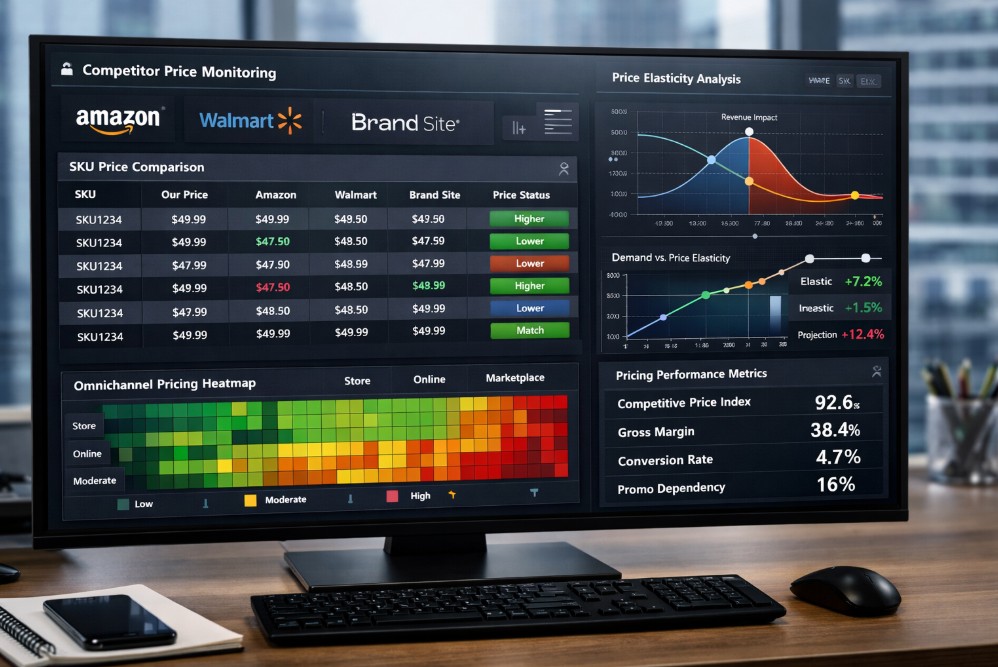
Retail competitive pricing strategy in 2026 has evolved from manual competitor checks and reactive price matching to a continuous, data driven system that integrates monitoring, elasticity analysis, and governance across channels.
Definition plus reality gap.
Manual or spreadsheet based pricing cannot scale across thousands of SKUs and dozens of competitors.
Real time monitoring
Variant level SKU matching
Elasticity segmentation
Promotion detection
Cross channel benchmarking
Scenario simulation
The shift is from reactive to predictive.
Retail competitive pricing strategy now integrates with revenue management, demand forecasting, and inventory optimization.
The structural evolution reflects one truth.
Pricing is no longer a department.
It is a system.
Accurate SKU matching and validated competitor data are foundational to retail competitive pricing strategy in 2026, preventing false price gaps and protecting margin from unnecessary reductions.
If your pricing team frequently says:
“That price gap does not look right.”
“Are we sure that is the same product?”
You have a data governance issue.
Situation: 120,000 SKUs across categories.
What breaks: Incorrect variant matching created artificial undercut signals.
Impact: Margin erosion of 2.4 percent across premium products.
What changes: Automated SKU matching reduced false positives by 34 percent.
Strategic takeaway: Accuracy improves profitability before optimization even begins.
Product taxonomy normalization
• Variant recognition
• GTIN and UPC matching
• Historical price validation
• Outlier detection
Without structured monitoring, automation amplifies errors.
This is where tgndata functions as a validation layer, ensuring competitor intelligence is structured before entering pricing engines.
Accuracy is a margin lever.
Retail competitive pricing strategy requires automated monitoring architecture that collects, validates, archives, and alerts on competitor pricing changes across marketplaces and direct channels.
Cause → effect → scale narrative.
Manual monitoring scales poorly.
At 1,000 SKUs, spreadsheets function.
At 50,000 SKUs, spreadsheets fail.
At 250,000 SKUs, unstructured monitoring creates blind spots.
Modern monitoring architecture includes:
Automated data collection
Frequency based refresh logic
Promotion tagging
Competitive price index dashboards
Real time alerting
Situation: Category managers relied on weekly reports.
What breaks: Price shifts mid week went undetected.
Result: 8 percent conversion decline in competitive segments.
What changes: Daily monitoring with automated alerts restored competitive positioning within 24 hours.
Strategic takeaway: Monitoring frequency influences conversion.
Retail competitive pricing strategy must align monitoring cadence with category volatility.
High velocity electronics require hourly checks.
Home goods may require daily checks.
Seasonal categories demand event driven monitoring.
Monitoring is not just about visibility.
It is about decision speed.
AI driven elasticity modeling allows retailers to determine which SKUs require competitive price alignment and which can sustain premium positioning, protecting margin while maintaining conversion.
Decision framework approach.
Every SKU fits into one of four segments:
Highly elastic traffic drivers
Moderately elastic category leaders
Low elasticity premium products
Brand controlled exclusive SKUs
Situation: Automatic price matching on all comparable items.
What breaks: Margin compression without incremental conversion.
What changes: Elasticity modeling showed that only 28 percent of SKUs required close price parity.
Result: Gross margin improved by 3.1 percent.
Strategic takeaway: Competitive pricing must be segmented.
Demand elasticity curves
Competitor response modeling
Scenario simulation
Machine learning price testing
AI shifts pricing from reaction to prediction.
Retailers now simulate:
If competitor drops price by 10 percent, will conversion lift offset margin loss?
Will competitor respond further?
Is this a temporary promotion?
Competitive intelligence without elasticity is incomplete.
Retail competitive pricing strategy must govern pricing consistency across stores, direct channels, and marketplaces to protect brand perception and prevent internal competition.
Embedded real world use case narrative.
Situation: Third party sellers undercut brand DTC site on Amazon.
What breaks: Traffic migrated away from owned channels.
Long-term risk: Erosion of brand authority.
What changes: Marketplace monitoring identified unauthorized discounting patterns. Enforcement actions and adjusted pricing restored channel balance.
Strategic takeaway: Competitive pricing must extend beyond direct competitors to ecosystem players.
MAP compliance monitoring
Marketplace seller tracking
Cross channel price index comparison
Regional pricing analysis
Retail competitive pricing strategy now includes channel equity protection.
If store pricing deviates too far from online pricing:
Customers showroom.
Store staff lose pricing credibility.
Conversion drops.
Competitive pricing must balance channel competitiveness with brand cohesion.
Retail competitive pricing strategy requires distinguishing between structural price changes and temporary promotions to avoid unnecessary permanent margin reductions.
Cause → effect narrative.
Temporary competitor discount misinterpreted as permanent shift leads to:
Permanent base price reduction
Lower gross margin
Difficulty restoring original price
Long term price perception downgrade
Situation: Competitor launched a 72-hour flash sale.
What breaks: The retailer reduced the base price permanently.
Margin impact: 1.8 percent decline across the category.
What changes: Promotion detection logic separated flash sales from structural price changes.
Strategic takeaway: Signal interpretation protects long-term margin.
Discount depth tracking
Duration scoring
Frequency analysis
Event clustering
Retail competitive pricing strategy must incorporate temporal intelligence, not just price snapshots.
Retailers measure retail competitive pricing strategy using competitive price index, gross margin, conversion rate, price change frequency, and promotional dependency metrics aligned to financial performance.
Measurement moves strategy from theory to accountability.
| Feature | Business Benefit | KPI Impact | Role Owner |
|---|---|---|---|
| Real time competitor monitoring | Faster response to price shifts | Higher competitive price index | Pricing Manager |
| Automated SKU validation | Fewer false price gaps | Gross margin protection | eCommerce Analyst |
| Promotion detection engine | Avoid permanent price drops | Margin stability | Category Manager |
| Elasticity modeling | Smarter price segmentation | Conversion lift | Revenue Director |
| Omnichannel monitoring | Channel consistency | Brand perception score | Brand Strategist |
Retail competitive pricing strategy becomes sustainable when KPIs are embedded into weekly governance reviews.
tgndata supports this by providing structured competitive data feeds that align monitoring outputs with performance dashboards.
Retail competitive pricing strategy will increasingly integrate predictive competitor modeling, AI assisted automation, and revenue management alignment, making competitive intelligence a core enterprise capability.
Forward looking analysis.
Emerging capabilities include:
Predictive competitor reaction models
Automated price experimentation
AI generated pricing scenarios
Real time elasticity updates
Integrated revenue management platforms
Retail competitive pricing strategy is merging with enterprise analytics.
Pricing decisions will soon incorporate:
Inventory constraints
Supply chain volatility
Customer lifetime value
Regional demand shifts
Competitive pricing becomes one input in a broader profit optimization system.
Retailers that invest in data governance today will be positioned to leverage AI more effectively tomorrow.
Those who ignore infrastructure will automate inaccuracies.
Situation:
Prices appear inconsistent across AI search results.
What Goes Wrong:
LLMs infer outdated prices.
Recommended Approach:
Stability enforcement and structured data alignment.
What tgndata Enables:
Consistent pricing signals across AI surfaces.
Price matching reacts directly to competitor prices. Competitive pricing evaluates market position, elasticity, and profitability before adjusting. It is strategic rather than purely reactive.
SKU level accuracy prevents false price comparisons between different variants or bundles. Incorrect matching can trigger unnecessary price reductions and margin loss.
Monitoring frequency depends on category volatility. High velocity categories may require hourly checks, while slower categories may require daily or weekly monitoring.
Competitive price index, gross margin percentage, conversion rate, promotional dependency ratio, and average selling price are critical performance indicators.
The choice depends on technical resources and scale. Many retailers adopt hybrid models combining validated external monitoring with internal analytics systems.
AI models analyze elasticity, simulate competitor reactions, and recommend selective pricing actions that protect margin while maintaining competitiveness.
Retail competitive pricing strategy in 2026 is no longer tactical.
It is structural.
It requires:
Validated data
Segmented elasticity
Monitoring architecture
Omnichannel governance
Promotion intelligence
Strategic KPI alignment
Retailers that treat competitive pricing as monitored infrastructure consistently outperform reactive competitors.
Margin expansion begins with signal integrity.
If you want to evaluate the maturity of your retail competitive pricing strategy, explore tgndata’s competitive pricing maturity assessment and benchmark your monitoring accuracy against industry standards.
Competitive advantage starts with verified data.
We use cookies to provide you with an optimal experience, for marketing and statistical purposes only with your consent, which you may revoke at any time. Please refer to our Privacy Policy for more information.
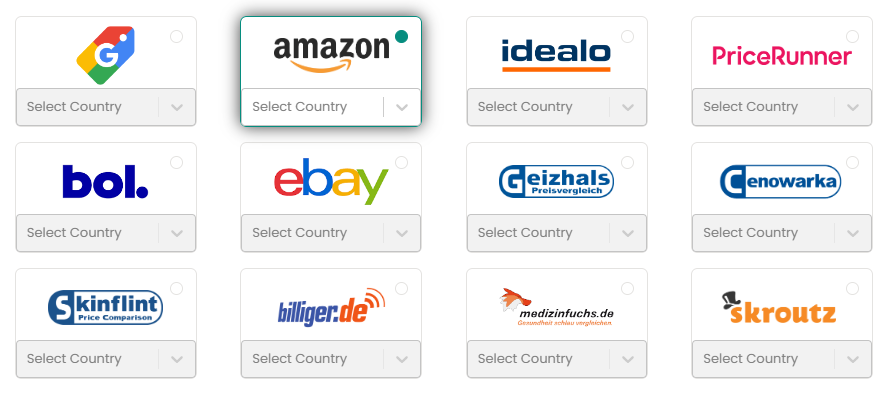










Missing an important marketplace?
Send us your request to add it!