
- Product
- Solution for
For Your Industry
- Partners
- Plans & Pricing
- Resources

For Your Industry
Pricing data is only valuable if it improves decisions.
Many retailers, ecommerce teams, and brands invest in pricing intelligence platforms expecting sharper pricing strategy, faster reactions to competitors, stronger margins, and more market visibility. But in practice, many teams end up with incomplete datasets, delayed updates, poor product matching, and dashboards that create more noise than insight.
The problem is not that pricing intelligence does not work.
The problem is that not all pricing data vendors deliver actionable, decision-ready intelligence.
If your team relies on competitor monitoring, dynamic pricing, MAP compliance, assortment benchmarking, or marketplace visibility, your pricing data vendor directly impacts revenue outcomes.
This checklist helps ecommerce leaders, pricing teams, and category managers evaluate whether their current vendor is delivering real business value or simply delivering data.

Pricing decisions are increasingly complex.
Retailers and brands now compete across:
Poor pricing visibility creates downstream problems across the business.
These include:
A weak pricing data vendor can quietly become a strategic liability.
That is why evaluating vendor quality should go beyond basic coverage claims or dashboard screenshots.
The real question is:
Can your pricing intelligence partner help your business act with confidence?
Use the checklist below to assess whether your current provider is creating measurable business value.
Accuracy is the foundation of pricing intelligence.
If your team cannot trust the data, every downstream pricing decision becomes risky.
Questions to Ask
High-value pricing data vendors invest heavily in:
Without these capabilities, pricing teams often waste time manually cleaning or verifying data.
Pricing moves quickly.
If your data is delayed, your pricing strategy becomes reactive instead of proactive.
This is especially critical in:
A price change discovered 24 hours late may already have impacted:
Strong pricing intelligence should support near real-time awareness where needed.
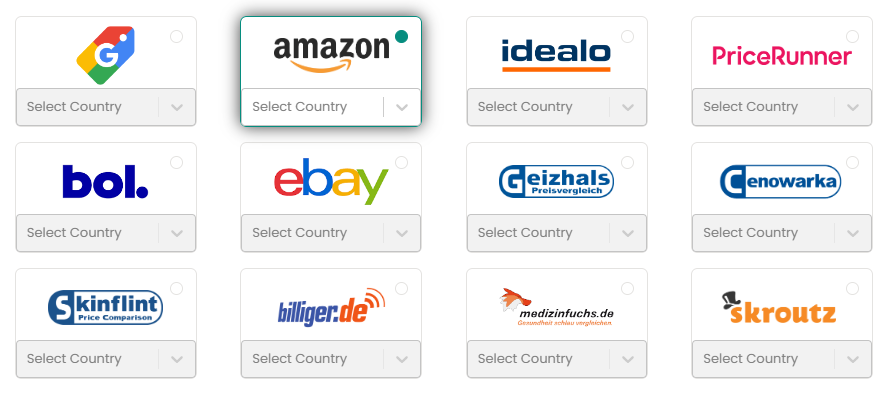
Many vendors claim extensive coverage but only monitor a narrow subset of retailers or marketplaces.
Your pricing visibility is only as good as your market coverage.
Coverage gaps create blind spots that can distort pricing strategy.
Product matching is one of the hardest problems in pricing intelligence.
A vendor that cannot accurately match products across retailers will create unreliable comparisons.
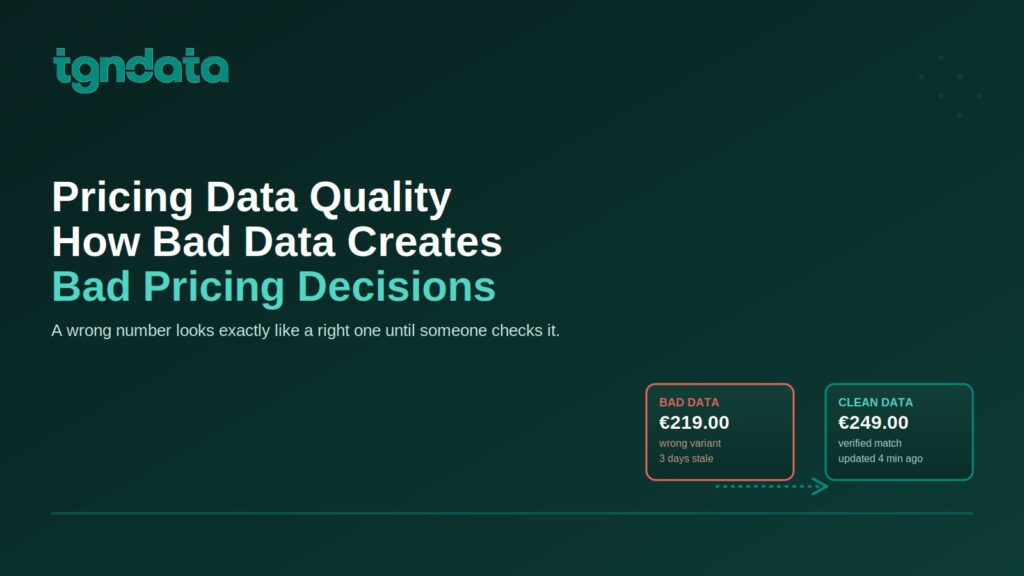
Inaccurate matching creates false pricing signals.
For example:
These errors can lead to poor pricing decisions and unnecessary margin reductions.
Some vendors stop at data collection.
But raw pricing feeds alone rarely create business value.
Your pricing intelligence platform should help your team identify opportunities, risks, and strategic actions.
The goal is not just data collection.
The goal is faster and better commercial decisions.
Pricing intelligence should improve profitability, not just visibility.
A valuable vendor helps teams avoid unnecessary price wars while remaining competitive.
Strong pricing data enables:
Without actionable pricing intelligence, many retailers default to reactive discounting.
Different organizations use pricing intelligence differently.
A generic platform may not support your operational reality.
Retailers may need:
Brands may prioritize:
Manufacturers may focus on:
The best pricing data vendors understand the commercial realities behind the data.
Even high-quality data loses value if teams struggle to use it.
Pricing intelligence should be accessible to commercial users, not only technical analysts.
Usability directly impacts adoption.
And adoption impacts ROI.
Pricing intelligence becomes more powerful when connected to broader business workflows.
Disconnected pricing data often creates operational silos.
Integrated pricing intelligence enables faster decision-making.
Pricing intelligence is not a “set it and forget it” category.
Your business evolves.
Competitors change.
Marketplaces shift.
Your pricing data partner should help you adapt.
Strong pricing intelligence partners often act as extensions of your pricing or ecommerce team.
They help clients:
What works for a small monitoring program may fail at enterprise scale.
As your business grows, pricing intelligence requirements become more complex.
A scalable pricing intelligence platform reduces the need for future vendor replacement.
You can use a simple evaluation model to assess vendor performance.
| Category | Score Range |
|---|---|
| Data Accuracy | 1-5 |
| Freshness | 1-5 |
| Market Coverage | 1-5 |
| Product Matching | 1-5 |
| Actionable Insights | 1-5 |
| Margin Support | 1-5 |
| Usability | 1-5 |
| Integrations | 1-5 |
| Transparency | 1-5 |
| Strategic Support | 1-5 |
| Scalability | 1-5 |
Suggested Interpretation
The goal is not perfection. The goal is ensuring your pricing intelligence investment creates measurable business value.
Many businesses tolerate weak pricing intelligence longer than they should.
Common warning signs include:
These problems reduce confidence in pricing decisions and create operational inefficiencies.
Organizations with mature pricing intelligence capabilities usually share several characteristics:
The focus is not collecting more data.
It is improving commercial decisions.
Pricing visibility supports:
High-performing teams understand that pricing automation only works if the underlying data is trustworthy.
The best teams operationalize pricing insights across:
tgndata helps retailers, brands, and ecommerce businesses transform pricing data into actionable competitive intelligence.
Instead of relying on fragmented or unreliable market visibility, businesses can monitor competitor pricing, track market movements, and identify strategic pricing opportunities with greater confidence.
Key areas where pricing intelligence platforms like tgndata can support business growth include:
For businesses operating in fast-moving ecommerce environments, pricing visibility is no longer optional.
It is a competitive requirement.
A pricing data vendor provides businesses with competitor pricing information, market pricing visibility, and pricing intelligence tools that help support strategic pricing decisions.
Inaccurate pricing data can lead to poor pricing decisions, reduced margins, incorrect competitor analysis, and inefficient promotional strategies.
Businesses should evaluate pricing intelligence platforms based on data accuracy, freshness, product matching quality, market coverage, usability, integrations, and strategic insight capabilities.
The required refresh rate depends on the industry and competitive environment. Fast-moving ecommerce categories may require intraday or near real-time updates.
Yes. Accurate pricing intelligence helps businesses optimize pricing decisions, avoid unnecessary discounting, improve promotional timing, and protect margins.
Pricing intelligence should do more than generate spreadsheets.
A strong pricing data vendor helps your business:
If your current vendor cannot reliably support these outcomes, it may be time to reevaluate your pricing intelligence strategy.
The businesses that win in e-commerce increasingly rely on accurate, actionable, and scalable pricing intelligence.
And the quality of your pricing data partner directly impacts how effectively you compete.
Want to evaluate how your current pricing intelligence setup compares?
Talk to tgndata about improving your market visibility, competitor monitoring, and pricing intelligence strategy.
We use cookies to provide you with an optimal experience, for marketing and statistical purposes only with your consent, which you may revoke at any time. Please refer to our Privacy Policy for more information.










Missing an important marketplace?
Send us your request to add it!