
- Product
- Solution for
For Your Industry
- Partners
- Plans & Pricing
- Resources

For Your Industry
Buy Box stock availability now shapes eligibility as much as price does, sometimes more. Losing the Buy Box is not always about your own price. When a competing seller runs out of stock, or restocks after being out, Buy Box eligibility and rotation shift, even if your price and inventory haven’t moved at all. As of 2025, Amazon’s Buy Box algorithm weighs price at roughly 25%, down from an estimated 40-50% before 2025, while delivery speed and inventory depth now carry comparable or greater weight. Stockouts trigger automatic suppression, and inventory levels below a seller’s 7-day demand forecast can trigger it too.
Most sellers monitor their own inventory closely and their competitors’ prices closely. Far fewer monitor their competitors’ stock status at all. That gap is exactly where Buy Box share quietly changes hands.
A lost Buy Box means a competitor is winning it. A suppressed Buy Box means no one is winning it. Suppression happens when none of the available offers meet Amazon’s value bar, whether because of price, poor seller metrics, or stock issues, and shoppers see “See All Buying Options” instead of an Add to Cart button.
This distinction matters for how a team should react. If the Buy Box is lost to a specific competitor, the fix is competitive: reprice, improve fulfillment speed, or wait for that competitor’s position to change. If it’s suppressed entirely, no seller is currently winning it, which often means there’s an opening the moment one seller’s metrics (price, stock, or delivery) clear the bar first.
Two very different problems produce the same symptom: a missing Buy Box. Treating them the same way wastes the reaction.
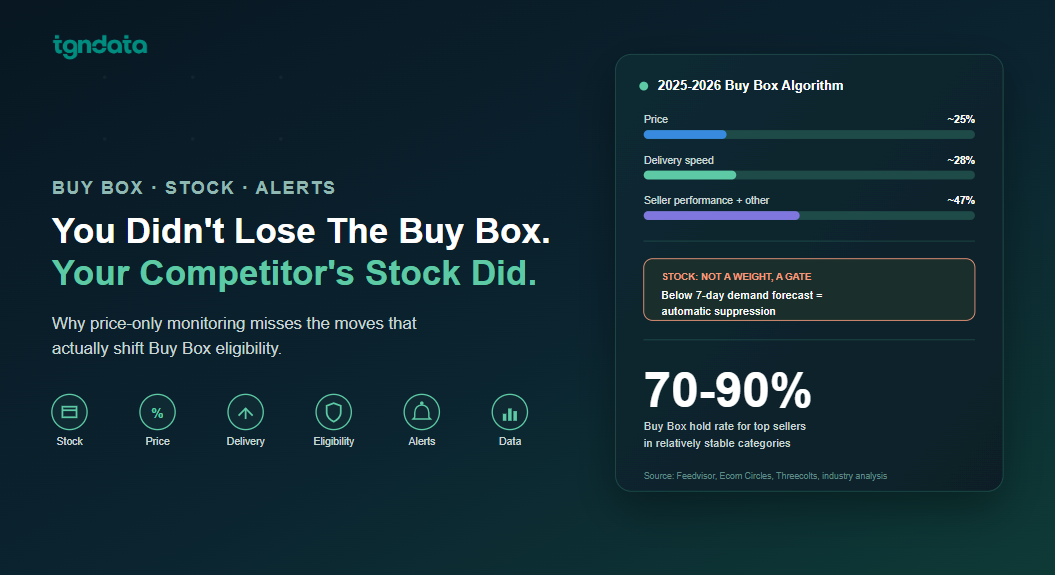
Stock availability affects Buy Box outcomes in both directions. When a competing seller goes out of stock, they lose Buy Box eligibility immediately and the box rotates to another qualifying seller, sometimes one that wasn’t winning it a day earlier. When that same competitor restocks, they re-enter eligibility and can reclaim share from sellers who didn’t adjust in response.
Industry analysis of the 2025 Buy Box algorithm update found inventory levels below a seller’s 7-day demand forecast can trigger automatic suppression, independent of price. Amazon’s tightened storage limits, reduced from 6 months of forecasted sales to 5 as of May 2025, have made maintaining consistent inventory depth harder for many sellers, which means stock-driven Buy Box shifts are becoming more frequent, not less.
A price monitoring setup that ignores competitor stock status is only watching half of what actually moves the Buy Box.
Based on multiple industry analyses of Amazon’s post-2025 Buy Box algorithm:
Top-performing sellers in relatively stable categories typically hold the Buy Box 70-90% of the time. That range exists precisely because stock and delivery consistency, not just price, determine who stays in that top band and who drops out of it.
Price is now one of at least four comparably weighted signals. A monitoring strategy still built around price alone is optimizing for a shrinking share of the algorithm.
Consider a general scenario common across electronics and home goods categories, not a specific named case: two sellers hold roughly equal Buy Box share on a competitive SKU, both pricing within a few percent of each other. One seller’s stock dips below their 7-day demand forecast during a demand spike. Automatic suppression kicks in for that seller, and the Buy Box shifts to the second seller, who does nothing differently in price or listing quality. Days later, the first seller restocks and gradually reclaims share, unless the second seller has already captured enough sales velocity and review momentum to hold the advantage.
Neither seller’s price changed at any point in this sequence. The entire shift was driven by stock timing that neither side could see happening at the other, unless they were actively monitoring it.
If price is the only signal on your dashboard, this entire sequence looks like unexplained Buy Box volatility instead of a predictable, trackable event.
No. The same dynamic applies anywhere a marketplace or comparison shopping engine uses “in stock” status as a ranking or eligibility signal, including Google Shopping, idealo, bol.com, and other marketplace listings. A competitor going out of stock on any of these channels creates a visibility opening; a competitor restocking closes one. The Amazon Buy Box is simply the most studied and highest-stakes version of a pattern that shows up across every channel where availability affects placement.
For a broader breakdown of how price and availability interact across Buy Box and channel visibility generally, see Buy Box Strategy: How Price & Availability Win.
Every channel that ranks by availability has its own version of this blind spot. Amazon just makes it easiest to measure.
Closing this gap doesn’t require watching every competitor manually. It requires the right combination of signals, tracked together rather than separately:
For a breakdown of which specific alerts matter most and how to avoid alert fatigue while tracking all of this, see Price Monitoring Alerts: Which Alerts Ecommerce Teams Need Now.
Tracking price and stock as two separate, disconnected signals misses the exact moments when they interact to move the Buy Box.
Price monitoring alerts create noise when they notify teams about changes that do not require action. Too many alerts make teams slower because they stop trusting the system.
Common low-value alerts include:
For example, a category manager does not need 200 notifications about minor changes across low-volume SKUs. The manager needs a smaller number of alerts that show where price position, margin, or compliance risk changed.
A noisy alert system becomes a second inbox. A useful alert system becomes a pricing workflow.
A price monitoring alert dashboard should help teams move from detection to decision. The dashboard should not only list alerts, it should rank them by urgency and business impact.
A useful dashboard should show:
An ecommerce director reviewing weekly pricing performance should be able to see which alerts were acted on, which were ignored, and which competitors triggered the most pricing pressure.
The dashboard should make pricing priorities visible before the team opens a spreadsheet.
Buy Box eligibility depends on multiple signals beyond price, including inventory depth, delivery speed, and seller performance metrics. A competitor’s stock change, price change, or delivery improvement can shift the Buy Box even when your own listing hasn’t changed at all.
A lost Buy Box means a specific competitor is winning it. A suppressed Buy Box means no seller currently meets Amazon’s value bar, and shoppers see “See All Buying Options” instead of a direct purchase button.
Industry analysis puts price at roughly 25% of the current algorithm, down from an estimated 40-50% before 2025, with delivery speed and inventory depth now carrying comparable or greater weight.
Yes. Inventory levels below a seller’s 7-day demand forecast can trigger automatic suppression, independent of price or other metrics, according to industry analysis of the current algorithm.
Yes. Any marketplace or comparison shopping engine that uses stock status as a ranking or eligibility signal, including Google Shopping and major European marketplaces, shows a similar pattern where competitor stock shifts affect visibility.
Automated price and availability monitoring tools can track competitor stock status alongside price, generating alerts specifically when stock and price shift together, which is when Buy Box position is most likely to change.
We use cookies to provide you with an optimal experience, for marketing and statistical purposes only with your consent, which you may revoke at any time. Please refer to our Privacy Policy for more information.










Missing an important marketplace?
Send us your request to add it!