
- Product
- Solution for
For Your Industry
- Partners
- Plans & Pricing
- Resources

For Your Industry
A retail pricing calendar 2027 for European teams needs three dates for every event, not one: the day the promotion starts, the day its 30-day reference window opens, and the day your price data has to be clean. That matters because enforcement is real: in the European Commission’s coordinated check of Black Friday and Cyber Monday offers in late 2025, only 40% of the 314 online traders screened fully complied with EU price reduction rules. In 2027, Black Friday falls on Friday 26 November and its reference window opens on 27 October, so the promotions you run in the weeks before it decide how large a discount you can legally claim on the day.
Because in the EU, every announced discount is measured against the lowest price you applied in the 30 days before it, so each promotion on your calendar has a hidden second date: the day its reference window opens. Article 6a of the Price Indication Directive, inserted by the Omnibus Directive and in force across member states since May 2022, sets that rule. A typical ecommerce calendar lists Black Friday and Mother’s Day. A pricing calendar also has to show which earlier prices those discounts will be compared against.
The practical consequence is that promotions are not independent. If you cut a price for one event, that price can become the reference for the next event 30 days later, shrinking the discount you are allowed to advertise. tgndata covered the rule itself in depth in the 30-day lowest price rule; this article applies it to the full 2027 year.
Regulators are checking. Between November and December 2025, the European Commission and national consumer authorities screened online traders’ Black Friday and Cyber Monday offers. 94% of traders advertised discounts, at least 30% did not comply with the price reduction rules, a further 30% needed more information before authorities could judge, and only 40% were fully compliant. Of the traders using price comparisons, six in ten did not clearly explain the reference price.
Methodology note: These figures come from the European Commission’s published results of its 2025 consumer protection sweep. Authorities from 25 countries and the Commission screened 314 online traders’ pricing practices during the Black Friday and Cyber Monday period of November and December 2025. The sample was selected by enforcement authorities, not drawn at random, so it indicates enforcement focus rather than the compliance rate of the whole market.
Takeaway: the useful unit of planning is not the event but the event plus its 30-day shadow.
The 2027 calendar has three dense clusters for European pricing teams: January sales, a spring gifting cluster from Easter to Mother’s Day, and a Q4 run from October through Christmas, with Greece and Belgium adding market-specific sales periods. The table below lists each date with the day its reference window opens.
| Date (2027) | Event | Main markets | Window opens* | Pricing note |
|---|---|---|---|---|
| Mon 11 Jan to Sun 28 Feb | Winter sales (statutory) | Greece | 12 Dec 2026 | December promotions set the reference |
| Early January | Winter sales period (January) | Belgium | Early December | Waiting-period rules weakened, see Belgium |
| Sun 14 Feb | Valentine’s Day | DE, NL, BE, GR | 15 Jan | Gifting categories; usually premium-led |
| Fri 26 to Mon 29 Mar | Easter weekend (Easter Sunday 28 Mar) | DE, NL, BE | 20 Feb for a 22 Mar start | Short window after January clearance |
| Tue 27 Apr | Koningsdag | NL | 28 Mar | Sits inside the Mother’s Day window |
| Sun 2 May | Orthodox Easter | GR | 2 Apr | Five weeks after Western Easter |
| Thu 6 May | Ascension Day and Vatertag | DE | 6 Apr | Outdoor, grills, drinks |
| Sun 9 May | Mother’s Day | DE, NL, BE, GR | 3 Apr for a 3 May start | Collides with Koningsdag and Orthodox Easter |
| Sun 20 Jun | Father’s Day | NL | 21 May | Gifting; often a light promotion |
| July (date not yet announced) | Amazon Prime Day | DE, NL, BE | 30 days before Amazon’s dates | Typically mid-July, unconfirmed |
| Thu 1 Jul onwards | Summer sales period (July) | Belgium | 1 Jun | Same caveat as January |
| Mon 12 Jul to Tue 31 Aug | Summer sales (statutory) | Greece | 12 Jun | Early-July promotions set the reference |
| Late Aug to mid Sep | Back to school (varies by German state and NL region) | DE, NL, BE, GR | 30 days before your start | Stagger by region |
| October (date not yet announced) | Amazon Prime Big Deal Days | DE, NL, BE | 30 days before Amazon’s dates | Typically early to mid October, unconfirmed |
| Thu 11 Nov | Singles Day | DE, NL, BE, GR | 12 Oct | Falls inside the Black Friday window |
| Mon 22 Nov | Typical Black Week start | All | 23 Oct | Window opens before most October events end |
| Fri 26 Nov | Black Friday | All | 27 Oct | Peak reference-price risk |
| Sun 28 Nov | Sunday trading after Black Friday | GR | n/a | Optional opening allowed under Greek law |
| Mon 29 Nov | Cyber Monday | All | 30 Oct | Usually extends the Black Friday price |
| Sun 5 Dec | Sinterklaas (pakjesavond) | NL, BE (6 Dec) | 5 Nov | Overlaps Black Friday stock and prices |
| Sat 25 Dec | Christmas Day | All | n/a | Late gifting; delivery promises matter |
*Window opens = first day of the 30-day reference period for a price reduction that starts on the event date (or the start date shown). Amazon has not announced its 2027 event dates; treat both Prime events as estimates.
Two dates in this table are estimates. Amazon has not announced Prime Day or Prime Big Deal Days for 2027, and in 2026 the October event ran on 6 and 7 October in 22 countries including Germany, the Netherlands and Belgium. Mark both as placeholders and update them once Amazon confirms.
Takeaway: print the window-opening column next to the event column, because that is the date your pricing team, not your marketing team, actually works to.
A collision happens when one event’s discounted price falls inside the next event’s 30-day reference window, and in 2027 there are at least four that European teams should plan around.
| Earlier promotion | Later event | Why they collide |
|---|---|---|
| Singles Day, 11 Nov | Black Friday, 26 Nov | 11 Nov is inside the window from 27 Oct |
| Prime Big Deal Days, October (estimate) | Black Week, from 22 Nov | Any event price after 23 Oct counts |
| Christmas promotions, mid to late Dec 2026 | Greek winter sales, 11 Jan | Window runs from 12 Dec |
| Koningsdag, 27 Apr | Mother’s Day, 9 May (NL) | Window for a 3 May start runs from 3 Apr |
| Early-July promotions or Prime Day | Greek summer sales, 12 Jul | Window runs from 12 Jun |
Here is how one collision plays out, as an illustrative example. A Dutch electronics retailer sells wireless headphones at a regular €129. It runs a Singles Day offer at €109 on 11 November and returns to €129 the next day. On Black Friday it wants to advertise €89. The reference price is now €109, the lowest price in the previous 30 days, so the claim is roughly 18% off, not 31% off €129. If the team had wanted to lead with “30% off” on Black Friday, the Singles Day promotion on that product was the decision that ruled it out.
[INSIDE IMAGE 1: retail-pricing-calendar-2027-singles-day-black-friday.png]
There are ways to plan around collisions. You can keep Singles Day and Black Friday on different product sets, run Singles Day as a non-price promotion such as a gift with purchase, or design one continuous campaign. Member states may allow a derogation for a series of uninterrupted, progressively increasing discounts, where the reference stays the price before the first reduction; check whether and how your market applies it before relying on it.
Takeaway: decide product by product which event gets the price cut, because a cut in one event shrinks the claim available in the next.
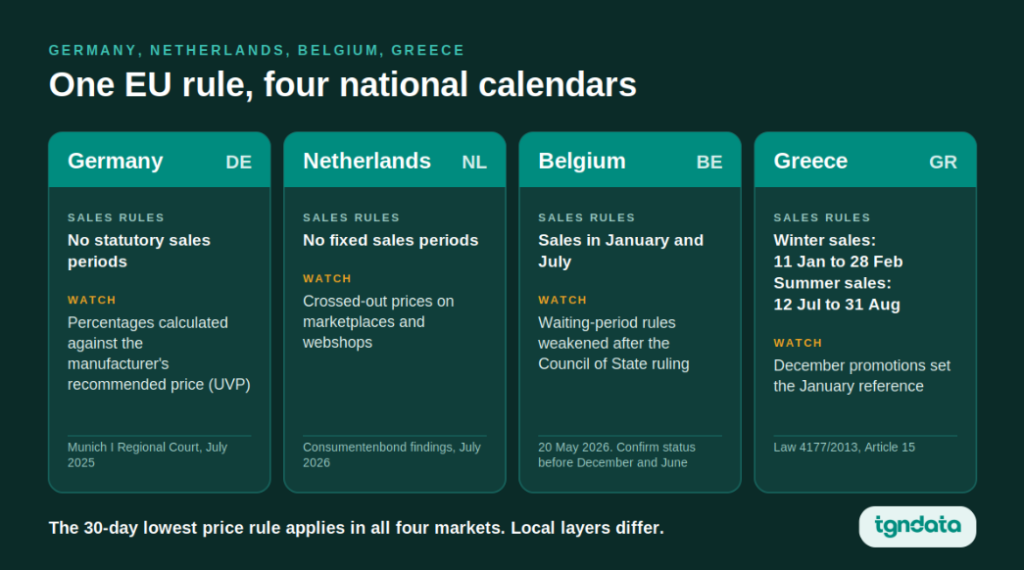
The 30-day rule applies across the EU, but Germany, the Netherlands, Belgium and Greece each add their own layer: German case law on recommended retail prices, Dutch consumer scrutiny of marketplaces, a Belgian court ruling that unsettled the sales-period regime, and Greek statutory sales periods.
Germany
Germany has had no statutory sales periods since 2004, so the 30-day rule in the Price Indication Ordinance (PAngV) is the main constraint. German courts read it strictly. In July 2025 the Regional Court of Munich I ruled, in a case brought by the Verbraucherzentrale Baden-Württemberg, that several of Amazon’s Prime Deal Days discounts were unlawful because they were calculated against the manufacturer’s recommended price (UVP) rather than Amazon’s own earlier price. Amazon said it would appeal. Showing a percentage against UVP during a promotion is the practice to review first.
Demand at peak is also flattening. The Handelsverband Deutschland (HDE) forecast €5.8 billion in German retail sales for Black Friday and Cyber Monday 2025, about 2% below the previous year and the first expected decline since its records began in 2016.
Methodology note: The HDE figure is a forecast, published in November 2025, supported by a survey that IFH Köln ran for HDE in October 2025 among more than 1,000 online shoppers. In that survey, 48% planned to shop on Black Friday and 54% planned to use it for Christmas purchases. It measures expected spending, not recorded sales.
Netherlands
The Netherlands also has no fixed sales periods, and scrutiny comes from consumer organisations as well as the ACM. In July 2026 the Dutch Consumentenbond reported that it had examined products advertised with a crossed-out price and a percentage discount on Amazon and Bol, and flagged 108 promotions where the product had been available more cheaply before the “discount”. Bol is a major Dutch marketplace, so its listings belong in any Dutch monitoring set alongside webshops.
Belgium
Belgium entered 2026 with the strictest sales regime of the four markets: statutory sales periods in January and July, and a waiting period, from 3 December to 2 January and from 1 to 30 June, during which clothing, footwear and leather goods retailers could not announce price reductions. On 20 May 2026, the Council of State ruled in three judgments that the ban on using terms such as solden, soldes or Schlussverkauf outside the official periods conflicts with the EU Unfair Commercial Practices Directive and must be set aside.
Law firms Stibbe and Andersen both note that the waiting period has largely lost its practical meaning as a result, while the general rules on announcing price reductions still apply. The federal consumer protection minister, Rob Beenders, said it made little sense to keep fining retailers under the waiting-period rules, and that the law will need to be adapted. The provision remains formally on the books, so fashion retailers planning promotions for December 2026 and June 2027 should confirm the status first.
Greece
Greece keeps statutory sales periods. Under Article 15 of Law 4177/2013, as amended by Law 4965/2022, winter sales run from the second Monday of January to the end of February, and summer sales run from the second Monday of July to the end of August. The intermediate periods in May and November were abolished in 2022. In 2027 that means 11 January to 28 February, and 12 July to 31 August. Shops may also open on the Sunday after the last Friday of November, which is 28 November 2027.
Penalties for misleading discounts are tied to turnover: Greek reporting on the rules cites fines of 2% of annual turnover, with a minimum of €20,000. Because the winter sales window opens on 12 December, Greek retailers who cut prices for Christmas are setting their January reference at the same time.
Takeaway: one EU rule, four national calendars, so a multi-market retailer needs a calendar per market, not one European calendar. tgndata’s guide to cross-border pricing covers the wider coordination problem.
Each quarter has a different job: Q1 cleans data and clears stock, Q2 manages a tight gifting cluster, Q3 runs clearance while preparing Q4, and Q4 is about sequencing collisions. The lock, test and watch structure below gives each quarter one decision to fix, one hypothesis to test, and one market signal to monitor.
Q1: clean the baseline
Q2: manage the gifting cluster
Q3: clear and prepare
Q4: sequence the collisions
Takeaway: if each quarter fixes one decision early, the next quarter starts with clean references instead of inherited problems.
Competitor reference windows are as visible as your own: if you track a rival’s price history, you can see when it cuts prices inside a window and estimate how deep its event discount can credibly go.
Three patterns are worth tracking across 2027:
Comparing these patterns by event, year on year, is more informative than comparing by calendar month, because event dates move. Black Friday 2026 was 27 November; in 2027 it is 26 November. Start with the products that matter most, using the method in how to prioritise SKUs for competitive monitoring.
Takeaway: the most predictive input for an event plan is how each competitor priced the same products in the 30 days before last year’s version of that event.
Build the 2027 calendar now, while 2026 peak data is still being collected, and attach a reference window and an owner to every event. Concrete steps:
Takeaway: a calendar that shows windows, collisions and owners is a pricing document; one that shows only dates is a marketing poster.
tgndata is price intelligence software for retailers and brands, and for calendar planning it supplies the two datasets the approach depends on: your own price history and your competitors’.
Takeaway: the calendar tells you when to decide; price history tells you what you are allowed to claim and what your competitors are likely to do.
The most important price monitoring alerts are competitor price drops, price increases, price gap changes, MAP violations, promotion changes, and stock availability shifts.
Pricing teams should receive competitor price alerts as soon as high-impact changes happen. Low-priority products can be reviewed in daily or weekly batches.
Stock data shows whether a competitor price is commercially relevant. An out-of-stock competitor price should not always influence your pricing decision.
Alert fatigue happens when pricing teams receive too many low-value notifications. It causes teams to ignore alerts, delay action, or miss important changes.
No. Ecommerce teams should review margin, competitor relevance, stock status, and product priority before matching a competitor price drop.

Free download
An 11-page booklet for pricing and ecommerce teams. Enter your work email and download it instantly.
We use cookies to provide you with an optimal experience, for marketing and statistical purposes only with your consent, which you may revoke at any time. Please refer to our Privacy Policy for more information.










Missing an important marketplace?
Send us your request to add it!