
- Product
- Solution for
For Your Industry
- Partners
- Plans & Pricing
- Resources

For Your Industry
AI Shopping Agents are now the leading tool European shoppers use to compare products: in Deloitte’s August 2026 survey of 13,500 consumers across 15 countries, 56% had already shopped with AI, and 57% of those AI users relied on it to compare products, ahead of marketplaces, retailer websites and stores. That makes your prices, stock and product data the first thing an agent weighs, often before a shopper ever reaches your site. It does not mean the cheapest offer automatically wins: a study of more than two million listings found Google’s AI Mode frequently shows a different, usually higher, price than classic search for the same product. Retailers need to know exactly where they stand on the products agents compare most.
AI shopping agents are AI assistants that research, compare and recommend products for a shopper, and in a few markets can also buy them; in Europe today, their main job is comparison, not checkout. They include general assistants such as ChatGPT, Gemini, Perplexity and Microsoft Copilot, search features such as Google AI Mode, and retailer-built assistants inside apps and websites.
The gap between the headlines and actual behaviour is large. commercetools’ Autumn 2026 radar, citing Forrester’s mid-2026 assessment, notes that most “agentic” experiences are still conversational: humans still make the decision and complete checkout in the vast majority of cases. OpenAI retired ChatGPT Instant Checkout in March 2026, according to Fast Company and Eco, shifting its model towards discovery in the chat and purchase on the merchant’s site. Google’s agentic checkout and Universal Cart launched in the US first, and Lengow reports Google has published no timeline for continental Europe.
What is live in Europe is AI-assisted comparison at scale. According to Verity Score, Google AI Mode reached more than 40 European countries on 8 October 2025, and France joined on 22 July 2026 after a regulatory hold. Google says AI Mode has passed one billion monthly users, as reported by Real Internet Sales. OpenAI, meanwhile, has expanded ChatGPT Ads to 31 European markets, positioned around the moments when people research and compare, according to commercetools.
For pricing teams, the practical definition is simple: AI shopping agents are a new comparison layer that sees your prices before your shoppers do.
More than half: 56% of European consumers have used AI to shop at least once, and AI is now the number one channel for comparing products among those who use it. Deloitte describes it as the fastest technology adoption European retail has seen, crossing 50% in about 18 months, against roughly five years for e-commerce and ten for smartphones.
Deloitte’s study found that among shoppers who use AI, 57% use it to compare products, ahead of marketplaces, retailer websites and the shop floor. Search still leads for research and social media for inspiration, and traditional channels still lead at the point of purchase. The implication Deloitte draws is that retailers now serve two customers: the human and the agent advising them.
Methodology: Deloitte surveyed 13,500 consumers across 15 European countries for its AI Maturity Index 2026, “The Human and the Agent”, published on 14 August 2026. The 57% figure is a share of AI-using shoppers, not of all consumers.
Adoption is uneven, which matters for multi-country retailers. According to commercetools’ summary of the Deloitte data, Spain, Poland, Hungary and Italy lead with shopper penetration above 60%, while the UK, France and Germany sit at 48% to 52%. Willingness to delegate is concentrated at the top of the funnel: 24% to 34% of consumers would hand comparison and price-finding tasks to AI, but that falls to 8% at checkout.
Germany shows how quickly trust is moving. commercetools reports that, in Deloitte’s German data, the share of AI users citing data and privacy as a top concern fell from 52% in 2025 to about 30% in 2026, while the share willing to switch retailers based on an AI recommendation rose from 22% to nearly 30%. Mastercard’s research across 13 European countries, covering 26,000 people including teenagers and parents, found 18% of teens already use an AI assistant weekly to compare products, against 10% of parents.
The price-comparison step is exactly the step shoppers are handing to AI, which puts your price position at the centre of the AI shopping journey.
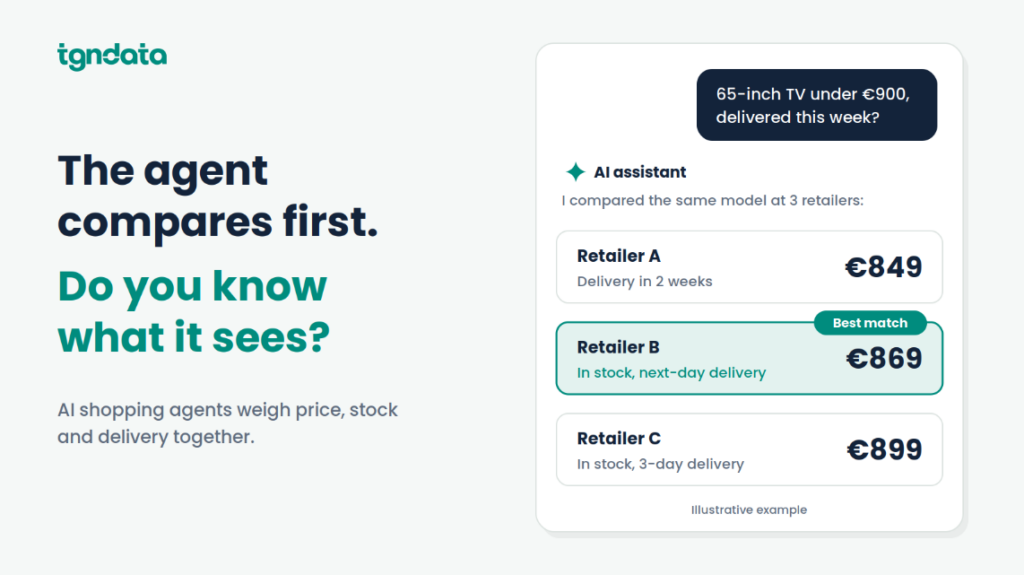
No: price is a major signal, but agents weigh it alongside availability, delivery, reviews and data quality, and the price they display is not always the lowest available. That is both a risk and an opportunity for retailers who are not the cheapest.
The clearest evidence comes from Productrise, which compared Google AI Mode with classic Google Search in August 2026. Among products that appeared on both surfaces for the same query on the same day, the displayed price differed 38.1% of the time. When it differed, AI Mode showed the higher price 68.4% of the time. Across all listings, the median AI Mode product cost $149 against $100 in classic search, a 49% gap. Only 1.28% of products ranking in classic search also appeared in AI Mode for the same search on the same day.
Methodology: Productrise tracked more than two million product listings across over 100,000 search results pages and AI Mode responses in the United States and the United Kingdom from 9 to 31 August 2026. Products were matched using Google’s product identifier for the same query on the same day, comparing the lead offer on each surface. Google has not independently verified the study; the company said all shopping results use its Shopping Graph and shoppers can click through to compare sellers, according to Real Internet Sales. Market note: this is US and UK data; no comparable study covering Germany, Benelux or Greece was found.
Two readings follow. First, the overlap figure means AI Mode surfaces a very different set of products from classic search, so ranking well in one does not guarantee visibility in the other. Second, a commentator quoted in the Productrise write-up observed that the retailer with the lowest price still tends to get the click in the end, even when a higher price is displayed in the AI grid. Price still decides the sale; it just no longer decides visibility on its own.
Being the cheapest will not guarantee a place in the agent’s answer, but being uncompetitive on price will make it hard to convert when you get there.
Because agents recommend from feeds and structured data, and a price that is out of date either misleads the shopper or gets your product filtered out before any agent can recommend it. The more comparison moves into AI answers, the less room there is for a feed that lags your website by a few hours.
Google’s Shopping Graph, which feeds its AI shopping experiences, holds more than 50 billion product listings, with 2 billion updated every hour, according to Google. That update rate is the standard your prices are compared against. Google’s Merchant Center Help explains that Googlebot compares feed prices with landing-page prices, and that products are disapproved when they do not match. If mismatches happen too often, Google stops automatic item updates for the account and may apply pre-emptive disapprovals, putting the whole account at risk. Google also warns that during big sales such as Black Friday, prices can change several times a day, which is exactly when mismatches spike.
The same logic applies to your competitors. An agent that shows a rival at a price they no longer charge, or recommends an offer that is out of stock, still shapes what your shopper expects to pay. The timing problem is covered in detail in delayed price updates and how often to update prices; the data-quality side in why bad pricing data wrecks decisions.
In an agent-led comparison, a price that is right but late is treated the same as a price that is wrong.
A clear, comparable advantage the agent can justify: a competitive price, confirmed availability, a fast delivery promise, or a combination of all three. Deloitte frames the task as being found, being chosen and being trusted, and “being chosen” is where pricing teams come in.
Deloitte’s guidance is that retailers need a genuinely comparable advantage on price, quality, trust or sustainability so the agent can justify recommending them, communicated in a way AI can interpret and compare. For most retailers, price and availability are the advantages that are easiest for an agent to read and hardest to fake. That does not mean racing to the bottom; price positioning without being the cheapest is still a valid strategy, provided the premium is explained by something the agent can see, such as stock on hand or next-day delivery.
Consider an illustrative scenario. A shopper asks an assistant for a 65-inch TV under €900 that can be delivered this week. The agent finds four retailers selling the same model: one at €849 with two-week delivery, one at €869 in stock with next-day delivery, one at €879 with free installation, and one at €899. A plausible recommendation is the €869 offer, not the cheapest, because it matches the full request. The retailer at €849 loses on delivery, and the one at €899 loses on price. This scenario is illustrative, built to show how agents combine signals; it is not drawn from a specific assistant’s output.
Availability is the signal retailers most often underestimate. As covered in competitor stock availability, a competitor stockout can make you the only valid answer, often without a price change.
AI shopping agents reward the offer that best matches the whole request, so price, stock and delivery have to be managed together, not in separate teams.
Five signals: your price index on the products shoppers compare most, competitor prices and stock across the channels agents read, price consistency across your own channels, competitor promotions, and delivery promises. These are the inputs an agent weighs, and all of them change daily.
1. Price index on high-intent SKUs. Agents are used most for considered purchases where shoppers compare. Identify the products where comparison is most likely, then track your price index against the competitors that appear alongside you. How to prioritise SKUs for competitive monitoring explains how to choose them.
2. Competitor prices and stock across webshops, marketplaces and Google Shopping. Agents draw on shopping feeds, product pages and marketplaces. Google Shopping monitoring matters here because Google’s AI shopping experiences are built on the same Shopping Graph that powers Shopping listings. Accurate product matching is what makes these comparisons valid.
3. Price consistency across your own channels. If your webshop, feed and marketplace listings show different prices for the same product, an agent may pick up the least favourable one, and Google may disapprove the listing. Marketplace vs DTC pricing covers how to keep channels aligned.
4. Competitor promotions. A time-limited promotion can move a competitor ahead in an agent’s answer for days. Track promotion depth and duration, not just base prices.
5. Delivery and availability. Monitor competitor stock status on your key SKUs, since a rival’s stockout is often the moment an agent switches its recommendation to you.
A price monitoring platform such as tgndata tracks these signals across competitor webshops, marketplaces and Google Shopping, keeps them in historical data, and alerts on real price and stock moves. tgndata does not monitor what individual AI assistants display; it monitors the market data those assistants draw on.
You cannot control what an agent says, but you can control whether your prices, stock and data give it a reason to choose you.
Europe has AI-assisted comparison at scale but very little agent checkout, which means the competitive battleground today is visibility and price position in AI answers, not payment integrations. Planning should follow what European shoppers can actually use.
| Capability | Europe (Sept 2026) | Source |
|---|---|---|
| Google AI Mode shopping answers | Live in 40+ European countries since Oct 2025; France since July 2026 | Verity Score |
| Google agentic checkout and Universal Cart | US-first; no published timeline for continental Europe | Lengow |
| ChatGPT Instant Checkout | Retired March 2026 | Fast Company, Eco |
| ChatGPT Ads | Expanded to 31 European markets | commercetools, citing OpenAI |
| Consumer willingness to let AI check out | 8% | commercetools, citing Deloitte |
Retailer-owned assistants are the other trend to watch. commercetools points to retailers such as Best Buy and Kohl’s launching their own assistants and to Home Depot rolling its assistant out to all its US stores. European retailers building their own assistants will face the same requirement: the assistant can only recommend confidently if pricing and stock data are current.
Treat AI shopping in Europe as a comparison channel that is already live, and a checkout channel that is still coming.
Get your price and stock data agent-ready, measure your price position on the products AI shopping agents compare most, and close the gaps before peak season. Here is how that breaks down by role.
Ecommerce Managers
Pricing Managers
Commercial Directors and Category Managers
Marketplace Managers
AI shopping agents do not change what wins a sale; they change how fast and how visibly the comparison happens.
AI shopping agents are AI assistants, such as ChatGPT, Google AI Mode, Gemini, Perplexity and Microsoft Copilot, that search, compare and recommend products for a shopper, and in some markets can complete the purchase. In Europe today they are used mostly for discovery and comparison, with the human still making the final decision and checking out on the retailer’s site.
Deloitte’s 2026 survey of 13,500 consumers in 15 European countries found that 56% have used AI to shop at least once, and among those AI users, 57% use it to compare products. Adoption varies by market: Spain, Poland, Hungary and Italy are above 60%, while Germany, France and the UK sit around 48% to 52%, according to commercetools’ summary of the findings.
No. A Productrise study of more than two million listings in the US and UK in August 2026 found that when Google’s AI Mode and classic search showed different prices for the same product, AI Mode showed the higher price 68.4% of the time. Price is an important signal, but agents also weigh availability, delivery, reviews and data quality, so being cheapest is not enough on its own.
Agents rely on product feeds and structured data, and an outdated price can lead to a wrong recommendation or no recommendation at all. Google Merchant Center, which feeds Google’s Shopping Graph, disapproves products whose feed price does not match the landing page, and repeated mismatches can trigger pre-emptive disapprovals across an account.
Only in limited cases so far. OpenAI retired ChatGPT Instant Checkout in March 2026, and Google’s agentic checkout and Universal Cart features launched in the US first, with no published timeline for continental Europe. Google AI Mode itself is available in more than 40 European countries, so AI-assisted comparison is already live even where agent checkout is not.
Retailers should monitor their price index against key competitors on the products shoppers compare most, competitor stock and delivery, price consistency across their own feed, website and marketplace listings, and competitor promotions. Price monitoring software such as tgndata tracks these signals across competitor webshops, marketplaces and Google Shopping, so teams can see where an agent is likely to rank them.
We use cookies to provide you with an optimal experience, for marketing and statistical purposes only with your consent, which you may revoke at any time. Please refer to our Privacy Policy for more information.










Missing an important marketplace?
Send us your request to add it!