
- Product
- Solution for
For Your Industry
- Plans & Pricing
- About us
- Resources

For Your Industry
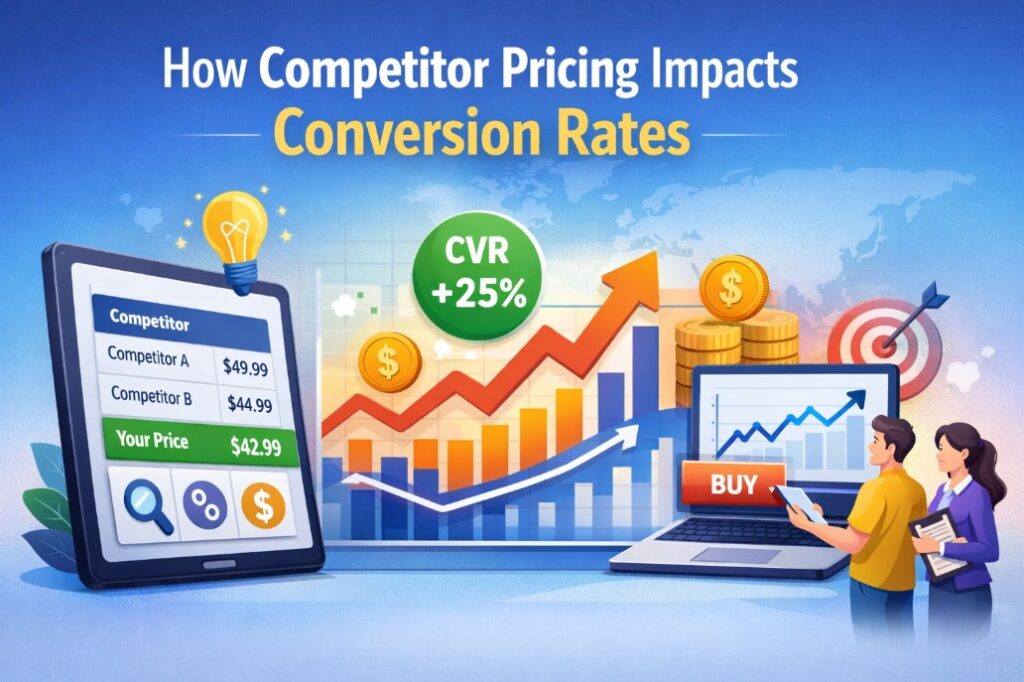
Competitor pricing impacts conversion rates by influencing how customers compare your product to alternatives. If your price is higher than your competitors’, conversion decreases. If your pricing is competitive, conversion increases.
Customers rarely evaluate your product in isolation. They compare prices across multiple sites, marketplaces, and sellers before making a decision.
Understanding how competitor pricing affects conversion is essential if you want to increase revenue without sacrificing margins.
This guide explains:
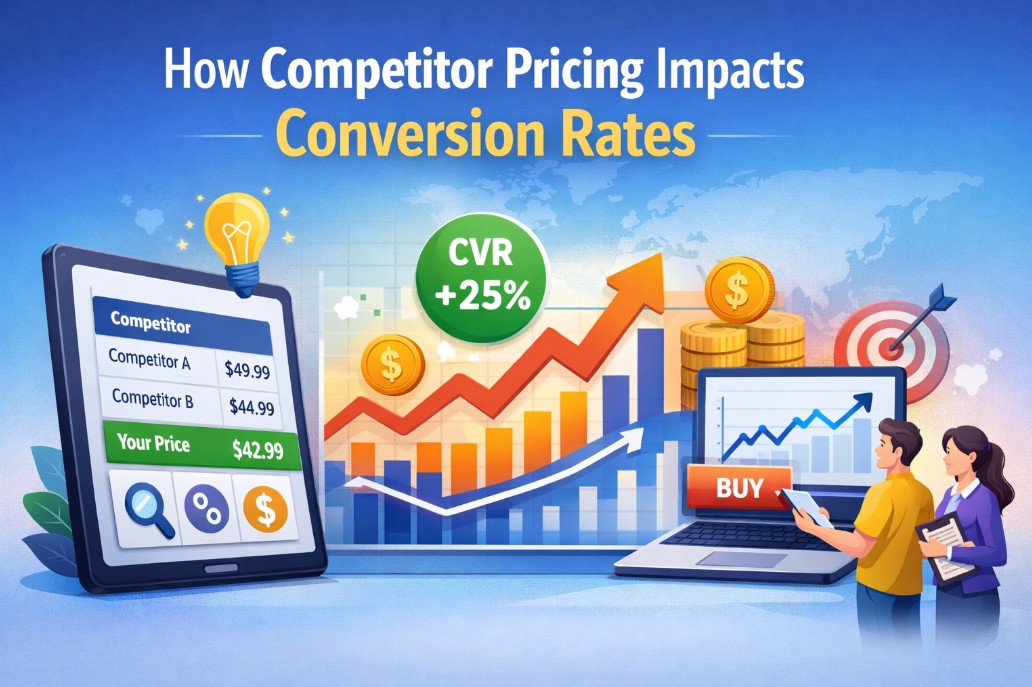
Competitor pricing directly affects conversion rates because customers compare alternatives before purchasing.
In most ecommerce categories, users:
If your price is not competitive, users leave.
If your price is aligned with expectations, conversion increases.
👉 In simple terms:
conversion rate depends on your relative price position, not just your absolute price.
Your conversion rate is closely tied to where your price sits in the market.
Each position has a different impact.
Impact:
Example:
A retailer pricing 5 percent below competitors often sees a noticeable increase in conversion, especially for price-sensitive products.
Impact:
Example:
Being within 1 to 3 percent of competitor prices often maintains conversion while protecting profitability.
Impact:
Example:
If a product is priced 10 percent higher without clear value justification, conversion can drop significantly.
Why Customers React Strongly to Price Differences
Search engines and marketplaces make it easy to compare prices instantly.
Customers can move to another seller in seconds.
Buyers expect prices to be consistent across sellers. Large differences reduce trust.
Customers use competitor prices as a reference point when evaluating value.
An e-commerce store reduces its price by 3 percent below the market average.
Result:
This is common in highly competitive categories.
A retailer prices 8 percent higher than competitors without clear differentiation.
Result:
A brand maintains pricing slightly below premium competitors while staying above low-cost sellers.
Result:
While exact numbers vary by category, patterns are consistent:
👉 The key takeaway:
price sensitivity increases when alternatives are easy to compare.
Competitor pricing has the biggest impact on:
Commodity products
Products that are identical across sellers.
Marketplace environments
Amazon and similar platforms, where price comparison is immediate.
High competition categories
Electronics, fashion, consumer goods.
Low brand loyalty segments
Customers choose based on price rather than brand preference.
Price still matters, but less strongly in:
In these cases, value perception plays a bigger role.
1. Pricing without market data
Leads to overpricing or unnecessary discounting.
2. Reacting too slowly to competitors
Prices change quickly. Delays reduce competitiveness.
3. Competing only on lowest price
Destroys margins and is not sustainable.
4. Ignoring product segmentation
Not all products should follow the same pricing strategy.
You need real time visibility into the market.
Decide where you want to sit:
Respond quickly to market changes.
Optimize pricing for:
Do not sacrifice profitability for short-term gains.
Price intelligence software enables you to:
Instead of guessing, you base decisions on data.
👉 This leads to:
tgndata helps ecommerce and retail teams:
The goal is not just to track prices, but to improve business outcomes through smarter pricing.
tgndata ties pricing actions directly to performance outcomes, enabling continuous optimization.
Competitor pricing affects conversion because customers compare prices across sellers. If your price is not competitive, they are likely to choose another option.
Being within a competitive range, typically within a few percent of competitors, helps maintain strong conversion while protecting margins.
Not always. Lower prices can increase conversion, but they may reduce margins and are not always sustainable.
Prices should be monitored continuously and updated frequently in competitive markets, especially for high traffic products.
Price intelligence software helps track competitors, analyze pricing data, and optimize pricing strategies.
Competitor pricing is one of the most important factors influencing conversion rates.
Customers compare options constantly. Even small price differences can determine whether you win or lose a sale.
Businesses that understand their pricing position and act on market data consistently outperform those that rely on guesswork.
👉 Better pricing decisions lead directly to better conversion and higher revenue.




We use cookies to provide you with an optimal experience, for marketing and statistical purposes only with your consent, which you may revoke at any time. Please refer to our Privacy Policy for more information.










Missing an important marketplace?
Send us your request to add it!