
- Product
- Solution for
For Your Industry
- Partners
- Plans & Pricing
- Resources

For Your Industry
Pricing has never been just about price. Yet most organizations still behave as if it is. They track competitor prices, build dashboards, and react to changes in visible numbers. But customers are not making decisions based on those numbers alone. They are evaluating a much richer equation that includes shipping costs, delivery speed, promotional incentives, and bundled value.
This mismatch creates a structural blind spot.
Companies believe they are competitive because their base price is aligned with the market. Meanwhile, competitors win by optimizing everything around that price.
To achieve true competitive insight, pricing teams must expand their scope. Monitoring price is no longer enough. What matters is understanding the full commercial offer.
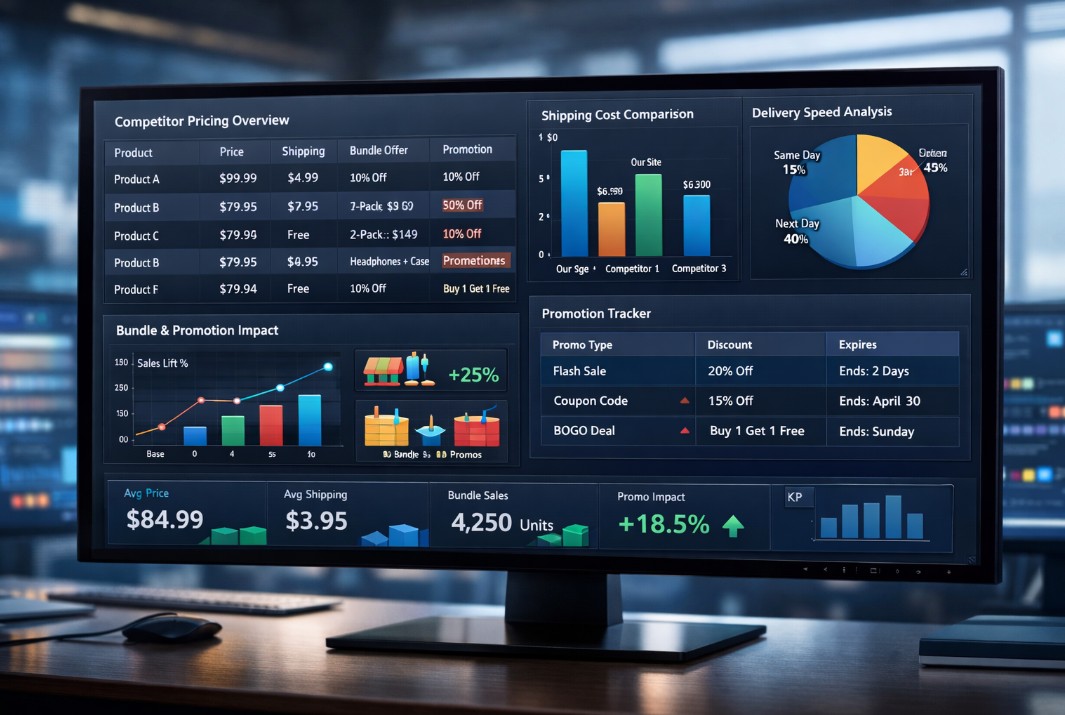
Price alone creates a false sense of competitiveness because it ignores total cost and perceived value. Customers consider shipping, delivery speed, promotions, and bundles when making decisions, so relying only on base price leads to inaccurate benchmarking and poor pricing strategies.
There is a fundamental disconnect between how businesses measure pricing and how customers experience it.
Internally, pricing is often reduced to a single number per SKU.
Externally, pricing is experienced as a complete offer.
A product listed at €90 may seem cheaper than one at €100.
But if:
Shipping is €15 versus free
Delivery takes five days instead of one
No promotion is available
Then the cheaper product is not actually more competitive.
Situation
A retailer aggressively matches competitor prices across key SKUs.
What breaks
Despite matching prices, conversion rates lag behind competitors.
What changes with full insight
Competitors offer same-day delivery and bundle accessories.
Strategic takeaway
Price parity does not equal competitiveness.
This is where many pricing strategies fail quietly. They optimize a metric that customers do not prioritize in isolation.
Shipping is a core pricing variable because it directly impacts total cost and delivery expectations. Customers often prioritize fast or free shipping over lower prices, making it essential to include shipping in competitive pricing analysis.
Shipping has evolved from an operational detail into a strategic pricing lever.
It influences:
Total purchase cost
Conversion likelihood
Customer satisfaction
When shipping is not competitive:
Cart abandonment increases
Price sensitivity increases
Brand perception weakens
At scale, this leads to revenue leakage that pricing teams often misattribute to price positioning.
Free shipping thresholds
Delivery speed guarantees
Geographic variability
Express vs standard options
Situation
An online fashion retailer struggles with declining checkout completion rates.
What breaks
They assume pricing is too high.
What changes with better data
Competitors offer free next-day delivery above €50.
Strategic takeaway
Shipping strategy is a pricing strategy.
tgndata helps structure availability data across competitors, turning fragmented logistics information into comparable pricing signals.
Promotions are often misinterpreted because they create temporary price changes that distort baseline pricing. Without tracking them accurately, businesses react incorrectly and risk reducing margins unnecessarily.
Promotions introduce volatility into pricing data.
But not all volatility is meaningful.
A price drop could mean:
A strategic repositioning
A temporary campaign
A personalized offer
Without context, these signals are indistinguishable.
Coupon-based discounts
Time-limited sales
Behavioral targeting
Loyalty incentives
Situation
A seller sees competitors undercutting prices by 20 percent.
What breaks
They reduce prices across their catalog.
What changes with proper tracking
The competitor discount was tied to a weekend campaign.
Strategic takeaway
Reacting to temporary promotions creates permanent margin damage.
Bundles increase perceived value by combining products into one offer, making direct price comparisons difficult. They allow competitors to maintain higher margins while appearing more attractive to customers.
Bundles are not just merchandising tactics.
They are pricing mechanisms.
Most systems treat bundles as separate SKUs.
But customers see them as:
Better deals
Added value
Lower risk purchases
Increase average order value
Mask individual product pricing
Reduce direct comparability
Situation
A competitor maintains higher individual product prices.
What breaks
They still outperform in sales.
What changes with bundle visibility
They offer bundled kits with perceived discounts.
Strategic takeaway
Value perception often outweighs price accuracy.
Most teams fail to scale pricing intelligence because data across shipping, promotions, and bundles is unstructured and inconsistent. Without proper normalization and validation, it cannot be used for reliable decision-making.
Understanding these signals conceptually is easy.
Operationalizing them is not.
Data fragmentation across sources
Inconsistent SKU mapping
Dynamic pricing rules
Lack of normalization
When data is unreliable:
Decisions become reactive
Trust in insights declines
Teams revert to simple metrics like price
tgndata acts as an operational backbone, ensuring that multi-dimensional pricing data remains structured and comparable.
Building true competitive intelligence requires combining price, shipping, promotions, and bundles into a unified view. This enables accurate benchmarking and more strategic pricing decisions.
The goal is not more data.
It is better decisions.
To evaluate competitiveness:
What is the total cost to the customer?
What value is being added beyond price?
Is the pricing signal stable or temporary?
Situation
Retailer loses market share despite competitive pricing.
What breaks
They ignore cross-channel differences in promotions and shipping.
What changes
They align pricing strategy with full offer context.
Strategic takeaway
Competitive intelligence must be holistic.
Dynamic pricing must be governed to avoid legal exposure, consumer backlash, and AI trust degradation.
It includes analyzing shipping, promotions, bundles, and delivery factors to understand total cost and perceived value, not just base price.
Shipping affects both total cost and customer experience. Faster or free delivery can significantly increase conversion rates.
Promotions introduce temporary price changes that can distort analysis if not tracked correctly, leading to poor pricing reactions.
Bundles combine products into one offer to increase perceived value and reduce direct price comparison.
Data quality and structure. Most pricing signals are unstructured and difficult to compare without normalization.
By combining multiple signals, validating data, and using structured intelligence systems.
The companies winning today are not necessarily cheaper.
They are more intelligent.
They understand that pricing is not a number.
It is a system.
A system that includes:
Shipping
Promotions
Bundles
Timing
Perception
Organizations that embrace this complexity gain clarity.
They stop reacting to incomplete signals.
They start making decisions based on reality.
tgndata enables this transition by transforming fragmented pricing signals into structured competitive intelligence.
We use cookies to provide you with an optimal experience, for marketing and statistical purposes only with your consent, which you may revoke at any time. Please refer to our Privacy Policy for more information.










Missing an important marketplace?
Send us your request to add it!