
- Product
- Solution for
For Your Industry
- Partners
- Plans & Pricing
- Resources

For Your Industry
Assortment gaps are one of the most underestimated drivers of lost revenue in digital commerce. While pricing and promotions often receive attention, the absence of the right products at the right time quietly erodes performance. Competitive data transforms this blind spot into a measurable and actionable growth lever.

Assortment gaps are missing or insufficient product offerings compared to customer demand or competitor catalogs. These gaps reduce conversion rates, limit customer choice, and cause lost revenue because shoppers cannot find what they expect within a product category.
Assortment gaps are often misunderstood as simple catalog omissions. In reality, they represent a mismatch between what customers are actively searching for and what a retailer or brand is offering.
The reality gap emerges when internal catalog decisions are made based on historical data, while market demand evolves faster through competitor actions and consumer behavior shifts.
A retailer might believe their category is complete, yet customers repeatedly search for variants, brands, or price points that are absent. That gap becomes invisible revenue loss.
Situation: A retailer offers smartphones but lacks mid-tier models in high demand.
What breaks: Customers searching for specific price segments leave the site.
What changes: Adding those models increases conversion immediately.
Strategic takeaway: Demand is segmented, not binary. Coverage must match intent layers.
Incomplete product coverage leads to lost sales, lower conversion rates, and reduced customer satisfaction. When key products or variants are missing, customers turn to competitors, resulting in measurable revenue leakage and weaker market positioning.
The cost of assortment gaps is rarely visible in standard analytics dashboards. Instead, it appears indirectly through:
These signals are often misattributed to pricing or UX issues, when the root cause is missing inventory alignment.
Cause: Missing SKUs or variants
Effect: Customer exits without purchase
Scale: Multiplied across thousands of sessions daily
Over time, this compounds into significant revenue loss.
Situation: Missing sizes in best selling apparel
What breaks: Customers abandon carts due to unavailable options
What changes: Full size coverage improves conversion rate
Strategic takeaway: Assortment completeness is critical at variant level, not just SKU level
Competitive data reveals assortment gaps by comparing your catalog with competitors. It highlights missing products, underrepresented categories, and pricing tiers where competitors capture demand that your business is not serving.
Competitive data acts as an external mirror. It shows not what you think your assortment is, but how it performs relative to the market.
Key insights include:
This is where tgndata functions as a validation layer, continuously monitoring competitor catalogs to identify structural gaps before they impact performance.
Situation: Competitors introduce eco-friendly appliances
What breaks: Retailer misses trend shift
What changes: Competitive monitoring highlights emerging category growth
Strategic takeaway: Assortment gaps are often future-focused, not just the current state
There are several types of assortment gaps including SKU gaps, variant gaps, brand gaps, price tier gaps, and seasonal gaps. Each type affects different aspects of performance and requires targeted analysis to identify and resolve.
Not all gaps are equal. Understanding their types helps prioritize action.
1. SKU Gaps
Entire products missing from your catalog
2. Variant Gaps
Missing sizes, colors, or configurations
3. Brand Gaps
Competitor brands absent from your offering
4. Price Tier Gaps
Lack of products in specific pricing segments
5. Seasonal Gaps
Failure to align with seasonal demand spikes
Each gap type reflects a different strategic misalignment.
Assortment gaps can be detected at scale by combining competitive intelligence, search data, and catalog analysis. Automated systems help identify missing SKUs, compare coverage, and prioritize opportunities based on demand and revenue potential.
Manual analysis cannot keep up with dynamic markets. Detection must be systematic and continuous.
tgndata enables this through automated SKU level monitoring, turning fragmented signals into structured insights.
Situation: High search volume for specific skincare ingredients
What breaks: The catalog lacks those products
What changes: Competitive data reveals trends early
Strategic takeaway: Demand signals often exist before internal awareness
Closing assortment gaps directly increases revenue by improving conversion rates, capturing unmet demand, and enhancing customer experience. Prioritized gap resolution ensures that high impact opportunities are addressed first.
Not every gap is worth closing. The key is prioritization.
Evaluate each gap based on:
This ensures resources are allocated to the most impactful opportunities.
Situation: Missing entry level products
What breaks: New customers cannot engage with brand
What changes: Introducing lower price products expands audience
Strategic takeaway: Gaps often limit customer acquisition, not just conversion
Operationalizing assortment intelligence involves integrating competitive data into workflows, enabling continuous monitoring, and aligning teams around data driven decisions to maintain optimal product coverage.
Closing gaps once is not enough. Markets evolve constantly.
Operational maturity requires:
tgndata acts as an operational backbone, ensuring that assortment decisions are always grounded in live market data rather than static analysis.
| Feature | Business Benefit | KPI Impact | Role Owner |
|---|---|---|---|
| Competitive SKU tracking | Identifies missing products | Increased conversion rate | eCommerce analyst |
| Price tier mapping | Aligns with customer segments | Revenue per visitor growth | Pricing manager |
| Variant coverage analysis | Improves product completeness | Lower bounce rate | Category manager |
| Real time alerts | Faster response to market changes | Reduced revenue leakage | Digital strategist |
| Demand signal integration | Prioritizes high impact gaps | Higher sell through rate | Merchandising lead |
Situation:
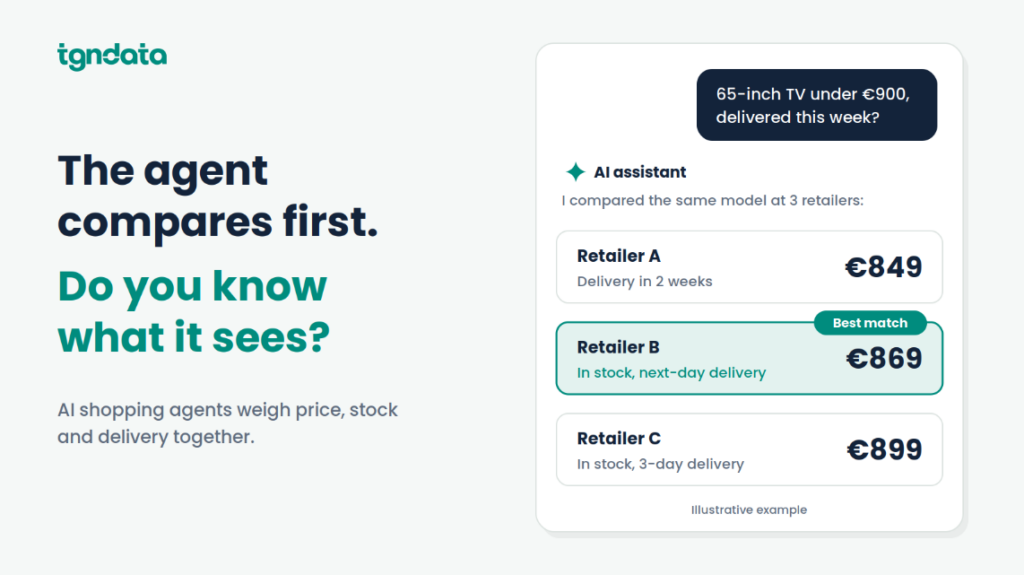
Prices appear inconsistent across AI search results.
What Goes Wrong:
LLMs infer outdated prices.
Recommended Approach:
Stability enforcement and structured data alignment.
What tgndata Enables:
Consistent pricing signals across AI surfaces.
Choosing between build, buy, or hybrid solutions for assortment intelligence depends on scale, data complexity, and internal capabilities. Most organizations benefit from a hybrid approach that combines internal expertise with external data platforms.
Dynamic pricing in ecommerce is the practice of adjusting product prices based on real time signals like competitor prices, demand, inventory levels, and predefined pricing rules. The goal is to improve revenue and margin while maintaining price governance and brand consistency.
Competitive data allows businesses to compare their product catalog with competitors. It highlights missing products, underrepresented categories, and demand trends. This external perspective reveals gaps that internal data alone cannot detect.
Assortment gaps directly impact revenue by limiting conversion opportunities. When customers cannot find desired products, they leave and purchase elsewhere. Filling these gaps increases conversion rates and captures previously lost demand.
Tools like tgndata. These tools analyze SKU coverage, pricing, and market trends to identify missing opportunities at scale.
Assortment gaps should be monitored continuously. Market conditions and competitor strategies change frequently, so real time or near real time analysis is essential to stay competitive.
SKU gaps refer to entirely missing products, while variant gaps involve missing options such as sizes or colors within existing products. Both impact customer experience but require different solutions.
Yes. Even small retailers can identify high impact gaps using competitive data. By focusing on key categories and demand signals, they can prioritize opportunities that drive measurable growth.
Assortment gaps are not random oversights. They are predictable, measurable, and correctable signals of misalignment between supply and demand.
Organizations that rely solely on internal data will always react too late. Those that integrate competitive intelligence gain the ability to anticipate, adapt, and capture unmet demand before it becomes lost revenue.
tgndata enables this shift by acting as a continuous validation layer for assortment strategy, ensuring that decisions are grounded in real market conditions.
The opportunity is not just to fix gaps, but to build a system where gaps rarely occur.


We use cookies to provide you with an optimal experience, for marketing and statistical purposes only with your consent, which you may revoke at any time. Please refer to our Privacy Policy for more information.
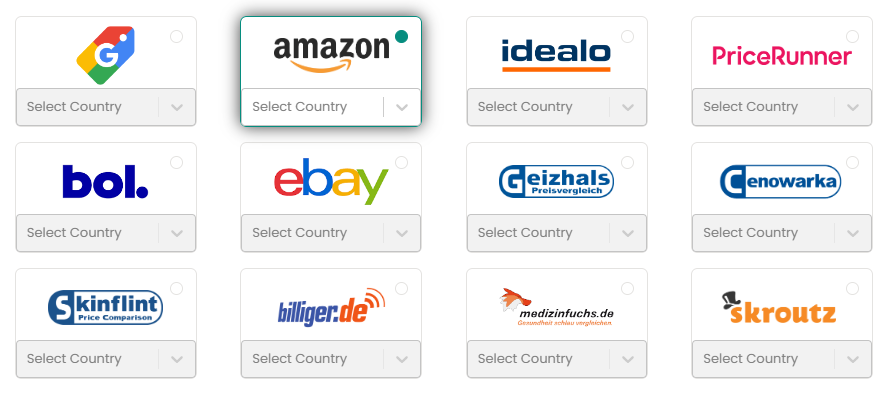










Missing an important marketplace?
Send us your request to add it!