
- Product
- Solution for
For Your Industry
- Partners
- Plans & Pricing
- Resources

For Your Industry
Psychological pricing is the practice of setting and presenting prices to match the mental shortcuts shoppers use to judge value, and the best-measured shortcut is the left digit: in US supermarket scanner data, shoppers reacted to a one-cent rise from a 99-ending price as if it were a rise of roughly 15 to 25 cents.
That finding comes from Avner Strulov-Shlain’s study in the Review of Economic Studies (2023), and it explains why a €4.99 tag can outsell a €5.00 tag even though the gap is one cent. Black Friday falls on 27 November 2026, 24 days from today, and it is the one week of the year when every price cue gets tested at once.
The catch is that shoppers have learned to test back: in a Which? analysis of Black Friday 2024 offers at UK retailers, none of the deals checked was at its cheapest price of the year on the day itself.
This guide covers nine tactics, the evidence behind each, and the specific condition under which each one backfires.
Psychological pricing is a family of price-setting and price-presentation tactics that work on how shoppers perceive numbers, comparisons and deadlines, rather than on the price itself. The common ones are charm endings such as .99, round prices, strikethrough reference prices, decoy options, discount framing, free gifts, split-out fees, urgency cues and per-month framing. None of them changes what a product costs to make. All of them change what the shopper believes the price means.
Black Friday raises the stakes because volume and attention both peak. Adobe’s 2026 holiday forecast expects US online spending of $12.9 billion on Black Friday, up 9.2% year on year, with Cyber Monday at $15.1 billion, up 6.2%. Adobe also expects the best deals on TVs, toys, apparel, appliances and furniture to land on Black Friday itself. Shoppers will compare faster, across more tabs, with less patience for anything that looks off.
Methodology: the Adobe figures are a forecast, not results. Adobe published them on 28 September 2026 for the period 1 November to 31 December 2026, based on Adobe Analytics data from over 1 trillion visits to US retail sites across 18 product categories. They cover US online sales only. This guide is not Europe-specific, and it uses US, UK and EU evidence wherever each is strongest, flagging the geography each time.
For a wider view of how discounts shape behavior, see tgndata’s articles on the psychology of discounts and the psychology of buying. This guide goes one level down: tactic by tactic, with the evidence and the failure conditions.
Takeaway: Black Friday raises the stakes on every price cue, so each tactic deserves a deliberate yes or no rather than a default.
The nine tactics are charm pricing, round prices, reference prices, decoy tiers, discount framing, free gifts, partitioned prices, scarcity cues and per-month framing, and each one has a condition that turns it from a gain into a risk. The table below is the short version. The sections after it give the evidence.
| # | Tactic | Mental shortcut it uses | Best fit | Backfires when |
|---|---|---|---|---|
| 1 | Charm pricing | Left digit dominates | Mass-market and unfamiliar items | Premium items, or pages already full of sale cues |
| 2 | Round prices | Round numbers feel right | Gifts and indulgent purchases | Buyers are calculating and comparing |
| 3 | Reference price | Anchoring on a higher number | Genuine markdowns | The old price was never really charged |
| 4 | Decoy tier | Context shifts preference | Tiers, sizes and bundles | The comparison is unclear or the option is a phantom |
| 5 | Discount framing | Bigger number feels bigger saving | Every promo headline | Used by habit near the 100 mark without a test |
| 6 | Free gift | Gift borrows the main product’s value | Premium products | The gift looks cheap or unpriced |
| 7 | Partitioned price | Total cost is underestimated | Delivery shown as a clear line | Fees appear late at checkout |
| 8 | Scarcity cue | Fear of missing out | Real stock and real deadlines | Timers reset or stock warnings repeat |
| 9 | Per-month framing | Small recurring amounts feel light | Durable, higher-ticket items | The total is hidden |
Takeaway: every tactic has a condition under which it flips, so document that condition before the tactic goes live.
Prices ending in 9 raised demand in most field tests, but the effect is conditional, and Black Friday is exactly the setting where the conditions are least favorable. Eric Anderson and Duncan Simester ran three field experiments in which price endings were manipulated for a retailer, and reported in Quantitative Marketing and Economics (2003) that a $9 ending increased demand in all three. They also found the lift was stronger for new items than for items the retailer had sold before, and they saw some evidence that the effect weakens when “Sale” cues are present.
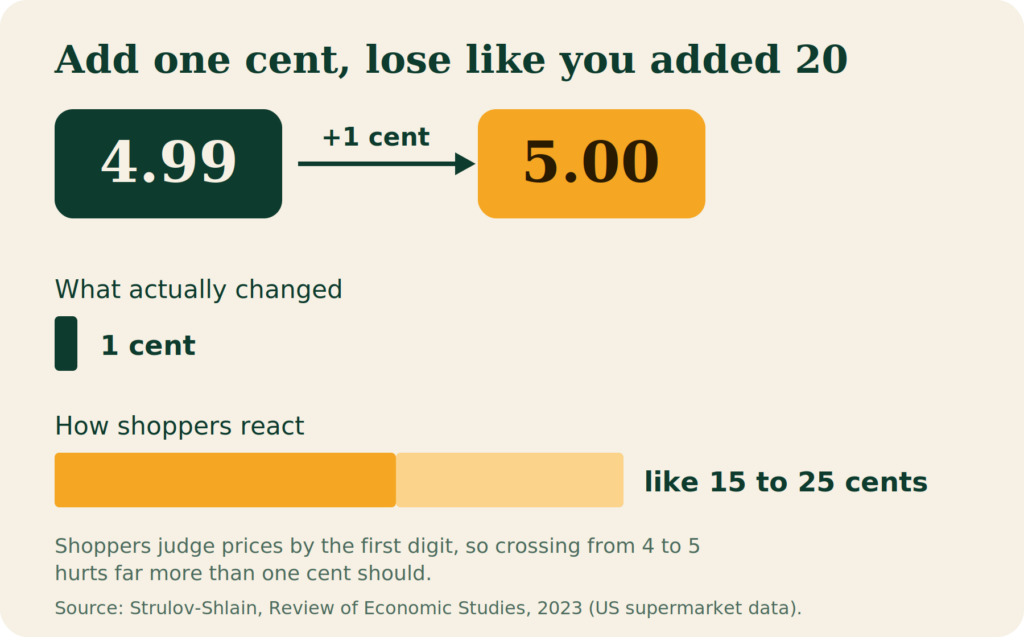
The scale of the left-digit effect is larger than most teams assume. Strulov-Shlain’s 2023 paper found that shoppers treated a one-cent increase from a 99-ending price as if it were an increase of 15 to 25 cents. Retailers, by contrast, priced as if the effect were only about 1.5 to 3 cents. He estimated that retailers forgo 1 to 4% of potential gross profit because they rely on rules of thumb rather than the structure of demand. His model also suggests that prices sitting just above a round number, such as a $3.09 tag, are rarely the best choice compared with the 99 ending just below the next whole unit.
Price tags 4.99 and 5.00: a one-cent rise that shoppers react to as if it were 15 to 25 cents
Moving from 4.99 to 5.00 adds one cent, but shoppers react as if the price rose by 15 to 25 cents. Source: Strulov-Shlain (2023).
Methodology: Strulov-Shlain used scanner data on 1,710 popular products in 248 stores of a single US retailer over 3.5 years, plus 12 products in Nielsen retail data across more than 60 chains and 11,000 stores over 9 years. Anderson and Simester’s experiments were field tests in catalog retail. Both are US studies of mostly grocery and apparel-type goods.
When it backfires. On a Black Friday page already full of “Sale” banners, a 9 ending may add little, and on a product the buyer knows well the lift shrinks. For premium or feeling-led items, a 9 ending can work against the positioning (see tactic 2). The sensible move is to keep 9 endings on value lines and unfamiliar items, and to run a holdout on pages with heavy sale cues.
Takeaway: use 9 endings where shoppers have little other information, and test them on pages already crowded with sale signals.
Round prices tend to work better when the purchase is driven by feeling, and non-round prices work better when shoppers are calculating. Monica Wadhwa and Kuangjie Zhang reported in the Journal of Consumer Research (2015) that round numbers are processed more fluently, which encourages shoppers to rely on feelings. In one experiment, participants were more inclined to buy champagne at $40.00 than at $39.72 or $40.28, and more inclined to buy a calculator at the non-round prices. The authors suggested that categories such as vacation packages, clothing and handbags could benefit from rounded prices, while practical goods such as appliances and toothpaste could benefit from non-rounded ones.
A scenario shows how this plays out. A €120.00 gift set for Black Friday sits in a feelings-led category where the round price may feel right. A €19.90 multipack of dishwasher tablets sits in a calculating category where a precise price signals a good deal. The same retailer can use both endings in the same week, and probably should.
Methodology: the five studies behind this finding were controlled experiments in which participants chose or rated products, so they show a direction of effect and not a retail sales lift. A separate line of work summarized by Nick Kolenda links round endings to a convenience effect, where the purchase feels quicker and easier.
When it backfires. A .99 ending on a gift-led product can cut against the “this feels right” sensation, and a round price on a commodity shopped via comparison sites can look lazy next to a competitor’s sharper number. Use competitor price data to see which ending your closest rivals use before you change yours.
Takeaway: match the price ending to the buying mindset, using sharp or 9-ending prices for calculating shoppers and round prices for feeling-led purchases.
A strikethrough reference price makes a sale price feel like a gain, but only while shoppers believe the old price was real, and Black Friday shoppers have learned to check. Which?, the UK consumer group, has tracked this for years. In its analysis of 175 home, tech and health products on offer at eight UK retailers during Black Friday 2024, the group found that none of the deals was at its cheapest price of the year on Black Friday itself. Across the whole analysis, 83% of products were the same price or cheaper on at least one occasion outside the four-week Black Friday sales period. The share varied widely by retailer: at John Lewis 94% of products had been cheaper or the same price at other times, at Amazon 88%, at Argos 79%, and at Richer Sounds only 55%.
Two price histories: an honest discount from a long-standing 89 to 59, and an inflated reference price raised to 89 for a week before dropping back to 59
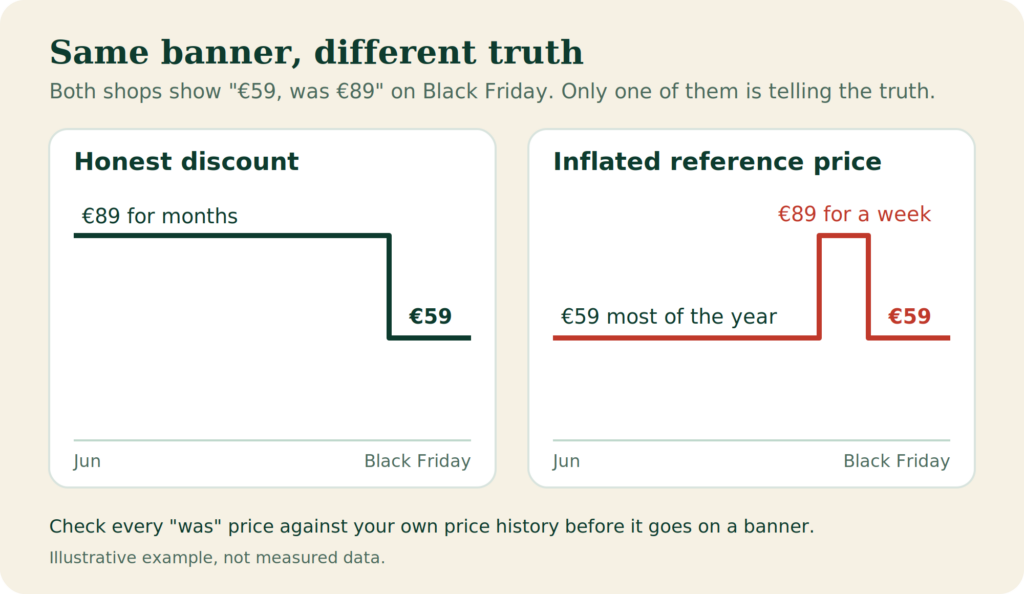
The same “€59, was €89” banner can be true or misleading depending on the price history behind it. Illustrative example, not measured data.
Methodology: Which? compared Black Friday prices with each retailer’s prices for the same products over a window running to May 2025. It reports the result in several windows (for example, the whole year and the period outside the four-week sale), so the percentages above are the “same or cheaper at other times of the year” measure. This is UK data on appliances and electronics. No EU equivalent was found, so treat it as an indicator of shopper skepticism and not as an EU benchmark.
The reference price is not the problem. Removing it can be worse. When J.C. Penney’s CEO Ron Johnson dropped sales and coupons in February 2012 in favor of everyday low prices, total sales for fiscal 2012 fell 24.8% to $12.985 billion and comparable store sales fell 25.2%, according to reporting by JCK. Later, on a call with investors, Johnson said his customer “always wants a reference price” and that the company had brought back sales and coupons. In one category, jewelry, the company said it sold at a shallow discount off a third-party appraised value and grew that business 36% over 2012 on only a 20% discount. That is a company statement and not an independent audit, but it makes the point: a credible anchor beats a deep discount from a doubtful one.
Methodology: J.C. Penney figures are company-reported results for fiscal year 2012 across roughly 1,100 US stores. Wharton faculty quoted at the time also pointed to confusing three-tier pricing and a lack of testing, so the sales decline should not be attributed to the missing coupons alone.
When it backfires. A “was” price that was never charged, or was charged for only a few days, turns the anchor into evidence against you. The fix is operational: compare each “was” price with your own price history before it goes on a banner, and check what competitors are charging for the same item. tgndata’s Black Friday strategy that protects your margin covers discount bands that rely on real data rather than blanket markdowns.
Takeaway: a reference price is an asset only while it is true, so audit every “was” price against price history before shoppers do.
A decoy option can push shoppers toward a target option, but the best-known evidence is a classroom experiment, so treat it as a hypothesis to test and not a guarantee. The effect was first described by Joel Huber, John Payne and Christopher Puto in the Journal of Consumer Research in 1982. The famous retail-style example comes from Dan Ariely’s account of The Economist’s subscription page: web-only at $59, print-only at $125, and print plus web at $125. When 100 students chose among all three, 16% picked web-only, none picked print-only, and 84% picked the combination. When the print-only decoy was removed, 68% chose web-only, as reported by The Conversation.
A retail-style illustration from Professor Gary Mortimer at QUT shows the same logic in a product range. A blender at $89 offers 900 watts and five accessories, and another at $149 offers 1,200 watts and 12 accessories. Adding a third at $125 with 1,000 watts and nine accessories makes the $149 model look like better value, because $24 more than the middle option buys three more accessories and 200 more watts. This is an illustrative example, not measured sales data.
When it backfires. If shoppers cannot see why the decoy is worse, the comparison does not form. If the decoy is a phantom that no one can actually buy, you risk reviews and trust. Decoys are best used in real tiers, sizes and bundles, which links naturally to tgndata’s guide to pricing ladders.
Takeaway: use a decoy only where all three options are real, and measure the mix shift toward the target, not just conversion.
Show the discount in whichever form gives the bigger-looking number: percent off for lower-priced items, and currency off for higher-priced ones. Shih-Fen Chen, Kent Monroe and Yung-Chien Lou reported in the Journal of Retailing (1998) that for a high-priced product a reduction framed in dollars seemed more significant than the same reduction framed as a percentage, and the opposite was true for a low-priced product. Wharton professor Jonah Berger popularized this as the Rule of 100: below about 100 in currency, a percentage looks larger, and above it, an amount looks larger.
A scenario makes it concrete. A €60 jacket reduced by €12 reads better as “20% off”, because 20 is a bigger number than 12. A €600 laptop reduced by €120 reads better as “save €120”, because 120 beats 20. The discount is identical in both cases, and the perceived size is not.
Methodology: the original study measured perceived significance and purchase intentions among participants in a controlled design, not sales in live stores. The Rule of 100 is a practitioner summary and not a law. Commentary on it notes the effect is likely weaker near the 100 mark, and it was formulated for currencies of broadly similar value to the dollar, which includes the euro and pound.
When it backfires. Applying one framing everywhere by habit will leave value on the table at both ends of the price range, and applying it near the threshold without a test is guesswork. The framing also does not rescue a discount that is not real (see tactic 3). For a deeper view of how promotions interact with margin, see tgndata’s piece on price elasticity using competitive data.
Takeaway: lead with percent on low-priced items and with an amount on high-priced ones, and test the zone around 100.
A free gift can protect the perceived value of the gifted item better than a small discount, but results differ depending on how the offer is framed. Mauricio Palmeira and Joydeep Srivastava reported in the Journal of Consumer Research (2013) that willingness to pay for a product after a promotion ends was higher when it had been offered free than when it was offered at a low price. In one study, people offered free spaghetti with a jar of tomato sauce would later pay an average of $2.95 for it, against $1.83 for those who had been offered it at $0.50. The authors’ explanation is that a free item takes on the value of the main purchase it is paired with.
The picture is not one-sided. Priya Raghubir found in the Journal of Product and Brand Management (2005) that willingness to pay for a gifted item fell when the offer was framed as “buy one, get one free” and not as a joint bundle price, especially when the promotion did not state the gift’s price. The practical reading is that a gift works best when it is paired with a premium product and when its value is stated.
When it backfires. A gift that looks cheap next to a high-end product, or an unpriced gift that invites low-value guesses, can pull perceived value down. Free gifts also change the comparison set, since a competitor’s cheaper headline price may not include your bundle. Monitoring bundles and promotions, not just prices, is covered in tgndata’s article on going beyond price monitoring.
Takeaway: consider a gift with purchase instead of a deeper cut on premium lines, and always state the gift’s value.
Splitting a price into a base and a surcharge tends to lower the total that shoppers remember and to raise demand, but revealing the surcharge late turns that gain into distrust. Vicki Morwitz, Eric Greenleaf and Eric Johnson reported in the Journal of Marketing Research (1998) that partitioned prices decreased consumers’ recalled total costs and increased demand. A later line of work on drip pricing, where fees appear only after the shopper has started to buy, found in Marketing Science (2020) by Shelle Santana, Steven Dallas and Vicki Morwitz that consumers exposed to drip pricing tend to end up choosing the lower base price with the higher total, even after the total is revealed.
In an airline scenario presented by Morwitz and Santana, using an online panel of 327 people, disclosing fees reduced buying intentions, and not disclosing all fees was viewed as deceptive. That is the trade-off in one line: concealment lifts conversion for inexperienced shoppers and costs trust.
When it backfires. If a €49.00 item shows €4.90 delivery only at the last step, the shopper has already mentally committed, and the surprise is read as a trick. A cleaner approach is to show the total early, for example “€49.00 + €4.90 delivery = €53.90”, so the split informs and does not conceal.
Takeaway: show the delivered total as early as possible, so splitting the price clarifies and never hides.
Scarcity and urgency cues are the most overused tactic, and the evidence on their sales payoff is weaker than their prevalence suggests. A team from Princeton and the University of Chicago, led by Arunesh Mathur, crawled about 53,000 product pages across 11,000 shopping sites and reported in 2019 that it found 1,818 instances of dark patterns on 1,254 sites, around 11.1% of the sample. Countdown timers alone appeared 393 times on 361 sites. On a subset of 183 sites the patterns were outright deceptive, including timers for “limited-time” sales that reset whenever the page reloaded and low-stock notices that appeared on a recurring schedule.
On effectiveness, Jamie Luguri and Lior Strahilevitz ran experiments on representative samples of US adults and reported in the Journal of Legal Analysis (2021) that mild dark patterns more than doubled sign-ups for a dubious service, and aggressive ones nearly quadrupled them. The acceptance rates were 11% in the control group, 26% under mild patterns and 42% under aggressive patterns. But aggressive patterns generated a strong backlash and mild ones did not. In their second study, “must act now” messages did not make consumers more likely to buy a costly service.
Methodology: the Mathur study is an automated crawl measuring prevalence, not effectiveness. The Luguri and Strahilevitz experiments tested enrolment in an identity theft protection plan, not retail timers, so they show how pressure and obstruction behave rather than the exact lift from a countdown clock. Treat them as a warning about backlash, not as a forecast for your store.
When it backfires. A timer that resets, a “only 2 left” message that never changes, or a “12 people are viewing this” banner that is generated are all easy for shoppers to spot, especially when they open the page twice. Black Friday already has real deadlines, such as the end of the offer or Cyber Monday on 30 November, and real stock positions. Use those. Watching competitor stock also helps you decide when a genuine low-stock message is credible, as covered in tgndata’s article on competitor stock availability.
Takeaway: use urgency only when it is true, tie it to real stock and real end dates, and never let a timer reset.
Quoting a cost as a small recurring amount can make a purchase feel lighter, though the research suggests the effect depends on the size of the amount and the product. John Gourville described this in the Journal of Consumer Research (1998) as the “pennies-a-day” strategy. His account is that reframing a one-time expense as a small ongoing one leads shoppers to compare it with small everyday expenses rather than with large one-off ones.
Later work by Atlas and Bartels in the Journal of Consumer Research (2018) compared an aggregate price, such as $250 for the year, with a periodic one, such as 69 cents a day. They found periodic pricing increased purchase intentions, and that the effect extended to goods with high daily prices, a result the pennies-a-day account alone did not predict. They argue that pricing format changes perceived costs and benefits, not only how big the cost looks. The older account also implies the framing can backfire for larger amounts.
Methodology: both studies measure how shoppers evaluate offers and how likely they say they are to buy, not live store sales, so treat the direction of the effect as the finding and test the size yourself.
When it backfires. If a “from €25 a month” line on a €600 appliance hides the full price, the shopper discovers the real figure at checkout and the same trust problem as tactic 7 applies. The safest version shows both, for example “€600, or from €25 a month”.
Takeaway: show the per-month figure beside the total price, never instead of it.
Test one tactic per page type against a holdout group, and judge it on margin per visitor and not on conversion alone. Strulov-Shlain’s finding that retailers forgo 1 to 4% of potential gross profit by relying on rules of thumb is a reminder that intuition about price cues is often wrong in both directions. And Luguri and Strahilevitz’s finding that aggressive tactics produce backlash is a reminder that short-term lift can hide longer-term cost.
Here is a hypothetical calculation (not measured data) with a €30 unit cost. Variant A at €49.99 converts at 2.0%, so margin per visitor is 0.020 x €19.99 = €0.40. Variant B at €52.00 converts at 1.9%, so margin per visitor is 0.019 x €22.00 = €0.42. Variant A wins on conversion, and variant B wins on profit. A test judged on conversion alone would pick the wrong one.
A practical test design before Black Friday:
For the measurement side, tgndata’s guide to measuring price elasticity with competitive data shows how competitor context changes how you read test results.
Takeaway: a good test judges tactics on margin per visitor, with trust signals as guardrails.
Price intelligence software supports psychological pricing by showing what shoppers will compare your price against: competitor prices, price history, promotions, bundles and stock. tgndata is price intelligence software for retailers and brands. As a price monitoring platform, it covers competitor price monitoring, promotions, availability and pricing analytics, and its published feature set includes market activity, competitor insights, pricing trends, price indexing and historical data.
The link to each tactic is practical:
For a week-by-week view of the monitoring side, see tgndata’s Black Friday price monitoring playbook.
Takeaway: psychological pricing decides how a price is perceived, and price intelligence shows what that price is being compared against.
With 24 days to Black Friday, the highest-value moves are auditing your reference prices and urgency cues first, then testing two or three tactics, and keeping everything honest. The plan below is built backward from 27 November.
By role:
Takeaway: audit first, test second, and treat honesty as part of the pricing strategy and not a constraint on it.
Psychological pricing is the practice of setting and presenting prices to match the mental shortcuts shoppers use to judge value, such as the left digit, reference prices, comparisons and deadlines. It changes how a price is perceived, not what the product costs. Common examples are .99 endings, strikethrough prices, tiered options and countdown timers.
In field experiments, prices ending in 9 increased demand, and a large study of US scanner data found shoppers reacted to a one-cent step from a 99 ending as if it were 15 to 25 cents. The effect is conditional, though: it is stronger on new items and weaker when sale cues are present. Test it on your own pages, especially during Black Friday when sale cues are everywhere.
It depends on the retailer and the product. In a UK analysis by Which? of 175 products at eight retailers, none of the deals was at its cheapest price of the year on Black Friday 2024, and 83% were the same price or cheaper on at least one occasion outside the four-week sales period. Results varied by retailer, with Richer Sounds the best performer at 55% cheaper or equal at other times.
The evidence is mixed and mostly indirect. A study of 11,000 shopping sites found 393 countdown timers, and on a subset of 183 deceptive sites some timers reset when the page reloaded. A separate experiment found that “must act now” messages did not make people more likely to buy a costly service. Timers tied to a real deadline are safer, while fake ones risk shopper backlash.
Discount framing and clear total pricing are the lowest-risk starting points, because they change how true information is presented and not what is claimed. Showing percent off on lower-priced items and an amount off on higher-priced ones costs nothing to test. Auditing your reference prices against price history is the second safe step, because it removes the biggest credibility risk.
Test one tactic per page type against a holdout group and judge it on margin per visitor, not on conversion alone. Add return rate and review sentiment as guardrails, freeze changes a few days before the peak, and review the results after the event. A higher price with slightly lower conversion can still earn more profit per visitor.
tgndata is price intelligence software for retailers and brands. See how competitor price monitoring, price history and stock tracking help you keep every price cue honest before Black Friday.
We use cookies to provide you with an optimal experience, for marketing and statistical purposes only with your consent, which you may revoke at any time. Please refer to our Privacy Policy for more information.










Missing an important marketplace?
Send us your request to add it!