Marketplaces in Europe: 10 Platforms Pricing Teams Should Monitor

Marketplaces in Europe account for more than 60% of online gross merchandise value (GMV): 60.8% in 2025, up from 56.2% in 2023, according to Cross-Border Magazine’s April 2026 analysis, which means a pricing team that only watches its own webshop and a few direct rivals is blind to most of the market.

In this guide, tgndata, price intelligence software for retailers and brands, walks through the ten marketplaces in Europe that matter most to pricing teams, from France and Iberia to Germany, Benelux, Poland and Central Europe. For each platform you get the latest market numbers, the pricing risk it creates, and what a price monitoring platform should capture, plus a simple routine for keeping the list current. The rules change fast: in 2026 alone, a German antitrust ruling on Amazon and a new EU customs duty on low-value parcels both reshaped marketplace pricing. We also cover the regional specialists worth adding, and why eBay and Vinted are treated here as market context rather than monitored channels.

AAAWgmp1bWIAAAAeanVtZGMycGEAEQAQgAAAqgA4m3EDYzJwYQAAABZcanVtYgAAAEdqdW1kYzJtYQARABCAAACqADibcQN1cm46YzJwYTo3NjE1M2JmNi1hYTBjLTQ2ZjUtOTkyNC01NDU5MjAzN2NkMmYAAAADl2p1bWIAAAApanVtZGMyYXMAEQAQgAAAqgA4m3EDYzJwYS5hc3NlcnRpb25zAAAAALxqdW1iAAAARGp1bWRjYm9yABEAEIAAAKoAOJtxE2MycGEuaW5ncmVkaWVudC52MwAAAAAYYzJzaNugIswnePmzR+V26KatrtUAAABwY2JvcqNpZGM6Zm9ybWF0bWltYWdlL3N2Zyt4bWxqaW5zdGFuY2VJRHgseG1wOmlpZDplOGYyZmUwOC03YTE1LTRmYmEtODVlYy0xNmQyNGY0MzNmZGJscmVsYXRpb25zaGlwaHBhcmVudE9mAAAB4mp1bWIAAABBanVtZGNib3IAEQAQgAAAqgA4m3ETYzJwYS5hY3Rpb25zLnYyAAAAABhjMnNoNobX16UxUN9BuYcciBynIwAAAZljYm9yomdhY3Rpb25zgqJmYWN0aW9ua2MycGEub3BlbmVkanBhcmFtZXRlcnOha2luZ3JlZGllbnRzgaJjdXJseC1zZWxmI2p1bWJmPWMycGEuYXNzZXJ0aW9ucy9jMnBhLmluZ3JlZGllbnQudjNkaGFzaFggIzeNfY/9xVHKqVdJMQBC8OzLmlqwozZyNOAK0+suv/ukZmFjdGlvbngdY29tLmFudGhyb3BpYy5jbGF1ZGUucHJvdmlkZWRqcGFyYW1ldGVyc6F4H2NvbS5hbnRocm9waWMub3JpZ2luLWNvbmZpZGVuY2VndW5rbm93bmtkZXNjcmlwdGlvbnhmQ2xhdWRlIHByb3ZpZGVkIHRoaXMgZmlsZSBhdCB0aGUgcmVxdWVzdCBvZiBhIHVzZXIgYW5kIG1heSBoYXZlIGNyZWF0ZWQgb3IgbW9kaWZpZWQgdGhlIGZpbGUgY29udGVudHMubXNvZnR3YXJlQWdlbnShZG5hbWVmQ2xhdWRlcmFsbEFjdGlvbnNJbmNsdWRlZPUAAADIanVtYgAAAEBqdW1kY2JvcgARABCAAACqADibcRNjMnBhLmhhc2guZGF0YQAAAAAYYzJzaNQITE1jmkhxSWVdQ1W8ta8AAACAY2JvcqVjYWxnZnNoYTI1NmNwYWRNAAAAAAAAAAAAAAAAAGRoYXNoWCAitLOtfrIhv8pEg3ZnoxV7VUlY2ivKWd6+4LfXJR7L+WRuYW1lbmp1bWJmIG1hbmlmZXN0amV4Y2x1c2lvbnOBomVzdGFydBi3Zmxlbmd0aBkeBAAAAj5qdW1iAAAAJ2p1bWRjMmNsABEAEIAAAKoAOJtxA2MycGEuY2xhaW0udjIAAAACD2Nib3KlY2FsZ2ZzaGEyNTZpc2lnbmF0dXJleE1zZWxmI2p1bWJmPS9jMnBhL3VybjpjMnBhOjc2MTUzYmY2LWFhMGMtNDZmNS05OTI0LTU0NTkyMDM3Y2QyZi9jMnBhLnNpZ25hdHVyZWppbnN0YW5jZUlEeCx4bXA6aWlkOjg0MjI4MjllLTlkY2UtNGEyNy1hY2UyLTFjMTEzM2MwMTk2NHJjcmVhdGVkX2Fzc2VydGlvbnODomN1cmx4LXNlbGYjanVtYmY9YzJwYS5hc3NlcnRpb25zL2MycGEuaW5ncmVkaWVudC52M2RoYXNoWCAjN419j/3FUcqpV0kxAELw7MuaWrCjNnI04ArT6y6/+6JjdXJseCpzZWxmI2p1bWJmPWMycGEuYXNzZXJ0aW9ucy9jMnBhLmFjdGlvbnMudjJkaGFzaFgg0YrK2JBz1WD+PTqgmh2ERPHyiuFa7xnhnb/4pC0dneCiY3VybHgpc2VsZiNqdW1iZj1jMnBhLmFzc2VydGlvbnMvYzJwYS5oYXNoLmRhdGFkaGFzaFggb/BGZdmR/TJXPl2D/Fy3odV1pvqr4MzsEmwT8R8A8Jp0Y2xhaW1fZ2VuZXJhdG9yX2luZm+jZG5hbWVvQW50aHJvcGljIEZpbGVzZ3ZlcnNpb25lMS4wLjBrc3BlY1ZlcnNpb25lMi40LjAAABA4anVtYgAAAChqdW1kYzJjcwARABCAAACqADibcQNjMnBhLnNpZ25hdHVyZQAAABAIY2JvctKEWQISogEmGCFZAgowggIGMIIBjaADAgECAhRA5aAK7sI50L64g/oGQgU9Z1UTADAKBggqhkjOPQQDAzBJMRcwFQYDVQQKEw5BbnRocm9waWMsIFBCQzEuMCwGA1UEAxMlQW50aHJvcGljIENvbnRlbnQgQ3JlZGVudGlhbHMgUm9vdCBDQTAeFw0yNjA4MDcxODQzNTZaFw0yODA4MDYxOTQzNTZaMEQxFzAVBgNVBAoTDkFudGhyb3BpYywgUEJDMSkwJwYDVQQDEyBBbnRocm9waWMgQ2xhdWRlIENvbnRlbnQgU2lnbmluZzBZMBMGByqGSM49AgEGCCqGSM49AwEHA0IABJh6CmvLUBgFFNU0vUKlOVtE6djd17L5SuwX0LemFisBM3dkd/3cyjxFA3Qo5S46fX0/ihY0VZ7mfb9KF703t5OjWDBWMA4GA1UdDwEB/wQEAwIHgDAVBgNVHSUEDjAMBgorBgEEAYPoXgIBMAwGA1UdEwEB/wQCMAAwHwYDVR0jBBgwFoAUzlHiBIFOZFsj+OPEz5o+nMHXXMIwCgYIKoZIzj0EAwMDZwAwZAIwMXMdFJ4BetLLVY7ORuE9noqbbAZOZn/aArXyTwFAZfKrPzxF2vPoJNf1+UCdg1XGAjBwX1zd9WGqYkqmL5SFqw1QySjr1zJfpJM9+1rdDwSPLMOPOjKuiXjoU/pUUeG9RwmhY3BhZFkNngAAAAAAAAAAAAAAAAAAAAAAAAAAAAAAAAAAAAAAAAAAAAAAAAAAAAAAAAAAAAAAAAAAAAAAAAAAAAAAAAAAAAAAAAAAAAAAAAAAAAAAAAAAAAAAAAAAAAAAAAAAAAAAAAAAAAAAAAAAAAAAAAAAAAAAAAAAAAAAAAAAAAAAAAAAAAAAAAAAAAAAAAAAAAAAAAAAAAAAAAAAAAAAAAAAAAAAAAAAAAAAAAAAAAAAAAAAAAAAAAAAAAAAAAAAAAAAAAAAAAAAAAAAAAAAAAAAAAAAAAAAAAAAAAAAAAAAAAAAAAAAAAAAAAAAAAAAAAAAAAAAAAAAAAAAAAAAAAAAAAAAAAAAAAAAAAAAAAAAAAAAAAAAAAAAAAAAAAAAAAAAAAAAAAAAAAAAAAAAAAAAAAAAAAAAAAAAAAAAAAAAAAAAAAAAAAAAAAAAAAAAAAAAAAAAAAAAAAAAAAAAAAAAAAAAAAAAAAAAAAAAAAAAAAAAAAAAAAAAAAAAAAAAAAAAAAAAAAAAAAAAAAAAAAAAAAAAAAAAAAAAAAAAAAAAAAAAAAAAAAAAAAAAAAAAAAAAAAAAAAAAAAAAAAAAAAAAAAAAAAAAAAAAAAAAAAAAAAAAAAAAAAAAAAAAAAAAAAAAAAAAAAAAAAAAAAAAAAAAAAAAAAAAAAAAAAAAAAAAAAAAAAAAAAAAAAAAAAAAAAAAAAAAAAAAAAAAAAAAAAAAAAAAAAAAAAAAAAAAAAAAAAAAAAAAAAAAAAAAAAAAAAAAAAAAAAAAAAAAAAAAAAAAAAAAAAAAAAAAAAAAAAAAAAAAAAAAAAAAAAAAAAAAAAAAAAAAAAAAAAAAAAAAAAAAAAAAAAAAAAAAAAAAAAAAAAAAAAAAAAAAAAAAAAAAAAAAAAAAAAAAAAAAAAAAAAAAAAAAAAAAAAAAAAAAAAAAAAAAAAAAAAAAAAAAAAAAAAAAAAAAAAAAAAAAAAAAAAAAAAAAAAAAAAAAAAAAAAAAAAAAAAAAAAAAAAAAAAAAAAAAAAAAAAAAAAAAAAAAAAAAAAAAAAAAAAAAAAAAAAAAAAAAAAAAAAAAAAAAAAAAAAAAAAAAAAAAAAAAAAAAAAAAAAAAAAAAAAAAAAAAAAAAAAAAAAAAAAAAAAAAAAAAAAAAAAAAAAAAAAAAAAAAAAAAAAAAAAAAAAAAAAAAAAAAAAAAAAAAAAAAAAAAAAAAAAAAAAAAAAAAAAAAAAAAAAAAAAAAAAAAAAAAAAAAAAAAAAAAAAAAAAAAAAAAAAAAAAAAAAAAAAAAAAAAAAAAAAAAAAAAAAAAAAAAAAAAAAAAAAAAAAAAAAAAAAAAAAAAAAAAAAAAAAAAAAAAAAAAAAAAAAAAAAAAAAAAAAAAAAAAAAAAAAAAAAAAAAAAAAAAAAAAAAAAAAAAAAAAAAAAAAAAAAAAAAAAAAAAAAAAAAAAAAAAAAAAAAAAAAAAAAAAAAAAAAAAAAAAAAAAAAAAAAAAAAAAAAAAAAAAAAAAAAAAAAAAAAAAAAAAAAAAAAAAAAAAAAAAAAAAAAAAAAAAAAAAAAAAAAAAAAAAAAAAAAAAAAAAAAAAAAAAAAAAAAAAAAAAAAAAAAAAAAAAAAAAAAAAAAAAAAAAAAAAAAAAAAAAAAAAAAAAAAAAAAAAAAAAAAAAAAAAAAAAAAAAAAAAAAAAAAAAAAAAAAAAAAAAAAAAAAAAAAAAAAAAAAAAAAAAAAAAAAAAAAAAAAAAAAAAAAAAAAAAAAAAAAAAAAAAAAAAAAAAAAAAAAAAAAAAAAAAAAAAAAAAAAAAAAAAAAAAAAAAAAAAAAAAAAAAAAAAAAAAAAAAAAAAAAAAAAAAAAAAAAAAAAAAAAAAAAAAAAAAAAAAAAAAAAAAAAAAAAAAAAAAAAAAAAAAAAAAAAAAAAAAAAAAAAAAAAAAAAAAAAAAAAAAAAAAAAAAAAAAAAAAAAAAAAAAAAAAAAAAAAAAAAAAAAAAAAAAAAAAAAAAAAAAAAAAAAAAAAAAAAAAAAAAAAAAAAAAAAAAAAAAAAAAAAAAAAAAAAAAAAAAAAAAAAAAAAAAAAAAAAAAAAAAAAAAAAAAAAAAAAAAAAAAAAAAAAAAAAAAAAAAAAAAAAAAAAAAAAAAAAAAAAAAAAAAAAAAAAAAAAAAAAAAAAAAAAAAAAAAAAAAAAAAAAAAAAAAAAAAAAAAAAAAAAAAAAAAAAAAAAAAAAAAAAAAAAAAAAAAAAAAAAAAAAAAAAAAAAAAAAAAAAAAAAAAAAAAAAAAAAAAAAAAAAAAAAAAAAAAAAAAAAAAAAAAAAAAAAAAAAAAAAAAAAAAAAAAAAAAAAAAAAAAAAAAAAAAAAAAAAAAAAAAAAAAAAAAAAAAAAAAAAAAAAAAAAAAAAAAAAAAAAAAAAAAAAAAAAAAAAAAAAAAAAAAAAAAAAAAAAAAAAAAAAAAAAAAAAAAAAAAAAAAAAAAAAAAAAAAAAAAAAAAAAAAAAAAAAAAAAAAAAAAAAAAAAAAAAAAAAAAAAAAAAAAAAAAAAAAAAAAAAAAAAAAAAAAAAAAAAAAAAAAAAAAAAAAAAAAAAAAAAAAAAAAAAAAAAAAAAAAAAAAAAAAAAAAAAAAAAAAAAAAAAAAAAAAAAAAAAAAAAAAAAAAAAAAAAAAAAAAAAAAAAAAAAAAAAAAAAAAAAAAAAAAAAAAAAAAAAAAAAAAAAAAAAAAAAAAAAAAAAAAAAAAAAAAAAAAAAAAAAAAAAAAAAAAAAAAAAAAAAAAAAAAAAAAAAAAAAAAAAAAAAAAAAAAAAAAAAAAAAAAAAAAAAAAAAAAAAAAAAAAAAAAAAAAAAAAAAAAAAAAAAAAAAAAAAAAAAAAAAAAAAAAAAAAAAAAAAAAAAAAAAAAAAAAAAAAAAAAAAAAAAAAAAAAAAAAAAAAAAAAAAAAAAAAAAAAAAAAAAAAAAAAAAAAAAAAAAAAAAAAAAAAAAAAAAAAAAAAAAAAAAAAAAAAAAAAAAAAAAAAAAAAAAAAAAAAAAAAAAAAAAAAAAAAAAAAAAAAAAAAAAAAAAAAAAAAAAAAAAAAAAAAAAAAAAAAAAAAAAAAAAAAAAAAAAAAAAAAAAAAAAAAAAAAAAAAAAAAAAAAAAAAAAAAAAAAAAAAAAAAAAAAAAAAAAAAAAAAAAAAAAAAAAAAAAAAAAAAAAAAAAAAAAAAAAAAAAAAAAAAAAAAAAAAAAAAAAAAAAAAAAAAAAAAAAAAAAAAAAAAAAAAAAAAAAAAAAAAAAAAAAAAAAAAAAAAAAAAAAAAAAAAAAAAAAAAAAAAAAAAAAAAAAAAAAAAAAAAAAAAAAAAAAAAAAAAAAAAAAAAAAAAAAAAAAAAAAAAAAAAAAAAAAAAAAAAAAAAAAAAAAAAAAAAAAAAAAAAAAAAAAAAAAAAAAAAAAAAAAAAAAAAAAAAAAAAAAAAAAAAAAAAAAAAAAAAAAAAAAAAAAAAAAAAAAAAAAAAAAAAAAAAAAAAAAAAAAAAAAAAAAAAAAAAAAAAAAAAAAAAAAAAAAAAAAAAAAAAAAAAAAAAAAAAAAAAAAAAAAAAAAAAAAAAAAAAAAAAAAAAAAAAAAAAAAAAAAAAAAAAAAAAAAAAAAAAAAAAAAAAAAAAAAAAAAAAAAAAAAAAAAAAAAAAAAAAAAAAAAAAAAAAAAAAAAAAAAAAAAAAAAAAAAAAAAAAAAAAAAAAAAAAAAAAAAAAAAAAAAAAAAAAAAAAAAAAAAAAAAAAAAAAAAAAAAAAAAAAAAAAAAAAAAAAAAAAAAAAAAAAAAAAAAAAAAAAAAAAAAAAAAAAAAAAAAAAAAAAAAAAAAAAAAAAAAAAAAAAAAAAAAAAAAAAAAAAAAAAAAAAAAAAAAAAAAAAAAAAAAAAAAAAAAAAAAAAAAAAAAAAAAAAAAAAAAAAAAAAAAAAAAAAAAAAAAAAAAAAAAAAAAAAAAAAAAAAAAAAAAAAAAAAAAAAAAAAAAAAAAAAAAAAAAAAAAAAAAAAAAAAAAAAAAAAAAAAAAAAAAAAAAAAAAAAAAAAAAAAAAAAAAAAAAAAAAAAAAAAAAAAAAAAAAAAAAAAAAAAAAAAAAAAAAAAAAAAAAAAAAAAAAAAAAAAAAAAAAAAAAAAAAAAAAAAAAAAAAAAAAAAAAAAAAAAAAAAAAAAAAAAAAAAAAAAAAAAAAAAAAAAAAAAAAAAAAAAAAAAAAAAAAAAAAAAAAAAAAAAAAAAAAAAAAAAAAAAAAAAAAAAAAAAAAAAAAAAAAAAAAAAAAAAAAAAAAAAAAAAAAAAAAAAAAAAAAAAAAAAAAAAAAAAAAAAAAAAAAAAAAAAAAAAAAAAAAAAAAAAAAAAAAAAAAAAAAAAAAAAAAAAAAAAAAAAAAAAAAAAAAAAAAAAAAAAAAAAAAAAAAAAAAAAAAAAAAAAAAAAAAAAAAAAAAAAAAAAAAAAAAAAAAAAAAAAAAAAAAAAAAAAAAAAAAAAAAAAAAAAAAAAAAAAAAAAAAAAAAAAAAAAAAAAAAAAAAAAAAAAAAAAAAAAAAAAAAAAAAAAAAAAAAAAAAAAAAAAAAAAAAAAAAAAAAAAAAAAAAAAAAAAAAAAAAAAAAAAAAAAAAAAAAAAAAAAAAAAAAAAAAAAAAAAAAAAAAAAAAAAAAAAAAAAAAAAAPZYQNz8wQ1bJB9X+tBfheflkM9C5f7i7p0wNKQc1A+TJ9nXBc5JRQ1ASFAE5kCiyoy8YNbE0numN7LO8Q2OBr5UkV0= Marketplace share of European online GMV rose from 56.2% in 2023 to 60.8% in 2025 Two stacked columns. In 2023 marketplaces carried 56.2 percent of European online gross merchandise value. In 2025 they carried 60.8 percent, a gain of 4.6 percentage points. MARKETPLACES IN EUROPE Most online GMV now sits on marketplaces +4.6 pts 56.2% marketplaces 43.8% other 2023 60.8% marketplaces 39.2% other 2025 Share of European e-commerce GMV via marketplaces Source: Cross-Border Magazine, April 29, 2026
SHORTLIST

Which marketplaces in Europe should pricing teams monitor?

The ten marketplaces in Europe that pricing teams should monitor are Amazon, Zalando, Allegro, Kaufland, Cdiscount, bol, Otto, Douglas, Decathlon and Fnac Darty. Together they cover the pan-European leaders, the national champions that shoppers use as price references in Europe’s largest markets, and the category specialists in beauty, sports, electronics and culture. Regional specialists such as eMAG, Skroutz and Galaxus are covered in their own section, and eBay and Vinted are covered separately as market context.

#PlatformMain marketsModelWhat it pressures in your pricing
1AmazonMost large European marketsHybrid retail and marketplaceBuy Box ownership and price position
2ZalandoEurope-wideFashion retail plus partner programmeMarkdown depth and reference prices
3AllegroPoland, Czechia, Slovakia, HungaryMarketplaceCentral European price levels
4KauflandNine countries, Germany to SpainOpen seller marketplace networkMany sellers on one product, no single price
5CdiscountFranceMarketplace-first retailerFrench price references across sellers
6bolNetherlands, BelgiumHybrid retail and partner marketplaceDutch and Belgian price references
7OttoGermanyHybrid, selective marketplaceBrand and home categories in Germany
8DouglasMore than 20 European countriesBeauty retail plus partner programmeBeauty promotions and effective prices
9DecathlonMore than ten countriesSports retail plus partner marketplaceOwn-brand price points next to branded offers
10Fnac DartyFrance, Belgium, Spain, PortugalHybrid retail and marketplaceElectronics and culture price references

Methodology: this list is tgndata’s editorial selection for pricing relevance across Europe, not a revenue ranking. We weighed European reach, the role each platform plays as a price reference in its main markets, marketplace growth, and category relevance for retailers and brands. For reference, Cross-Border Commerce Europe’s 2026 TOP 100 report, covering 28 European markets, ranks Amazon first and includes Zalando in its top ten using cross-border sales, international SEO, geographic coverage and share of foreign visits (reported by E-Commerce Nation, October 19, 2026). That index measures cross-border relevance, so national champions such as Allegro, Cdiscount, bol and Otto rank lower even though pricing teams compete against them daily. We left out classifieds and niche platforms such as OLX, Etsy, AbeBooks and StockX, and treat eBay and Vinted as market context because they sit outside tgndata’s monitoring coverage.

Start with the platforms where your SKUs are listed and where your shoppers compare, then add the national leader in each country you sell in.

CONTEXT

What recent events changed marketplace pricing in Europe?

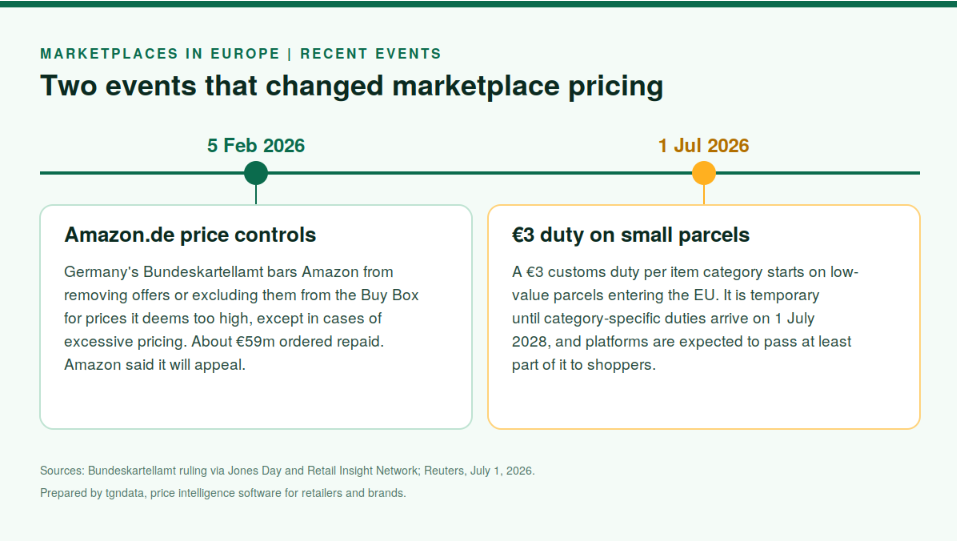
Two events in 2026 changed how marketplace prices behave: the Bundeskartellamt’s ruling on Amazon price controls and the EU’s €3 duty on low-value parcels. One touches seller price freedom on Europe’s largest marketplace, the other the landed price of imported goods.

On February 5, 2026, Germany’s Bundeskartellamt prohibited Amazon from using price control mechanisms that removed seller offers or excluded them from the Buy Box when Amazon judged prices too high. According to Jones Day’s summary, such influence is allowed only for excessive pricing, and the authority ordered disgorgement of about €59 million. Amazon said it would appeal, and Jones Day noted that the decision was not yet final. Methodology: a single regulatory decision on Amazon.de, covering Amazon’s German marketplace; the €59 million figure is a partial estimate the authority described as covering the infringement so far.

On July 1, 2026, a €3 customs duty per item category took effect on low-value parcels entering the EU. Reuters reported that it is a temporary measure until category-specific duties begin on July 1, 2028, and that platforms are likely to pass at least part of the cost on to shoppers. Context from the Commission, as reported by Logos Press, puts the number of small e-commerce parcels at 5.8 billion in 2025, up 26% on 2024. Methodology: Reuters reporting on the Council decision; the parcel count is a Commission figure cited secondhand, so treat it as indicative.

Timeline of two 2026 events: Amazon ruling in Germany and the EU €3 customs duty

These events also sit on top of a structural shift. Marketplaces generated €11.5 billion of German online turnover in the first half of 2026, up 6.4%, according to bevh figures reported by ChannelEngine, and more than half of German online sales now run through them. For pricing teams, the practical result is that a competitor’s price on a marketplace is increasingly the price your customer sees first. Our guide to pricing intelligence for ecommerce marketplaces covers the foundations, and marketplace pricing vs DTC pricing explains how to handle conflicts with your own webshop.

These rulings, fines and duties moved marketplace prices from a purely commercial question to a regulated one, so monitoring now needs evidence, not just alerts.

PLATFORM 1 | EUROPE-WIDE

1. Amazon: the Buy Box still decides who wins

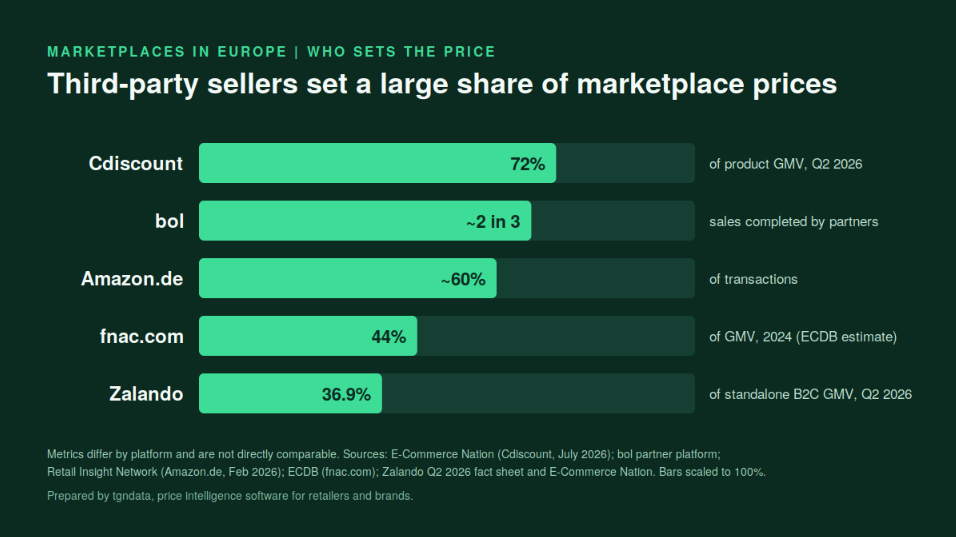
Amazon is the first marketplace to monitor in Europe because it runs local storefronts in most large European markets, ranks first in Cross-Border Commerce Europe’s 2026 index of cross-border marketplaces, and controls the Buy Box, which decides which seller gets the sale. Germany is its largest European store and the clearest example of its weight. A 2026 ranking by ecommercegermany places amazon.de first with about US$64.6 billion in revenue, more than the next five German online shops combined (no EUR equivalent was found, so this is the one US figure in this article). Retail Insight Network reported that third-party sellers account for roughly 60% of transactions on the German site.

The pricing environment is shifting. After the Bundeskartellamt ruling, Amazon has less room to push sellers out of the Buy Box for high prices, but it has not stopped competing hard on delivery. ChannelEngine reports that from September 1, 2026, Amazon requires fulfilled-by-merchant sellers in Germany and the UK to keep an on-time delivery rate of at least 90% or risk listing deactivation. Installment payments through PayPal, launched in Germany and Austria in August 2026 for purchases of €30 to €10,000, may also lift conversion on high-ticket items, so a price gap can matter less or more depending on category.

Methodology: ecommercegermany ranks German online shops by estimated revenue, with no sample or timeframe beyond 2026 disclosed; the 60% share comes from Retail Insight Network’s February 2026 coverage; the delivery and payment details come from ChannelEngine’s July 2026 roundup of Amazon announcements.

What to monitor: Buy Box owner per SKU, the number of competing offers, fulfilled-by-Amazon versus merchant fulfillment, Amazon’s own retail price, and competitor stock. Our articles on Buy Box strategy, Buy Box stock availability and pricing intelligence for Amazon sellers go deeper.

Amazon rewards the seller with the best mix of price, availability and delivery, so monitor the whole offer, not the price alone.

PLATFORM 2 | EUROPE-WIDE

2. Zalando: partner growth means more price setters

Zalando matters to fashion, sports and beauty pricing because its partner business is growing faster than its own retail, which adds more price setters to the same pages. In its Q2 2026 results of August 4, Zalando reported GMV of €4.9 billion, up 20.7% on a reported basis but only 4.4% pro-forma after the ABOUT YOU acquisition, and 62.5 million active customers. Partner business reached 36.9% of standalone B2C GMV, up 3.2 percentage points, and 31.9% at group level including ABOUT YOU. Retail media revenue grew 39.5%.

Two pricing consequences follow. First, more partners mean more independent markdown decisions on the same brands. Second, reference prices matter: under EU rules, a discount must be measured against the lowest price of the previous 30 days, a rule 30% of EU online traders were found to get wrong. Our guide to the 30-day lowest price rule explains how price history serves as proof.

Methodology: figures come from Zalando’s Q2 2026 fact sheet and results coverage (E-Commerce Nation, ICT Business); “pro-forma” growth adjusts for the ABOUT YOU consolidation since July 11, 2025. The 30% statistic is cited in tgndata’s own 30-day rule article.

What to monitor: markdown depth and timing by brand, partner versus Zalando offers, price history for reference-price compliance, and stock depth by size.

Zalando’s partner growth turns fashion pricing into a multi-seller game, so track markdown behaviour by brand, not by platform.

PLATFORM 3 | POLAND AND CENTRAL EUROPE

3. Allegro: Central Europe's home-grown leader

Allegro is the marketplace to monitor in Poland and, increasingly, in Czechia, Slovakia and Hungary, where its international business is growing far faster than its core. In preliminary Q2 2026 results, Allegro reported group GMV of PLN 19.6 billion, up 14.4% year on year, with Polish GMV up 12.0% and international GMV up 82.4%. After its final Q2 results on September 17, 2026 it raised its full-year guidance to group GMV growth of 13% to 15% and international growth of 65% to 75%, according to Quartr’s summary. In mid-2025 Allegro reported 21.1 million active buyers across its markets, including 15.2 million in Poland and 3.9 million in Czechia, Slovakia and Hungary.

Two forces shape Allegro prices. In Czechia, Slovakia and Hungary, Allegro is rebuilding the former MALL business into marketplaces and growing them aggressively. In Poland, it now faces Kaufland, whose Polish marketplace grew GMV by 322% in 2025. Pricing teams selling into Central Europe should therefore treat Poland, Czechia, Slovakia and Hungary as one connected price zone. Our guide to cross-border pricing covers the currency and VAT side.

Methodology: Q2 2026 GMV figures are Allegro’s preliminary consolidated results of July 13, 2026; guidance comes from Quartr’s summary of the September 17 results; buyer counts are from Allegro’s Q2 2025 press release. Figures are reported in Polish zloty and not converted to avoid exchange-rate distortion. The Kaufland.pl growth figure is from ESM Magazine.

What to monitor: price and delivery terms for every seller on your EANs, price gaps between Allegro.pl and its Czech, Slovak and Hungarian sites, and your position against Kaufland and Amazon in Poland.

Allegro’s international sites are growing several times faster than its Polish core, so plan Central European prices as one market, not four.

PLATFORM 4 | NINE EUROPEAN COUNTRIES

4. Kaufland: Europe's fastest-expanding marketplace network

Kaufland is the fastest-expanding marketplace network in Europe, and its structure means there is no single Kaufland price for any product. With Kaufland.nl and the Spanish marketplace launched in September 2026, Kaufland Global Marketplace covers nine countries: Germany, Austria, the Czech Republic, Slovakia, Poland, France, Italy, the Netherlands and Spain, according to Cross-Border Magazine and RetailDetail. ESM Magazine reports that GMV across all Kaufland marketplace countries grew 11.9% in fiscal 2025, and that Kaufland.pl grew GMV by 322% after its 2024 launch. In Germany alone, EuroWeekly News counted more than 15,000 international sellers, over 45 million products and up to 32 million monthly visitors.

For pricing teams, Kaufland is a good stress test for product matching. Many sellers list the same EAN with different shipping terms, and one registration lets them sell across all nine countries, so the same product can appear at different prices in different markets. Our explainer on how product matching works in price monitoring shows why EAN, title and image matching need to work together.

Methodology: the country list comes from Cross-Border Magazine (June 2026), RetailDetail and EuroWeekly News (September 2026); GMV growth figures are Kaufland statements reported by ESM Magazine; German seller, product and visitor counts are Kaufland figures relayed by EuroWeekly News in September 2026.

What to monitor: the lowest and median offer per EAN in each country, shipping cost included in total price, seller count per product, and stock flags.

Kaufland’s open, multi-country structure rewards teams that measure the whole offer distribution, not a single competitor price.

PLATFORM 5 | FRANCE

5. Cdiscount: France's marketplace-first retailer

Cdiscount is the French marketplace to monitor because it has shifted most of its business to third-party sellers, which turns its prices into a moving mix of many merchants. E-Commerce Nation reports that in Q2 2026 Cdiscount’s total GMV rose 5.7%, driven by marketplace growth of 12%, and that the marketplace now accounts for 72% of product GMV, up 3.3 points in a year. Cdiscount belongs to the Casino group, which says its financial restructuring should be completed by the end of 2026.

Cdiscount also reaches beyond France. Its Octopia business supplies marketplace technology and services to other retailers, and Lengow notes that merchants already selling on Cdiscount can activate other marketplaces in the Octopia network, including Greece’s Skroutz, from the same feed. That means the same sellers, and similar prices, can surface on more than one European platform.

Methodology: GMV and marketplace share are Cdiscount’s estimated H1 2026 figures published July 30, 2026, as reported by E-Commerce Nation; the Octopia network detail comes from Lengow’s Skroutz integration page.

What to monitor: the lowest and median seller offer per EAN, Cdiscount’s own offers versus sellers, shipping-inclusive price, and price moves around France’s regulated sales periods.

With 72% of product GMV coming from sellers, Cdiscount has no single price, so measure the full offer spread on your SKUs.

PLATFORM 6 | NETHERLANDS AND BELGIUM

6. bol: the Dutch and Belgian price reference

bol is the default marketplace for Dutch and Belgian shoppers, and it sets the local price reference for most consumer categories. bol’s own company page, with a reference date of March 31, 2026, reports 14 million active customers, a range of 63 million items and 43,300 sales partners across the Netherlands and Belgium. Its partner platform says partners already complete two out of every three sales and that new partners must integrate through a bol-certified API partner.

Because partners now carry most of the sales, bol behaves less like a single retailer and more like an auction of offers. That is where Benelux pricing teams see margin pressure first. Teams selling into both countries should also treat the Netherlands and Belgium as separate price checks, since delivery terms and competitors differ.

Methodology: all figures are bol company statements as of March 31, 2026 (customers, items, partners) and the bol partner platform page (share of sales); these are totals, not samples.

What to monitor: bol’s own offer versus partner offers, the default offer shown to the shopper, delivery speed, and price parity across Dutch and Belgian listings. Our guide on why brands lose control on marketplaces explains how to regain it when partner sellers undercut you.

On bol, partners make most of the sales, so your price risk comes from other sellers more than from bol itself.

PLATFORM 7 | GERMANY

7. Otto: a selective marketplace with brand-heavy reach

Otto is Germany’s most important home-grown marketplace for brand and home categories, and its growth shows it is taking share while staying more selective than open platforms. Xpert.Digital reports that Otto’s GMV grew by about nine percent in 2024/25, from €6.5 billion to over €7 billion, and xictron’s 2026 overview cites 12.2 million active customers and more than 90 million visits per month from Otto Group data. ChannelEngine notes that entry is more selective than on open marketplaces.

Selectivity changes the monitoring job. With fewer sellers per product, a single competitor price on Otto can anchor the whole page, and Otto’s own retail offer may sit next to partner offers for the same item. Brands that rely on recommended retail prices should also check whether the same item is priced differently on Otto and on Amazon.

Methodology: Otto GMV figures are Otto Group fiscal-year numbers reported by Xpert.Digital; the customer and visit figures are vendor-compiled from Otto Group data by xictron; no sample sizes apply because these are company-reported totals.

What to monitor: Otto’s own offer versus partner offers on the same product, price versus Amazon, delivery promise, and promotional timing around key retail dates. Our Retail Pricing Calendar 2027 lists the EU dates that drive those moves.

Otto is smaller than Amazon but more concentrated, so one competitor price move can reshape a whole category page.

PLATFORM 8 | EUROPE-WIDE (BEAUTY)

8. Douglas: beauty pricing under pressure

Douglas is the beauty marketplace to monitor across Europe because it operates in more than 20 European countries and says price competition is now hurting its results. In its third quarter of 2025/26, to June 2026, Douglas reported revenue of €987.8 million, down 2%, and adjusted EBITDA down 19.4% to €127.5 million, according to Retail Insight Network. The group named weak demand in Germany, France and the Netherlands, which make up around 60% of its business, and ongoing price competition in European beauty, with Premium Beauty News reporting that it cited continuously high price sensitivity among consumers. Sales in its DACHNL segment, which covers Germany, the Netherlands, Belgium, Austria and Switzerland, fell 2.8% in the quarter.

Douglas runs around 1,970 stores and an online Partner Programme that lets external brands and sellers list on its sites, as ChannelEngine’s marketplace profile describes. That mix of own range, partner offers and store-linked promotions makes beauty prices on Douglas a reference point for brands and for competing perfumeries and drugstores. The company also says it will put more weight on e-commerce, so expect online price activity to intensify.

Methodology: quarterly figures are Douglas Group results for April to June 2026 as reported by Retail Insight Network and Premium Beauty News; the store count and country footprint are from the company’s Q2 2025/26 release and segment overview of May 12, 2026; the Partner Programme description is from ChannelEngine’s marketplace profile.

What to monitor: price and promotion depth on your top beauty SKUs, Douglas’s own offer versus partner offers, gift-with-purchase and code-based promotions that change the effective price, and price gaps between Douglas’s country sites. tgndata’s cosmetics and beauty page covers how this applies to the category.

When the market leader in beauty says price competition is squeezing margins, every brand selling through it should be watching effective prices, not just list prices.

PLATFORM 9 | EUROPE-WIDE

9. Decathlon: a sports retailer turned marketplace

Decathlon is the marketplace to monitor in sports and outdoor, because Europe’s best-known sports retailer has opened its webshops to third-party brands and sellers across more than ten European countries. Seller-services firm FiveX describes the Decathlon marketplace, built on Mirakl, as open to third-party sellers in more than ten European countries, including all three. Belgium went first: RetailDetail reported at launch that Decathlon wanted to grow its online range from 40,000 to 50,000 product references to more than 200,000, with partners ranging from Adidas to local start-ups. Decathlon’s own marketplace disclosure for decathlon.be reports 1,218,530 average monthly active visitors between August 2025 and January 2026.

The pricing challenge is that your branded products sit next to Decathlon’s own brands, which are designed to hit sharp price points. The same disclosure explains that some products, whether sold by Decathlon or a partner, can receive sponsored placements, and that partner offers can benefit from privileged partnerships. Visibility on Decathlon is therefore shaped by more than price.

Methodology: the visitor figure is Decathlon Belgium’s own marketplace disclosure for August 1, 2025 to January 31, 2026; the range target comes from RetailDetail’s coverage of the Belgian launch, citing Trends Magazine; country coverage is from FiveX’s 2026 seller guide, a vendor source.

What to monitor: your branded products’ prices against Decathlon’s own-brand alternatives, partner offers on the same EAN, sponsored versus organic placement, price gaps between the Belgian, Dutch and German sites, and promotions at the start of each sports season. tgndata’s sports and fitness page shows how this applies to the category.

On Decathlon, branded products compete with sharp own-brand price points and paid placements, so track position as well as price.

PLATFORM 10 | FRANCE, BELGIUM, SPAIN, PORTUGAL

10. Fnac Darty: the electronics and culture marketplace of France and Belgium

Fnac Darty belongs on the list because it is a price reference for electronics, books and culture in France, Belgium, Spain and Portugal, and its marketplace is driving its online growth. In Q1 2026 the group’s revenue grew 0.9% like-for-like to €2.31 billion, and RetailDetail reports that, helped by the marketplace, online sales reached 22% of total revenue. In the same quarter, Belgian revenue rose 3.2% like-for-like to €157.9 million, driven by online sales, according to the company’s results release. In Belgium the group runs Fnac and Vanden Borre, which ECDB describes as a hybrid of own stock and third-party sellers with GMV generated almost entirely in Belgium. ECDB estimates that third-party sellers made up 44% of fnac.com GMV in 2024.

Ownership is also in play. EP Group, controlled by Daniel Křetínský, has made a takeover bid that Fnac Darty’s board recommended, with closing expected in the second half of 2026. A new owner could change pricing strategy, so keep a close eye on Belgian electronics prices around the closing.

Methodology: Q1 2026 revenue, Belgian revenue and takeover timeline are from Fnac Darty’s results release of April 23, 2026; the online share is RetailDetail’s reading of the same results; the Vanden Borre profile and the 44% third-party share are ECDB estimates.

What to monitor: Fnac’s and Vanden Borre’s own offers versus marketplace sellers on the same EAN, price gaps between French, Belgian, Spanish and Portuguese sites, and your price position against Amazon, Cdiscount and bol. tgndata’s consumer electronics page covers the category.

In France and Belgium, Fnac, Darty and Vanden Borre are electronics price references in their own right, so benchmark them alongside Amazon, Cdiscount and bol.

REGIONAL SPECIALISTS

Which regional marketplaces should you add next?

Add regional specialists when your sales or competitors are concentrated in their markets: eMAG in Southeast Europe, Skroutz in Greece and Galaxus in Switzerland and its neighbours. They are smaller than the top 10 at European level, but they often set the reference price in their own country or category.

  • eMAG (Romania, Bulgaria, Hungary). Economedia reports that eMAG Group’s sales passed €2 billion and that independent sellers on the platform grew from 31,698 in fiscal 2020 to 56,972 in fiscal 2024. Its marketplaces in Bulgaria and Hungary have run for more than ten years and are used by Romanian sellers for cross-border sales, according to Wall-Street.ro.
  • Skroutz (Greece). Founded in 2005, Skroutz evolved from a price comparison platform into Greece’s largest marketplace, with around 9,000 merchants and 2.5 million active users at the time of its 2026 sale to Blackstone. Lengow, citing ECDB, puts its 2025 GMV at about US$1.8 billion. Because shoppers compare against the Skroutz price, track position and total price including shipping.
  • Galaxus (Switzerland, Germany, Austria, France, Italy, the Netherlands, Belgium). Digitec Galaxus reported 2025 platform sales of CHF 3.764 billion, up 17%, with its EU markets contributing €418 million, up 15%. ChannelEngine, citing Carpathia, reports that it overtook Zalando as Switzerland’s largest online store.

Methodology: eMAG figures are company data reported by Economedia and Wall-Street.ro; Skroutz figures come from the Blackstone announcement (via Naftemporiki) and Lengow citing ECDB, in US dollars because no EUR figure was available; Galaxus figures are company results published January 7, 2026.

Your top 10 should match your footprint: keep the European leaders, then add the specialist that owns each market or category you sell in.

FAQ

Frequently Asked Questions

Which marketplaces in Europe should pricing teams monitor first?

Start with the platforms where your SKUs are listed and where most of your market shops. Across Europe that usually means Amazon and Zalando, then the national leader in each country you sell in, such as Allegro in Poland, Cdiscount in France, bol in the Netherlands and Belgium, and Otto and Kaufland in Germany.

Cross-Border Magazine reported in April 2026 that marketplaces accounted for 60.8% of European online GMV in 2025, up from 56.2% in 2023. German figures are slightly lower, with HDE data cited by Eightx putting marketplaces at about 56.7% of German online sales.

Since July 1, 2026 a €3 duty applies per item category on low-value parcels, and Reuters reported that platforms are likely to pass at least some of the cost to shoppers. The duty is temporary until category-specific duties start in July 2028, and some platforms ship in bulk to EU warehouses, so pricing teams should track checkout price rather than listed price.

On February 5, 2026 it prohibited Amazon from using price control mechanisms that removed offers or excluded them from the Buy Box on Amazon.de, except for excessive pricing, and ordered disgorgement of about €59 million. Amazon said it would appeal, and Jones Day noted the decision was not yet final at the time, so sellers should keep monitoring Buy Box behaviour rather than assume the rules have settled.

Allegro leads in Poland and is growing fast in Czechia, Slovakia and Hungary, where its international GMV rose 82.4% in Q2 2026. Kaufland also runs marketplaces in Poland, Czechia, Slovakia and Austria as part of a nine-country network, and eMAG is the main reference in Romania, Bulgaria and Hungary.

It depends on how volatile your category is and how much of your sales a platform drives. Fast-moving categories and Buy Box competition on Amazon justify very frequent checks, while slower channels can run daily. tgndata’s guide on how often to monitor competitor prices breaks this down by channel and volatility.

Key Takeaways

  • Marketplaces in Europe carried 60.8% of online GMV in 2025, up from 56.2% in 2023, so monitoring only your own webshop and direct rivals leaves most of the market unseen.
  • The ten marketplaces to monitor across Europe are Amazon, Zalando, Allegro, Kaufland, Cdiscount, bol, Otto, Douglas, Decathlon and Fnac Darty, with eMAG, Skroutz and Galaxus as regional additions.
  • Cross-border marketplace networks are reshaping competition: Kaufland now runs marketplaces in nine countries, and Allegro’s international GMV grew 82.4% in Q2 2026.
  • Marketplace-first models mean no single price: Cdiscount’s sellers generate 72% of its product GMV and Zalando’s partner share reached 36.9% of standalone B2C GMV, so track the full offer spread and price history.
  • Two 2026 events changed marketplace pricing: the Bundeskartellamt’s Amazon ruling (February 5) and the €3 EU customs duty on low-value parcels (July 1). eBay and Vinted are treated as market context, read through refurbished offers, price indexes and competitor reactions.
  • Prioritise platforms by your own listings, shopper overlap, price volatility and regulatory exposure, let SKU priority set how often each is checked, and review the list at least once a year.

IN THIS ARTICLE

SHARE THIS ARTICLE
Facebook
LinkedIn
Email

Increase Revenue with Smarter, Real-Time Pricing

Track competitors, optimize pricing decisions, and protect your margins all in one platform.

Make faster pricing decisions and stay competitive without manual work.

Monitor any major Sales Channel
in any country !

Missing an important marketplace?
Send us your request to add it!