
- Product
- Solution for
For Your Industry
- Partners
- Plans & Pricing
- Resources

For Your Industry
A competitive pricing strategy helps you decide how to price your products against the market while protecting margin, revenue, and brand position. It is not about blindly matching competitors. It is about knowing where you should lead, match, or hold price based on demand, stock, product value, and profitability.
For ecommerce businesses, competitive pricing depends on accurate market visibility. You need to know who your real competitors are, how often prices change, when promotions happen, which products are in stock, and where your price gaps create risk or opportunity.

A competitive pricing strategy is a pricing approach that uses competitor prices, market conditions, product positioning, and margin targets to set prices that help a business win demand without unnecessary discounting.
In practice, this means answering questions like:
Start with the commercial goal. Competitive pricing can support different outcomes:
A retailer selling high-volume electronics may prioritize price competitiveness on bestsellers. A premium brand may prioritize channel control and avoid aggressive discounting. A marketplace seller may need faster repricing rules because competitor prices change frequently.
Your objective determines how aggressive your strategy should be.
Not every seller is a pricing competitor.
Segment competitors by relevance:
For each competitor, decide whether they are:
This prevents bad pricing decisions based on irrelevant competitors.
Do not begin with your entire catalog unless you have the systems to monitor it properly.
Prioritize:
These products should form your pricing watchlist.
Competitive pricing depends on reliable data. You need more than a spreadsheet of competitor prices.
Track:
This is where price intelligence software becomes critical. Public listings describe tgndata as a platform for competitor price tracking, benchmarking, market data analysis, dashboards, alerts, product matching, dynamic pricing rules, and ecommerce price monitoring.
Every product should not follow the same pricing rule.
Use pricing roles such as:
Key value items
These are highly visible products shoppers use to judge whether your store is competitive. Keep them tightly benchmarked against priority competitors.
Margin protectors
These products generate profit and may not need aggressive discounting. Avoid unnecessary price cuts.
Exclusive or differentiated products
If shoppers cannot easily compare the product elsewhere, you have more pricing flexibility.
Promotional products
These need temporary rules tied to campaigns, competitor activity, or seasonal demand.
Long-tail products
These may not require daily changes, but should still be monitored for large price gaps or stock-driven opportunities.
Pricing rules turn strategy into execution.
Examples:
Good pricing rules combine competitor data with business constraints. Bad pricing rules chase the lowest price and destroy margin.
Stock data changes how you interpret price.
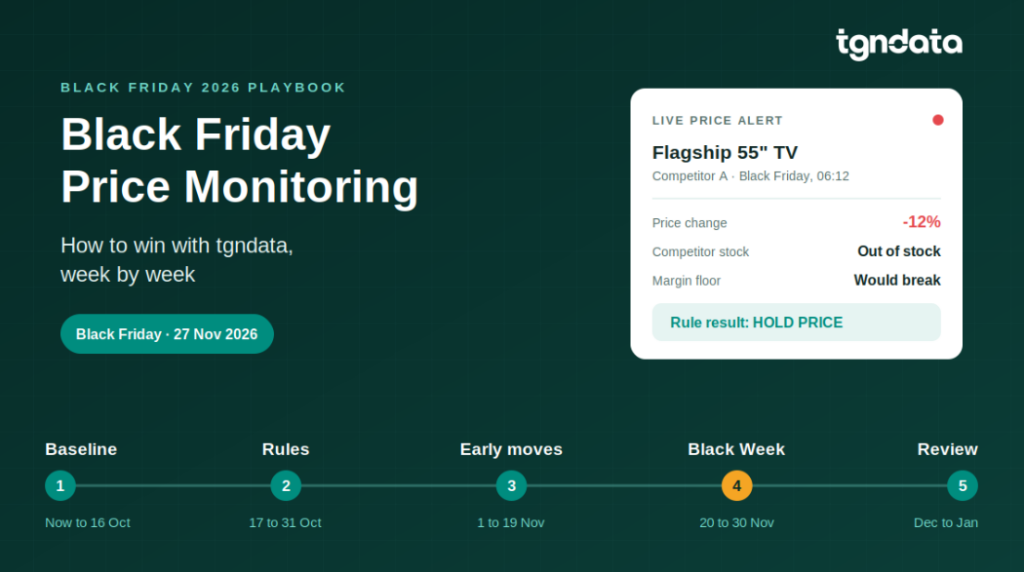
If a competitor is cheaper but out of stock, their price may not matter. If most competitors are out of stock and you have availability, you may be able to increase price or reduce discounts.
A strong competitive pricing strategy tracks:
Price without availability context is incomplete.
A price gap is the difference between your price and the market benchmark.
Useful benchmarks include:
Not every gap is a problem. A higher price may be justified by better service, faster delivery, stock availability, warranty, loyalty benefits, or brand strength.
Focus on gaps that affect conversion, margin, or market visibility.
Manual pricing does not scale across thousands of SKUs and fast-moving competitors.
Automation is useful when:
Dynamic pricing should not mean uncontrolled pricing. It should mean governed automation based on rules, market signals, and profitability.
tgndata is publicly described as supporting dynamic pricing rules, automated monitoring, alerts, dashboards, product matching, historical data, and API access, making it relevant for businesses that want to operationalize competitive pricing at scale.
Measure pricing performance regularly.
Track:
The goal is not to be cheapest. The goal is to improve pricing decisions.
Imagine an ecommerce retailer sells consumer electronics.
A high-traffic laptop model is priced at €899. Competitor A sells it for €879, Competitor B sells it for €895, and Competitor C is out of stock at €849.
A weak strategy would immediately drop the price to €849.
A better strategy would:
That is competitive pricing. It uses market data, but it does not surrender strategy.
Chasing the lowest price
Being cheapest is not always profitable or necessary.
Monitoring too many irrelevant competitors
Bad benchmarks create bad decisions.
Ignoring stock availability
Out-of-stock prices can distort the market.
Using one rule for every product
Different SKUs need different pricing logic.
Relying on manual checks
Manual monitoring is slow, inconsistent, and difficult to scale.
Ignoring margin floors
Competitive pricing without margin protection becomes discounting.
Competitive pricing is a strategy that uses competitor prices and market data to set product prices that balance competitiveness, revenue, and margin.
No. Competitive pricing is the strategy. Dynamic pricing is one way to execute it by adjusting prices automatically based on rules and market signals.
No. You should match competitors only when it supports your goals and protects margin.
You need competitor prices, stock availability, promotions, product matches, historical trends, marketplace data, and your own margin rules.
Building a competitive pricing strategy is not about reacting to every price change in the market. It is about making controlled, data-driven decisions that balance competitiveness with profitability.
The companies that win are not the ones with the lowest prices. They are the ones with the best visibility into their market, the clearest pricing rules, and the ability to act quickly when conditions change.
By defining your pricing goals, focusing on the right competitors, segmenting your products, and using real-time market data, you can turn pricing from a reactive task into a strategic advantage.
Want to turn your pricing strategy into a competitive advantage?
Use tgndata to monitor competitor prices, stock, and promotions in real time so your team can make faster, smarter pricing decisions without sacrificing margin.
We use cookies to provide you with an optimal experience, for marketing and statistical purposes only with your consent, which you may revoke at any time. Please refer to our Privacy Policy for more information.
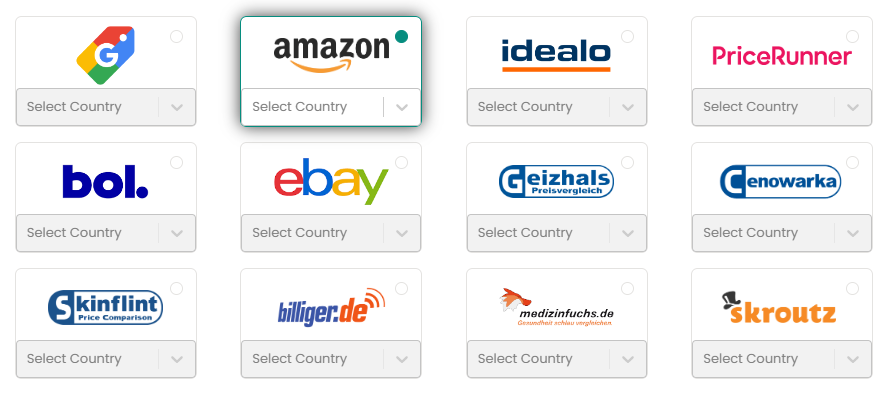










Missing an important marketplace?
Send us your request to add it!