
- Product
- Solution for
For Your Industry
- Partners
- Plans & Pricing
- Resources

For Your Industry
Penetration pricing is a launch strategy that sets the entry price below the market to win share fast, and in a peer-reviewed study of 663 digital camera launches in a large European country, penetration launches started 18% below the market price, yet only 20% of products followed that path. The strategy is easy to start and hard to finish. In the same study the penetration pattern was defined by prices that kept falling relative to the market, not by a tidy step back up, and a 2025 Simon-Kucher survey of German streaming users found that nearly half would consider cancelling after a 20% price rise. This guide defines penetration pricing, shows where it has worked and been tested in Europe, lists the risks, and sets out an exit plan that raises prices in small steps without losing the customers you paid to win.
Penetration pricing is the practice of launching a product or service at a deliberately low price, below what the market would normally pay, to build volume and share quickly, with a plan to raise the price once demand is established. Three parts make it penetration pricing rather than a one-off discount: a below-market entry price, a volume or share objective instead of a short-term profit target, and a planned move to a sustainable price later. Salesforce describes it as the mirror image of skimming, where penetration starts low and rises while skimming starts high and falls, and DealHub adds that it usually depends on price-elastic demand.
A simple retail version shows how it works. Imagine a Dutch DIY webshop that launches an own-label cordless drill. Matched competitor products sell for a median of €100, so the webshop enters at €82, which is 18% below the reference. The goal is not to make €12 on each drill. It is to get the drill into thousands of baskets, collect reviews, win repeat purchases of batteries and accessories, and then move the price toward €100 before competitors or customers anchor on €82. This scenario is illustrative, not a client example, and we use it again below.
Penetration pricing is not the same as a promotion. A promotion is a temporary reduction from an established price. Penetration pricing is the first price a customer ever sees, which is why it shapes what they believe the product is worth. It is also not the same as predatory pricing, which is aimed at pushing rivals out of the market. We separate those clearly in the comparison section.
Penetration pricing is an entry price plus an exit plan, and a launch with only the first half is just a discount.
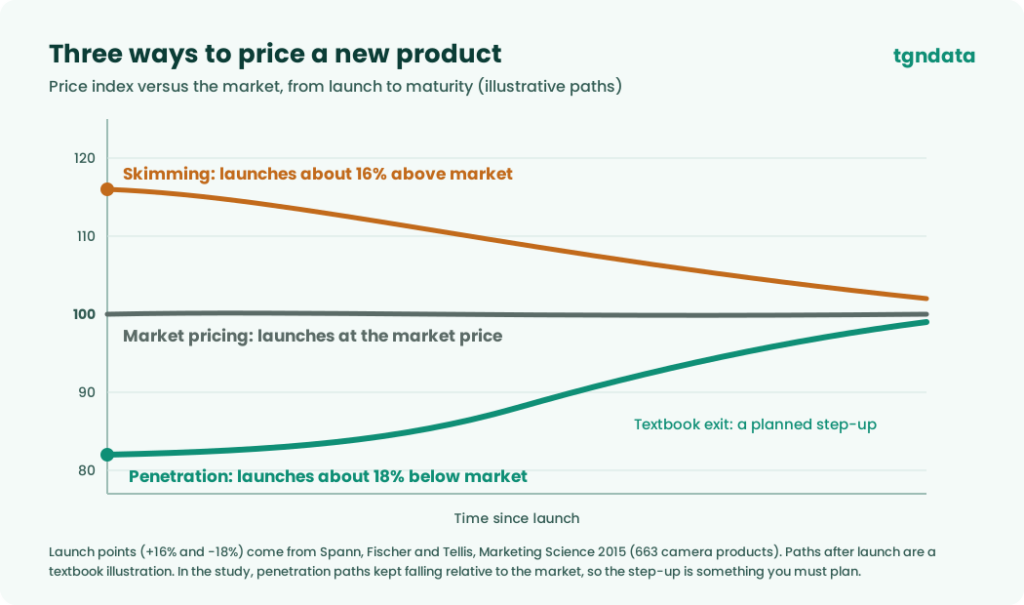
It is less common than textbooks suggest: in the best-known European dataset, 20% of new products used a penetration path, 20% used skimming and 60% launched at market prices. The data comes from Martin Spann, Marc Fischer and Gerard Tellis, who analysed pricing paths for new digital cameras and published the results in Marketing Science in 2015. Penetration launches entered 18% below the market price, while skimming launches entered 16% above it.
The authors also found who tends to choose each path. According to the INFORMS press release, market pricing and penetration happen more often after a market has taken off and as competition intensifies, late entrants lean toward market pricing, firms with an established reputation prefer skimming, and penetration is more likely for firms with larger cumulative sales. That last point matters: penetration pricing is not only a startup tactic. Scale players use it too, because scale lowers their unit costs.
Why do so few firms commit? Tellis explained that competitors tend to undercut a skimming price and match a penetration price, which removes the scale advantage the strategy was meant to create. The authors conclude that firms run a portfolio, using penetration on some products and skimming on others so that the margins of one lane help fund the other.
Methodology: The study analysed 663 digital camera products sold under 79 brand names in one large European country, classifying each product’s price path relative to the market during its introduction and early growth phase. It covers one durable goods category in one country, so the percentages will differ in grocery, fashion or subscriptions. Source: Spann, Fischer and Tellis, Marketing Science, 34(2), 2015, with the INFORMS press release summarising the findings.
There is a second finding that is easy to miss. In the study’s classification, the penetration pattern is a launch 18% below market followed by a price that continues to fall relative to the market. In other words, the textbook step-up back toward the market price did not happen automatically in the data. If you want one, you have to plan it.
Penetration pricing works best as one lane in a portfolio, and the step-up is a decision you make, not something that happens on its own.
Penetration pricing starts low and rises, skimming starts high and falls, loss leaders sell selected items cheaply to lift the whole basket, and predatory pricing is below-cost pricing by a dominant firm to drive out rivals. The four are often mixed up, and the difference matters for both strategy and law.
| Strategy | Entry price | Main goal | Typical user | Main risk |
|---|---|---|---|---|
| Penetration pricing | Below market | Share, adoption, scale | New entrants and scale players | Hard to raise prices, price war |
| Price skimming | Above market | Margin from early adopters | Differentiated or new-technology products | Slow adoption, rivals undercut |
| Loss leader | Selected items at or below cost | Traffic and basket size | Retailers | Attracts discount-only shoppers |
| Predatory pricing | Below cost, by a dominant firm | Remove competitors | Dominant firms only | Competition law |
The legal line deserves a clear sentence. In the EU, predatory pricing is assessed under Article 102 TFEU, which concerns abuse of a dominant position. The European Commission adopted new Article 102 guidelines on exclusionary abuses on 3 September 2026, replacing its earlier guidance on enforcement priorities. According to Crowell’s summary, price-cost tests based on average variable and average total cost remain central for predatory pricing, and Herbert Smith Freehills Kramer notes that the predatory pricing section mostly codifies existing case law. Wikipedia makes the practical point that it can be hard to tell legal penetration pricing from illegal predatory pricing, which is why cost records matter.
Most new entrants are far from dominant, so a low entry price is normally a legitimate competitive move. If your share in a narrow category becomes large, though, keep documentation showing your cost basis and your reason for the price, and ask counsel. This is general information, not legal advice. For the positioning side of the decision, see tgndata’s guide to price positioning without being the cheapest.
Penetration pricing is a growth tactic with a planned end, and the moment it looks like a permanent below-cost position held by a dominant firm, it becomes a legal problem.
It works when demand is price elastic, unit costs fall with volume, rivals cannot match the price profitably, and customers have a reason to stay after the price rises. Wiser lists many competitors, a mass market and scope for economies of scale as the conditions where it fits. AccountingTools makes the cost point directly: the strategy works best when higher volume lowers the cost of each unit, and it is hard for a resource-poor company that cannot survive on thin margins.
Cash is the other test. Baremetrics warns that a company without much cash can become insolvent before it becomes established, and the arithmetic explains why. Take the DIY webshop again. Market price is €100 and the variable cost of each drill, including purchase cost, shipping, payment fees and returns, is €70, so full-price contribution is €30. At €82 the contribution is €12. To earn the same total contribution as at full price, the webshop needs 2.5 times the unit volume (30 divided by 12). If the entry discount does not bring in at least that much extra volume, the launch is losing money relative to simply entering at the market price.
Five questions to answer before launch:
If the answer to the last question is only the low price, the exit will be painful.
Penetration pricing earns its keep only when volume lowers your costs or builds a customer base that stays, and you can prove both before you start.
Three European examples show different sides of the strategy: price-led marketplace entry (Temu), entry-tier pricing and later step-ups (Netflix in Germany and Italy), and portfolio launch pricing in consumer electronics (digital cameras). None is a perfect textbook case, and that is useful, because real markets rarely behave like the diagram.
Temu in Europe: a price-led entry that now faces a cost shock. Lengow’s analysis notes that Temu has kept ultra-competitive pricing at the centre of its offer while it localises in Europe. According to ecommercenews.eu, Temu’s Digital Services Act reporting showed an average of about 129.7 million monthly EU users in the second half of 2025, up from 115.7 million six months earlier, with Germany its largest market at 20.9 million. Retention Edge reports that Temu estimated about 124 million average monthly EU recipients in the six months to 30 June 2026, down from about 130 million. Then, on 1 July 2026, the EU introduced a temporary flat customs duty of €3 on low-value parcels from outside the bloc, running to 1 July 2028 and possibly extended, according to the Cyprus Mail. Cybernews reports that platforms such as Temu, AliExpress and Shein add the fee at checkout for parcels under €150. The user dip came before the duty took effect, so the duty is not its cause. What it shows is that an exit from a very low price can be forced by outside costs, and that a model built on the lowest price has the least room to absorb them.
Methodology: The EU user figures are six-month averages reported by Temu under the Digital Services Act, relayed by ecommercenews.eu and Retention Edge, and counted by the platform’s own rules, so they are not comparable with app-download or panel data. We treat Temu as a price-led entry, not as an officially labelled penetration pricing case.
Netflix: an entry tier, then a step-up, then a court. The ad-supported plan was built as a cheap way in for new users, according to Que.es. TradingPedia reports that Netflix raised the German ad-supported plan from €4.99 to €6.99 a month in September 2026, a 40% rise, alongside smaller percentage increases on other tiers, and cites a Citi estimate that German revenue per user could rise 24%. The new prices applied first to new customers, and t3n reported that existing customers were notified later and could defer the increase by about three months. This is a clean illustration of segmenting an exit: new customers first, existing customers with notice. The legal backdrop shows the risk of getting it wrong. In April 2026 a Rome court ruled that Netflix’s Italian price increases between 2017 and 2024 were unlawful because the contract clauses did not give a justified reason, according to Reuters, and Euronews reports potential refunds of up to €500 for long-standing Premium subscribers. Netflix said it would appeal.
Methodology: The German prices and the Citi estimate are as reported by TradingPedia, the notification detail is from t3n, and the Italian ruling is from Reuters and Euronews coverage of the consumer group Movimento Consumatori’s case. The Citi figure is an analyst forecast, not a measured result.
Digital cameras: the portfolio view. Spann, Fischer and Tellis found that firms rarely commit one way. They launched some products 18% below market and others at or above it, so that penetration products built volume while skimming products carried margin. That is the closest thing in the evidence to a recommended structure.
The examples agree on one point: the entry price is the easy decision, and the step-up is where the money, the customers and the legal risk are decided.
There are six: margin burn, a low price anchor, competitor retaliation, a low-quality signal, customers who leave at the step-up, and legal exposure. Most of them show up after launch, not during it.
1. Margin burn. The 2.5 times volume example above is the quickest check. A deep entry discount needs a large volume response, and if it does not arrive, cash runs out first.
2. A low price anchor. Wikipedia notes that the main drawback is that the strategy sets long-term price expectations and brand impressions, which makes it hard to raise prices later. Monetizely makes the same point from the pricing consulting side: customers used to a low rate tend to resist paying more.
3. Competitor retaliation. If rivals match your price, you pay the margin cost and get none of the volume gain. Wikipedia’s description of price wars is a cycle in which each competitor tries to match or undercut the other. The defence is early sight of the response. tgndata’s guide to using competition data without destroying margins covers how to tell a real competitor move from noise.
4. A low-quality signal. Stripe lists perceived low quality among the main challenges, alongside price wars and difficulty raising prices. A price far below the market can make shoppers wonder what is missing, especially for products that are hard to judge before use.
5. Churn at the step-up. This is the largest risk and the best documented. Simon-Kucher’s survey of more than 1,000 consumers in Germany found that almost one in five streaming users would consider cancelling after a 10% price rise and nearly half, 48%, after a 20% rise, with Disney+ subscribers at 58%. The same survey found willingness to cancel falls with tenure: 33% after one year of subscription and 8% after four years. Simon-Kucher’s Lisa Jäger called price increases the strongest driver of cancellations in streaming.
Methodology: Simon-Kucher surveyed more than 1,000 consumers in Germany about their streaming habits, subscriptions and budgets, and the findings were reported by Broadband TV News in October 2025. They measure stated intent in one subscription category, not actual behaviour in retail, so read them as a guide to relative risk: the bigger the single jump, the bigger the exposure.
6. Legal exposure. Article 102 matters only for dominant firms, but two other rule sets reach almost everyone. The 30-day lowest price rule shapes any promotion after your step-up, and consumer contract law governs price changes to subscriptions. Both are covered in the exit section below.
The low price is not what hurts a penetration launch, the missing exit plan is, because every one of these risks gets worse the longer the plan stays unwritten.
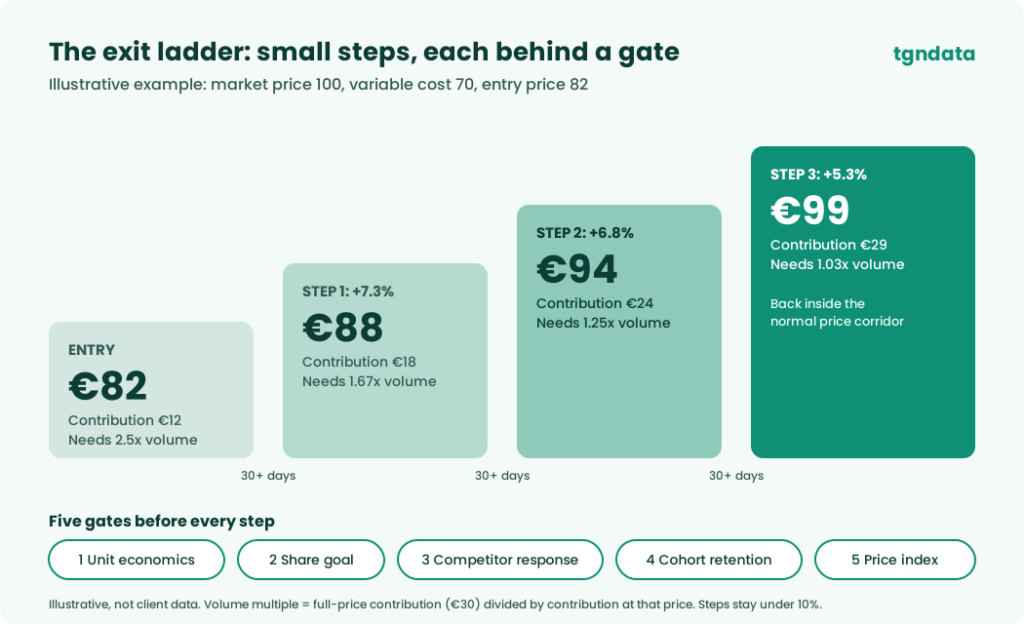
Exit in small, scheduled steps, each tied to a gate you set before launch, and add visible value before each step. The five gates are unit economics, share goal, competitor response, cohort retention and price index. A step happens only when all five pass.
Step 1: write the exit before launch. Decide what ends the entry price: a date, a share level, a customer count or a unit-economics threshold. E-commerce Fastlane suggests triggers such as reaching a given market share or customer count. Whatever you choose, write it down and name an owner. An exit with no owner defaults to never.
Step 2: fence the entry price. Limit the offer by segment, channel or time so the entry price does not become the default for your whole base. Netflix’s September 2026 move is an example: new customers saw the new prices first and existing customers followed with notice.
Step 3: climb in steps under 10%. The Simon-Kucher figures are the reason. A 10% rise worried about one in five users and a 20% rise worried nearly half. Back in the DIY scenario, a path from €82 to €99 can be split into three steps of about 7%, 7% and 5%, each at least 30 days apart. The 30-day gap is also convenient for compliance, as the next section explains.
Step 4: add value before the price rises. Rho advises tying the increase to value and giving at least 30 days of notice, and DealHub says vendors must be open about their intention to raise prices so that customers do not feel misled. In practice that means a visible improvement to range, delivery, service or warranty in the same month as the step, and a plain explanation.
Step 5: let the data open and close each gate. Hold a step if your key rival has just cut its price or if cohort retention dips below the level you modelled. Move earlier if rivals have raised their own prices or are out of stock on your matched products. Read the exit against tenure, too. Because willingness to leave falls as customers stay longer, a cohort that has bought three times is safer to move than one that has bought once.
Step 6: test, then roll out. Apply each step to a subset of products, a segment or one market first, and set a tolerance before you start, for example the volume drop you can absorb at the new contribution. The ladder in the image shows what that tolerance looks like: at €94 you need only 1.25 times the original volume to match full-price contribution, at €88 you need 1.67 times.
For how repricing rules protect floors and ceilings while you do this, see tgndata’s guide to ecommerce repricing strategies that increase profit.
A safe exit is a ladder of small steps with a gate at each rung, not a single jump on a date someone picked a year ago.
Three rule sets matter: the 30-day lowest price rule for promotions after a step-up, consumer contract law for subscription price changes, and Article 102 for dominant firms. The first two apply to almost every seller.
The 30-day lowest price rule. Under Article 6a of the Price Indication Directive, inserted by the Omnibus Directive, any announced price reduction must show the prior price, which is the lowest price the trader applied in at least the 30 days before the reduction. The European Commission’s guidance on the rule is summarised by RPC. tgndata’s guide to the 30-day lowest price rule covers the details, including the Court of Justice’s Aldi Süd ruling.
Here is why that matters for an exit. Suppose the DIY webshop steps up to €94 on day 1, and on day 12 runs a promotion at 10% off, a price of €84.60. The lowest price in the prior 30 days was the previous step at €88, so a claim of 10% off €94 would be misleading, and the real reduction is about 3.9%. The Dutch regulator ACM has also said it is prohibited to raise a price just before a reduction, according to tgndata’s article, so never push a step-up and a percentage-off banner into the same fortnight. A gap of 30 days or more between a step-up and any percentage-off promotion avoids most of the trouble, and the same article notes that for new products the ACM accepts a clearly stated shorter reference period.
Methodology: The calculation is our own worked example based on the rule as described in the Commission guidance summaries, with illustrative prices. National implementation differs, so confirm the counting convention with counsel in each market.
Subscription price changes. The Rome ruling against Netflix turned on contract clauses that allowed price rises without a justified reason, and a Cologne regional court reached a similar view for one German subscriber in May 2025, according to Digitec. If your entry price is a subscription or a membership, the step-up needs a contractual basis, a stated reason and a notice process that a court would accept.
Article 102. Relevant only if you are dominant. The Commission’s September 2026 guidelines keep price-cost tests at the centre, so keep cost records that show where your entry price sits.
For an EU seller, a legally clean exit leaves at least 30 days between a step-up and any percentage-off claim, and gives subscribers a stated reason and notice for every change.
Price intelligence software gives you the three data streams a penetration plan depends on: where your price sits against matched competitor products, how rivals respond, and whether your entry price still clears margin. tgndata is price intelligence software for retailers and brands, and these are the views a pricing team uses for this job, as described on tgndata’s own pages.
Two cautions. First, none of this works on bad matches: a pack of three matched to a single unit will show a price gap that does not exist. tgndata states 99%+ matching accuracy on its price intelligence page, and its guide to how product matching works explains how to audit it on the SKUs you care about. Second, history is your friend in a dispute, as covered in competitors’ price history insights.
For brands launching through retailers, the same data shows how far resellers move the price below your recommended level in the first weeks. In the EU, use that as market intelligence for your own pricing, because competition law limits how far brands can dictate resale prices.
You cannot run an exit ladder on instinct, because every gate on it is a number you have to be able to read daily.
Write the exit before you write the entry, and give each gate a number and an owner. Here is how that breaks down by role.
Pricing Managers
Ecommerce Managers
Category Managers
Commercial Directors and Revenue Managers
Brand Managers and Marketplace Managers
The teams that exit penetration pricing well treat the exit as a project with owners, dates and numbers, started on the same day as the launch.
Penetration pricing is a strategy that launches a product at a price below the market to win volume and share quickly, then raises the price once demand and loyalty are established. It is the opposite of price skimming, which starts high and falls. In a study of 663 digital camera launches in a large European country, penetration launches started 18% below the market price.
Examples include price-led marketplace entry, such as Temu in Europe, and low-priced entry tiers in streaming, such as Netflix’s ad-supported plan, which rose from €4.99 to €6.99 a month in Germany in September 2026. A simple retail version is an own-label product launched about 18% below the nearest brand and then raised in small, scheduled steps.
There is no universal duration. It should end when pre-agreed gates are met, such as a share target, unit economics that work at a higher price and stable customer retention. Survey data from German streaming users shows willingness to cancel falling from 33% after one year to 8% after four years, which supports tying the exit to how long customers have stayed instead of to a calendar date.
Penetration pricing is a low entry price meant to build a customer base and then rise, while predatory pricing is below-cost pricing by a dominant firm meant to drive out rivals. In the EU, predatory pricing is assessed under Article 102 TFEU using price-cost tests, and it applies only to dominant firms. Most new entrants are not dominant, but you should keep cost records and ask counsel if your share grows large.
Raise prices in steps under 10%, at least 30 days apart, add a visible improvement before each step, and gate each step on retention, competitor response and margin. A Simon-Kucher survey in Germany found almost one in five streaming users would consider cancelling after a 10% rise and 48% after a 20% rise, so large single jumps carry the most risk.
Yes, penetration pricing is legal in the EU when it is a genuine low price set by a firm that is not dominant. The rules to watch are Article 102 TFEU on below-cost pricing by dominant firms, the 30-day lowest price rule for any percentage-off promotion after a step-up, and consumer contract law for changing subscription prices, as the 2026 Rome ruling on Netflix price clauses shows. This is general information, not legal advice.
We use cookies to provide you with an optimal experience, for marketing and statistical purposes only with your consent, which you may revoke at any time. Please refer to our Privacy Policy for more information.










Missing an important marketplace?
Send us your request to add it!