
- Product
- Solution for
For Your Industry
- Partners
- Plans & Pricing
- Resources

For Your Industry
Price optimization software should help you make better pricing decisions, not just collect competitor prices.
For ecommerce teams, the right platform does three things well: it shows what is happening in the market, explains where pricing opportunities exist, and helps you act without losing control of margin, competitiveness, or brand positioning.
That means the most useful price optimization features are not always the flashiest ones. They are the features that improve pricing speed, data quality, decision confidence, and commercial outcomes.
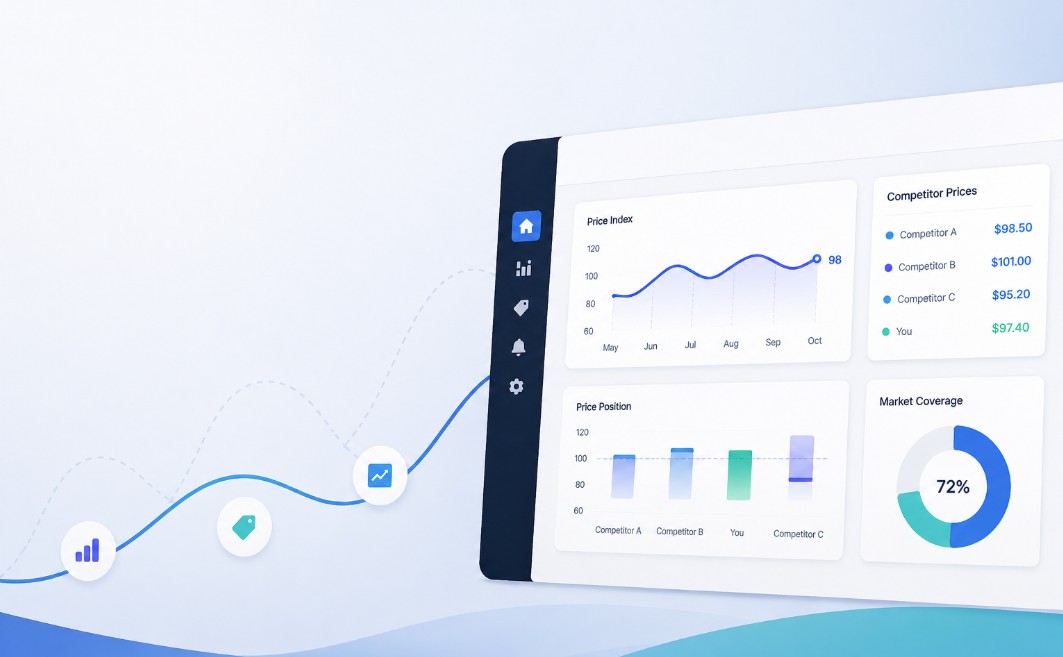
Price optimization software helps retailers and brands analyze market conditions, competitor prices, product availability, demand signals, and pricing rules to decide when and how prices should change.
In ecommerce, price optimization usually overlaps with:
The goal is simple: price products in a way that protects margin while staying competitive.
This is the foundation.
Without reliable competitor price data, every other feature becomes less useful. Your software should monitor competitor websites, marketplaces, and relevant sales channels regularly enough to reflect real market movement.
Look for:
For ecommerce teams, competitor price monitoring is not just about “who is cheaper.” It is about understanding where you are overpriced, underpriced, exposed to margin loss, or missing a market opportunity.
Product matching is one of the most important and most underestimated features.
If your platform cannot accurately match your products to competitor equivalents, your pricing decisions will be flawed. Manual matching also becomes impossible once you manage thousands of SKUs.
Strong product matching should handle:
This is especially important for retailers with large catalogs, brands monitoring resellers, and category teams comparing assortment coverage.
Dynamic pricing is useful only when it reflects your business logic.
Good price optimization software should let you create rules based on:
The key is control. Your pricing team should be able to automate repetitive decisions while still protecting margin and avoiding irrational price wars.
Some categories move slowly. Others change by the hour.
Your software should let you monitor pricing at the cadence your market requires. For high-competition categories such as electronics, appliances, fashion, beauty, automotive parts, and marketplace-heavy retail, stale data can lead to poor pricing decisions.
Useful update features include:
The right cadence depends on how quickly competitors change prices and how much revenue is at risk.
A single competitor price snapshot is not enough.
Historical data helps you understand patterns: who discounts frequently, which competitors trigger price drops, how promotions affect market position, and where your pricing strategy is consistently too aggressive or too passive.
Look for dashboards that show:
This turns price optimization from reactive repricing into strategic pricing management.
Pricing teams should not have to inspect every SKU manually.
The best tools surface only what needs attention. Alerts should flag commercial exceptions such as:
This helps teams focus on decisions, not data cleanup.
For brands and retailers selling through marketplaces, price optimization must include marketplace visibility.
Important capabilities include:
For brands, this protects pricing discipline. For retailers, it helps identify where marketplace competition is putting pressure on revenue or margin.
Different teams need different views.
An ecommerce manager may want competitiveness by category. A pricing analyst may need SKU-level rule performance. A brand manager may care about reseller violations. A leadership team may want margin and revenue impact.
Useful reports include:
tgndata is publicly listed with features such as dashboards, benchmarking, pricing analytics, competitor price tracking, real-time monitoring, reports, and dynamic pricing.
Price optimization should connect with the systems your team already uses.
Look for integrations or API access for:
This matters because pricing decisions often need to flow into operational systems, not stay trapped inside a dashboard.
The biggest risk in price optimization is making automated decisions from bad data.
Before choosing software, ask:
A cheaper tool with weak data quality can cost more than it saves.
Not every team needs advanced AI forecasting on day one.
Many ecommerce businesses get more value from strong fundamentals:
Advanced forecasting, machine learning, and fully autonomous pricing can be useful later, but only after the data foundation is reliable.
Use this checklist:
tgndata is a strong fit for ecommerce retailers and brands that need competitor price monitoring, pricing intelligence, dynamic pricing rules, marketplace visibility, dashboards, alerts, reporting, and product matching in one workflow.
It is especially relevant for teams managing competitive categories, large SKU counts, multiple competitors, or marketplace-driven pricing pressure.
Want to see how your prices compare across competitors, marketplaces, and categories? Use tgndata to monitor the market, identify pricing gaps, and automate smarter pricing decisions.
The most important feature is accurate competitor price monitoring. Without reliable and up-to-date market data, any pricing decision or automation will be flawed. Everything else, including dynamic pricing and analytics, depends on data quality.
Price optimization software helps improve profitability by identifying where products are overpriced or underpriced, protecting margin with pricing rules, and reacting faster to competitor changes. It enables smarter pricing decisions based on real market conditions instead of guesswork.
No. Many ecommerce teams see strong results using competitor monitoring, alerts, and pricing analytics alone. Dynamic pricing becomes more valuable once you have reliable data and clear pricing rules in place.
Product matching is critical. If your products are not correctly matched with competitor equivalents, your pricing insights will be inaccurate. Strong automated matching ensures you are comparing like-for-like products at scale.
Yes, but the use cases differ. Retailers focus on staying competitive and maximizing margin, while brands use it to monitor resellers, enforce MAP pricing, and maintain price consistency across channels.
We use cookies to provide you with an optimal experience, for marketing and statistical purposes only with your consent, which you may revoke at any time. Please refer to our Privacy Policy for more information.










Missing an important marketplace?
Send us your request to add it!