
- Product
- Solution for
For Your Industry
- Partners
- Plans & Pricing
- Resources

For Your Industry
Most companies assume pricing competition follows a simple rule: lower prices win customers. But in reality, the companies that consistently outperform competitors rarely win because they are the cheapest. They win because they implement a clear price positioning strategy that places their products at the right point in the market relative to competitors and perceived value.
A strong price positioning strategy allows organizations to compete effectively while maintaining healthy margins and long term brand equity. Instead of reacting to every competitor discount, successful businesses align pricing with value perception, category benchmarks, and competitive market signals.
In digital commerce environments where thousands of competitors adjust prices daily, pricing strategy is no longer a static decision. It requires continuous validation through competitive intelligence and market monitoring.
That is why leading retailers and brands increasingly treat pricing as an operational discipline supported by real time data.
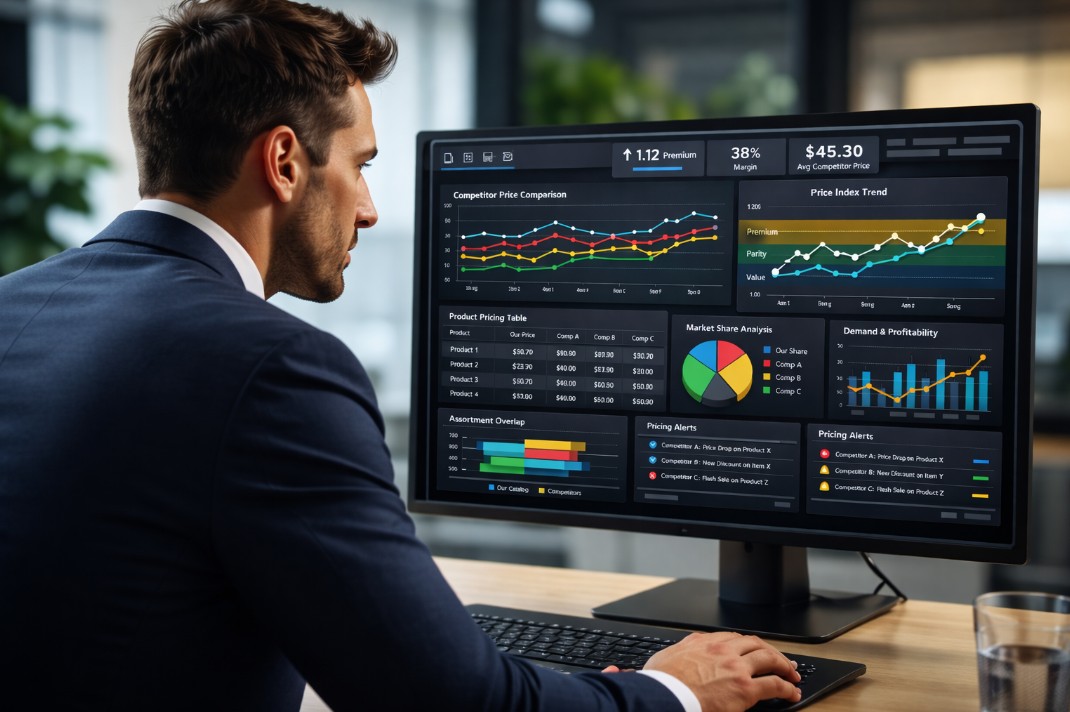
A price positioning strategy determines where a company’s products sit relative to competitors on the price spectrum. Instead of focusing solely on being cheapest or most expensive, businesses align pricing with perceived value, category expectations, and competitive benchmarks to maintain profitability and market differentiation.
Price positioning is often simplified into three basic categories.
Budget.
Market average.
Premium.
While those labels are useful starting points, the real concept is more nuanced.
Price positioning is fundamentally about relative comparison within a competitive landscape.
Customers rarely evaluate prices in isolation. Instead, they compare similar products across retailers and brands. These comparisons determine whether a product appears affordable, expensive, or appropriately priced.
Three common strategic positions typically emerge.
| Position | Strategic Purpose |
|---|---|
| Value focused | Capture price sensitive demand |
| Market aligned | Match category expectations |
| Premium positioned | Signal quality or differentiation |
Each of these positions can be profitable when executed correctly.
The critical factor is consistency between price and perceived value.
A premium price without premium perception quickly erodes demand. Likewise, a low price without operational efficiency destroys margins.
To evaluate positioning objectively, many organizations track price index metrics, which measure how their pricing compares to competitors.
For example:
Price Index 0.9 → cheaper than competitors
Price Index 1.0 → equal to competitors
Price Index 1.1 → priced above competitors
This simple benchmark helps pricing teams understand how their assortment is positioned across the market.
Without this visibility, businesses often misinterpret how customers actually perceive their prices.
Competing only on lowest price can lead to margin erosion, unstable profitability, and destructive price wars. When competitors match discounts, companies quickly lose their advantage. Sustainable price positioning strategies focus on value perception, selective competitiveness, and data driven pricing decisions rather than universal price reductions.
The temptation to win on price is strong.
Lower prices attract attention.
They increase short term conversions.
They create an illusion of competitiveness.
However, the long term effects are often damaging.
Competing solely on price triggers a cycle known as price compression.
This process typically unfolds in stages.
First, one competitor lowers prices to gain demand.
Then other competitors match or beat the discount.
Soon, the entire category experiences lower margins.
The result is a race where everyone moves faster but nobody moves forward.
Situation
A consumer electronics retailer attempted to dominate search results by offering the lowest prices across dozens of popular products.
What breaks without accurate data
Competitors monitored the retailer closely and continuously undercut prices by small amounts.
The retailer responded by lowering prices again.
Margins collapsed.
What changes when accuracy improves
Once the retailer began tracking competitor pricing daily, the team discovered that only a subset of highly visible products actually required aggressive pricing.
Strategic takeaway
Winning pricing strategies focus on strategic price positioning across categories, not universal discounting.
Price positioning is influenced by several market signals including competitor pricing, assortment overlap, consumer demand patterns, and promotional activity. Businesses that monitor these signals consistently gain a clearer understanding of how their products are perceived within the market price spectrum.
Pricing is shaped by far more than internal cost structures.
Markets constantly generate signals that influence price perception.
These signals include competitor actions, category dynamics, and consumer behavior.
Understanding these signals allows businesses to maintain the correct pricing position.
Competitors adjust prices frequently in digital marketplaces.
Even small changes can influence how customers interpret category pricing.
Monitoring these movements helps companies respond strategically rather than reactively.
Products sold by multiple retailers become comparison anchors.
Customers often evaluate these items when deciding whether a retailer is expensive or affordable.
If these key comparison products are priced incorrectly, the entire brand perception can shift.
Discount patterns within a category affect long term price expectations.
Frequent promotions can train customers to expect lower prices.
Understanding these cycles is essential for protecting brand positioning.
Products with high search visibility often become pricing reference points.
Maintaining competitive pricing on these products can shape the perception of the entire catalog.
Platforms like tgndata help organizations monitor these signals by tracking competitor catalogs and price changes across large product assortments.
Data driven pricing uses competitor intelligence, demand signals, and price benchmarking to optimize pricing decisions. By understanding where products sit relative to competitors, companies can maintain strong price positioning while protecting margins and avoiding unnecessary discounting.
Pricing decisions used to rely heavily on experience and intuition.
Today, digital commerce environments move too quickly for manual analysis.
Thousands of products, hundreds of competitors, and constant price changes create enormous complexity.
Data driven pricing provides the structure required to manage this complexity.
Key capabilities typically include:
competitor price monitoring
price index tracking
assortment overlap analysis
category level price benchmarking
Situation
A cosmetics brand selling through several online marketplaces struggled with inconsistent price positioning.
What breaks without accurate data
Third-party sellers occasionally list products significantly below recommended pricing levels.
This damaged the brand’s perceived value.
What changes when visibility improves
By tracking marketplace listings and competitor prices continuously, the brand quickly identified unauthorized discounting.
Strategic takeaway
Maintaining price positioning requires ecosystem wide visibility, not just internal price management.
Maintaining price positioning across large product catalogs requires automated monitoring, structured pricing policies, and reliable competitive data. Organizations that scale pricing successfully rely on pricing intelligence systems that continuously track competitor prices, product matches, and category benchmarks.
Managing pricing for a small catalog is manageable.
Managing pricing for tens of thousands of products is not.
Large retailers and marketplaces must evaluate pricing across enormous product assortments every day.
This requires operational infrastructure.
Key capabilities include:
automated competitor price monitoring
product matching across retailers
price movement alerts
category level pricing analysis
Situation
A major online retailer managed over 50,000 SKUs across multiple product categories.
What breaks without automation
Manual monitoring created blind spots where competitors temporarily undercut prices.
These blind spots often lasted weeks.
What changes when accuracy improves
Automated price monitoring enabled the pricing team to track their price index across the entire catalog daily.
Strategic takeaway
Maintaining strategic price positioning requires continuous competitive monitoring infrastructure.
tgndata functions as the operational backbone for this monitoring process by tracking competitor assortments and price changes across digital retail ecosystems.
Value perception determines whether customers accept higher prices for a product. Brands that communicate quality, reliability, or convenience effectively can maintain stronger price positions because customers perceive greater value relative to competitors.
Customers rarely judge prices objectively.
Instead, they evaluate price relative to perceived value.
Value perception can be influenced by multiple factors.
These include:
brand reputation
product quality
delivery speed
customer experience
product content and reviews
When these factors align correctly, companies gain pricing power.
Situation
A premium appliance manufacturer priced its products above the category average.
What breaks without visibility
Retailers occasionally ran aggressive promotions that temporarily lowered prices below target positioning.
What changes when monitoring improves
By tracking pricing across retail partners, the brand maintained consistent premium positioning.
Strategic takeaway
Premium pricing must be supported by consistent market monitoring and partner alignment.
| Feature | Business Benefit | KPI Impact | Role Owner |
|---|---|---|---|
| Competitor price monitoring | Market visibility | Price index stability | Pricing manager |
| Assortment intelligence | Identify overlapping products | Competitive coverage | eCommerce analyst |
| Automated price alerts | Detect market changes quickly | Margin protection | Revenue manager |
| Category benchmarking | Optimize category strategy | Conversion rate | Brand strategist |
| Pricing analytics dashboards | Strategic decision support | Revenue growth | Pricing director |
Situation
A grocery retailer operated in a highly competitive environment where customers frequently compared prices across stores.
What breaks without monitoring
Several high visibility products were consistently priced above competitors without the category managers realizing it.
What changes when intelligence improves
Using competitor price tracking, the retailer adjusted pricing for key comparison products while maintaining margins on less visible items.
Strategic takeaway
Strategic price positioning often requires targeted adjustments rather than universal price changes.
Organizations evaluating pricing intelligence tools typically choose between building internal monitoring systems, purchasing specialized platforms, or combining both approaches. The best option depends on catalog complexity, engineering resources, and competitive landscape.
Eventually most organizations face a strategic technology decision.
Should pricing intelligence infrastructure be built internally or purchased from specialized vendors?
Advantages:
complete customization
internal data ownership
Challenges:
high engineering costs
fragile scraping infrastructure
ongoing maintenance
Advantages:
faster deployment
scalable competitor monitoring
reliable product matching
Challenges:
vendor selection risk
integration requirements
Many companies combine internal analytics systems with external competitive intelligence platforms.
When evaluating vendors, pricing teams should focus on:
product matching accuracy
competitor coverage
catalog scalability
automation capabilities
data export flexibility
Platforms such as tgndata provide competitive catalog monitoring and price intelligence that integrate into existing pricing workflows.
Price positioning must be continuously monitored because markets change constantly. Competitors adjust pricing, new entrants appear, and promotional cycles influence demand. Businesses that track these dynamics maintain stronger pricing discipline and long term profitability.
Markets evolve continuously.
Competitors introduce new products.
Promotions alter category pricing expectations.
Supply chain shifts affect cost structures.
Without constant monitoring, companies gradually drift away from their intended price position.
This drift can go unnoticed until it begins affecting revenue or demand.
Leading organizations treat pricing as an ongoing operational system, supported by competitive intelligence and analytics.
By continuously monitoring competitor catalogs, price movements, and assortment overlap, pricing teams maintain strategic control over their market position.
A price positioning strategy determines where a company’s products sit relative to competitors on the market price spectrum. Instead of competing only on lowest price, businesses align pricing with perceived value, category benchmarks, and customer expectations to achieve sustainable profitability.
Competing solely on lowest price often triggers price wars and margin erosion. When competitors match discounts, companies lose their advantage quickly. Sustainable pricing strategies focus on value differentiation and strategic price positioning rather than constant discounting.
Companies typically measure price positioning using a price index that compares their prices to competitor averages. A value below one indicates cheaper pricing, while a value above one indicates premium positioning relative to the market.
Competitor monitoring provides visibility into market pricing dynamics. By tracking competitor prices and assortments, businesses can adjust pricing decisions quickly and maintain their intended market position.
Yes. Premium pricing can succeed when products offer strong perceived value through brand reputation, quality, customer experience, or unique features. Continuous monitoring ensures that premium pricing remains competitive within the category.
In digital commerce environments, pricing positions should be monitored continuously. Frequent competitor price changes and promotional activity can quickly shift market expectations.
The most successful companies rarely dominate markets by offering the lowest prices.
Instead, they win by occupying the right position on the price spectrum.
A strong price positioning strategy aligns:
competitive benchmarks
customer value perception
category pricing dynamics
operational pricing intelligence
When organizations combine strategic pricing with real time competitive monitoring, they gain the ability to maintain profitability while remaining highly competitive.
tgndata enables pricing teams to track competitor assortments, monitor price changes across large product catalogs, and continuously validate their market price position.
For companies looking to move beyond reactive pricing, the real competitive advantage lies in pricing intelligence supported by accurate market data.
We use cookies to provide you with an optimal experience, for marketing and statistical purposes only with your consent, which you may revoke at any time. Please refer to our Privacy Policy for more information.










Missing an important marketplace?
Send us your request to add it!