- Product
- Solution for
For Your Industry
- Partners
- Plans & Pricing
- Resources
For Your Industry
Real-time Price Monitoring is no longer a nice-to-have for e-commerce teams. It is now the core pricing infrastructure.
For retailers and brands selling in fast-moving online markets, prices can shift multiple times a day across competitors, marketplaces, resellers, and comparison engines. At the same time, shoppers can compare offers instantly, and platforms like Google expect accurate price consistency between feeds and landing pages. When pricing data is delayed, teams do not just miss insights. They miss revenue, margin, visibility, and control.

Real-time price monitoring is the continuous tracking of competitor prices, stock status, promotions, and assortment changes across the channels that matter to your business.
In practice, that means a pricing team can see when:
The goal is not just to collect data. The goal is to turn fresh market signals into better pricing decisions.
For companies operating at scale, that usually requires automated product matching, frequent data collection, alerting, historical tracking, and repricing workflows. tgndata is positioned in exactly this category, with price intelligence, real-time monitoring, dynamic pricing, product matching, and marketplace coverage for retailers and brands.
The case for price monitoring is not new. What has changed is the speed, visibility, and complexity of online pricing.
Customers no longer evaluate your price in isolation. They compare. They search. They switch tabs. They use comparison sites, marketplaces, and shopping engines to check alternatives in seconds. Research on online price comparison behavior has shown how digital transparency increases switching behavior and expands how consumers compare offers before buying.
That means your pricing team is competing inside a much more transparent market than even a few years ago.
If your competitor drops price this morning and you notice tomorrow, you may already have lost the sale.
On marketplaces and major ecommerce channels, pricing is rarely static. Sellers react quickly to each other. Promotions overlap. Stock-outs create sudden openings. Unauthorized sellers can distort brand positioning. A slow weekly check is simply not enough when the market moves hourly.
This is one reason modern pricing platforms emphasize near real-time monitoring, competitor alerts, and automated rules instead of manual checks. tgndata, for example, is described across multiple product listings as supporting real-time or hourly monitoring, dynamic pricing, alerts, and tracking across competitor domains and marketplaces.
Pricing accuracy affects more than conversions. It also affects channel visibility.
Google Merchant Center explicitly requires the price in product data to match the price shown on the landing page. If it does not, products can be disapproved until the mismatch is resolved and re-crawled. For ecommerce teams running promotions or frequent price changes, this makes synchronized monitoring and fast operational feedback much more important.
So the risk of stale pricing is not only “we were slightly overpriced.”
It can also be “our products stopped showing.”
In most categories, pricing teams are balancing growth and profitability at the same time. They need to stay competitive without racing to the bottom. That is hard to do when competitor data is incomplete, delayed, or manually collected.
Real-time monitoring helps teams separate signal from noise:
In other words, real-time visibility supports precision. And precision matters when every margin point counts.
Pricing decisions no longer sit in one isolated spreadsheet.
Today, ecommerce, category, marketplace, pricing, commercial, and brand teams all need pricing visibility for different reasons:
A real-time monitoring system creates a shared source of market truth across those teams.
Many companies still monitor prices manually, through ad hoc checks, low-frequency scrapes, or spreadsheets updated once per day or week.
That seems manageable until the hidden costs show up.
A small price gap on a top-selling item can materially affect click-through and conversion, especially in categories where shoppers compare multiple retailers before buying.
When teams only discover those gaps after the fact, they are not making pricing decisions. They are doing post-mortems.
The opposite problem is just as common.
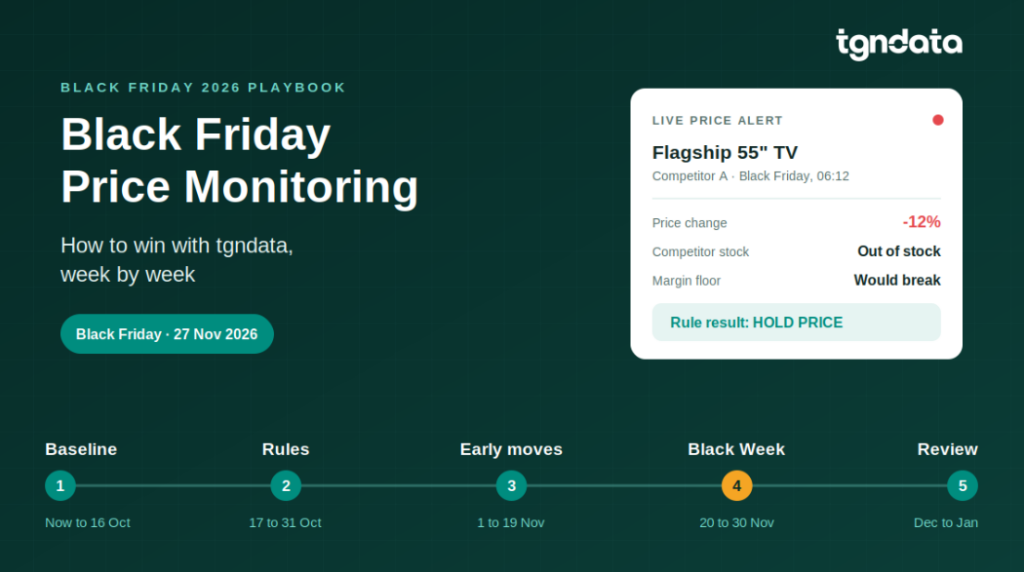
Without fresh competitor data, teams often discount defensively. They cut prices to stay “safe” without knowing whether the competitor is still lower, whether that offer is in stock, or whether the shopper is even comparing that seller.
Real-time monitoring reduces blind discounting because it gives context, not just a number.
A competitor stock-out changes the pricing equation immediately. If your closest rival is unavailable, you may have a temporary opportunity to protect margin rather than match a previous low price. But that opportunity only exists if you can see it in time.
Promotions are not just about base price. They include sale prices, bundles, shipping terms, coupon mechanics, and timing.
When a competitor launches or extends a promotion and your team learns about it too late, the issue is not only pricing. It is promotional responsiveness.
For brands, price monitoring is also about channel governance.
If unauthorized sellers or non-compliant resellers advertise below target price levels, the brand can lose control of positioning fast. Real-time monitoring helps flag breaches earlier, document them, and respond before discounting behavior spreads.
The value of real-time monitoring is not the dashboard itself. It is the set of decisions the dashboard makes possible.
You can react to meaningful competitor moves while they still matter.
That does not mean matching every price change. It means seeing important shifts early enough to choose the right response.
Dynamic pricing only works when the underlying market data is timely and accurate.
Otherwise, automation just makes bad pricing decisions faster.
This is why platforms in tgndata’s category combine frequent market tracking with rule-based repricing, alerts, and product matching. G2’s profile for tgndata describes it as enterprise-grade price monitoring and rule-based dynamic pricing for retailers and brands, with real-time updates and precise product matching across large SKU volumes.
Real-time monitoring is not only about the price tag. It also reveals:
That makes it useful for category strategy, not just tactical repricing.
When monitoring is continuous, pricing becomes easier to govern:
Pricing teams are often asked the same questions:
Those answers are stronger when they come from live market data instead of manually assembled snapshots.
A lot of teams think they need price monitoring when they actually need price intelligence.
There is a difference.
Basic monitoring tells you a competitor price changed.
Price intelligence tells you:
That distinction matters because raw data alone does not improve pricing performance.
To support real decisions, the system has to connect price changes to business context.
Not every tool labeled “price monitoring” is built for the same job. If the goal is better pricing execution, a few capabilities matter more than the rest.
Bad matching creates bad decisions.
If your system compares the wrong variants, bundle types, sizes, or sellers, the output is unreliable. High-confidence product matching is table stakes.
Some categories can tolerate daily updates. Others cannot.
The right platform should let you monitor sensitive SKUs more frequently and apply different logic by product, category, or competitor.
Modern pricing pressure often comes from marketplaces, unauthorized sellers, comparison engines, and resellers, not just the obvious retail set.
A useful monitoring system should reflect the real competitive landscape, not an idealized one.
Data is not enough. Teams need alerts tied to actual operating thresholds:
Without history, every price move looks urgent.
Historical tracking helps teams see patterns, distinguish normal behavior from meaningful shifts, and improve future decisions.
Monitoring becomes far more valuable when teams can act on it quickly through rules, exports, integrations, or pricing workflows.
Retailers need real-time monitoring because market prices can change before the trading day is over.
For them, the biggest use cases tend to be:
Retailers usually care most about speed, scale, and operational response.
Brands have a slightly different problem.
Their challenge is not only to stay competitive. It is also to protect market positioning across channels they may not fully control.
For brands, real-time monitoring helps with:
This is one reason tgndata’s positioning around retailers and brands is commercially strong. The company is not just framed as a generic analytics vendor. It is described across listings as a pricing intelligence and dynamic pricing platform for retailers, brands, and ecommerce teams, with use cases including marketplace tracking, assortment optimization, and MAP/MSRP protection.
Many teams only track obvious direct competitors and miss the channels actually influencing shopper decisions.
Real-time data should improve strategy, not create panic. Not every move deserves a response.
A competitor price without stock status or promo context can be misleading.
By the time a weekly report is reviewed, the most important moves may already be irrelevant.
Fresh data is useful only when teams know what action different scenarios should trigger.
The right mindset is not: “Can we see competitor prices?”
It is: “Can we detect meaningful market changes early enough to improve pricing outcomes?”
That shift changes how companies evaluate tools, workflows, and team priorities.
Real-time price monitoring is valuable because it helps teams:
Real-time price monitoring is the continuous tracking of competitor prices, stock status, promotions, and assortment changes across online channels so teams can respond quickly and make better pricing decisions.
It matters because ecommerce markets are highly transparent and fast-moving. A delayed response to a competitor price change, stock-out, or promotion can cost conversion, margin, and visibility.
No. It is valuable for both retailers and brands. Retailers use it to stay competitive and protect margin. Brands use it to monitor resellers, marketplaces, and MAP or MSRP compliance.
Price monitoring captures competitor prices. Price intelligence adds context, such as product matching, stock status, history, category view, and recommended actions, so teams can make better decisions.
Look for accurate product matching, frequent data collection, alerts, historical tracking, marketplace coverage, and workflow or repricing support.
Real-time price monitoring matters more than ever because ecommerce pricing is now faster, more transparent, more operationally sensitive, and more visible across channels than before. Shoppers compare instantly, marketplaces move quickly, feed accuracy affects discoverability, and pricing teams are under pressure to protect both growth and margin.
In that environment, delayed pricing data is not just inconvenient. It is expensive.
For retailers and brands, the question is no longer whether price monitoring is important. The real question is whether your current setup is fast, accurate, and actionable enough to compete in the market you are already in.
And increasingly, that answer depends on real-time visibility.
We use cookies to provide you with an optimal experience, for marketing and statistical purposes only with your consent, which you may revoke at any time. Please refer to our Privacy Policy for more information.
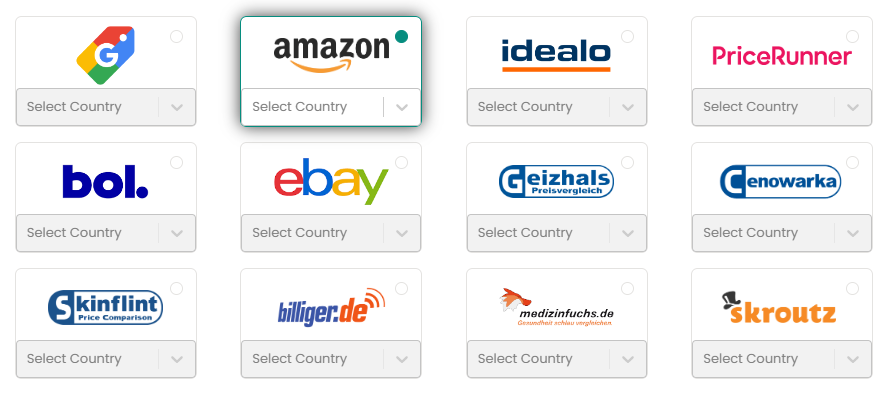










Missing an important marketplace?
Send us your request to add it!