
- Product
- Solution for
For Your Industry
- Partners
- Plans & Pricing
- Resources

For Your Industry
Dynamic pricing changes the price for all shoppers based on market conditions; personalised pricing changes the price for one shopper based on what the seller knows about them. In the debate over dynamic pricing vs personalised pricing, both practices produce prices that move, which is why the terms get used interchangeably in headlines, press coverage, and even internal pricing meetings. The distinction that matters is not how often a price changes. It is what data drives the change.
Dynamic pricing reacts to signals about the market: demand, stock levels, time of day, seasonality, costs, and competitor prices. If a competitor drops the price of a best-selling espresso machine by €40 on a Tuesday morning and your engine responds by lowering yours for every visitor, that is dynamic pricing. Personalised pricing reacts to signals about the person: browsing history, device, location, past purchases, or an inferred willingness to pay. If two shoppers see different prices for the same espresso machine at the same second because of who they are, that is personalised pricing.
The European Parliament’s 2022 study on personalised pricing, prepared for the Internal Market and Consumer Protection (IMCO) committee, draws the same line. It describes dynamic pricing as price differentiation that is based on current market demand rather than consumer data, and it separates several degrees of personalisation, including group personalisation where prices differ for segments such as students or older adults. That framing matters because EU legislators and regulators use it when they decide which practices need disclosure.
A practical test settles dynamic pricing vs personalised pricing for any pricing team: if two shoppers load the same product page at the same second, do they see the same price? If the answer is yes, you are running dynamic pricing, however fast it moves. If the answer is no because of the individual, you are personalising. For a refresher on how market-based engines are built, see our guide to dynamic pricing models explained and our beginner’s guide to dynamic pricing for retailers.
Takeaway on dynamic pricing vs personalised pricing: same moment, same product, same price for everyone means dynamic; a price keyed to the individual means personalised.
Yes, dynamic pricing is legal in the EU, and personalised pricing is legal too, but personalised prices set through automated decision-making must be disclosed to the consumer. There is no EU rule that bans a retailer from changing its prices, as often as it likes, in response to the market. The obligations sit around transparency and fairness.
Law firm Osborne Clarke, in its analysis of the Digital Fairness Act consultation, summarises the current position: EU consumer law does not prohibit dynamic pricing, and traders are free to set prices as long as consumers are adequately informed about the total price and, where it applies, about the fact that a price was personalised. The personalisation disclosure comes from Article 6(1)(ea) of the Consumer Rights Directive, added by the Omnibus Directive (Directive (EU) 2019/2161), which has applied since 28 May 2022.
When it comes to dynamic pricing vs personalised pricing, the scope of that disclosure is narrower than many teams assume. As Polish law firm Dudkowiak & Putyra explains in its Omnibus guidance, the duty to inform does not apply to dynamic or real-time pricing driven by factors unrelated to a specific user, such as a change in supply or demand. If a platform adjusts prices based on location, device, history, or cookies, however, it must tell the consumer. The European Parliament study adds that the scope of the provision is limited in practice, which is part of why the Commission is revisiting the topic.
Four other frameworks shape what a pricing engine can do in Europe:
Takeaway: market-based dynamic pricing needs no special label in the EU today, but personalised prices do, and every price change still has to survive UCPD, GDPR, and the 30-day rule.
Less common than the headlines suggest: the European Commission’s largest test found personalised price differences in only 6% of identical-product situations, while personalised ranking of offers was widespread. Measured as dynamic pricing vs personalised pricing, the evidence shows that European retailers personalise what shoppers see far more than what shoppers pay.
Methodology. The Consumer market study on online market segmentation through personalised pricing/offers in the European Union, published by the European Commission in July 2018, combined an EU28-wide online consumer survey, an online behavioural experiment, and a mystery shopping exercise across 160 ecommerce websites. The mystery shopping covered 8 Member States (Czechia, Germany, Spain, France, Poland, Romania, Sweden, and the then-member UK) and 4 markets: TVs, sports shoes, hotel rooms, and airline tickets. Fieldwork took place in Q2 and Q3 of 2017. Shoppers compared prices and rankings under personalisation and no-personalisation scenarios, varying factors such as browsing history and access route.
The findings split sharply. Over three fifths (61%) of the websites personalised the ranking of offers, rising to 92% of airline ticket sites and 76% of hotel sites, against 41% for sports shoes and 36% for TVs. The share of websites personalising offers ranged from 42% in Germany to 79% in Poland. Access through a price comparison website or a mobile device had the strongest impact on rankings. On prices, though, the study did not find consistent and systematic personalisation: price differences between the scenarios appeared in only 6% of situations with identical products, and where they did appear, the median difference was below 1.6%.
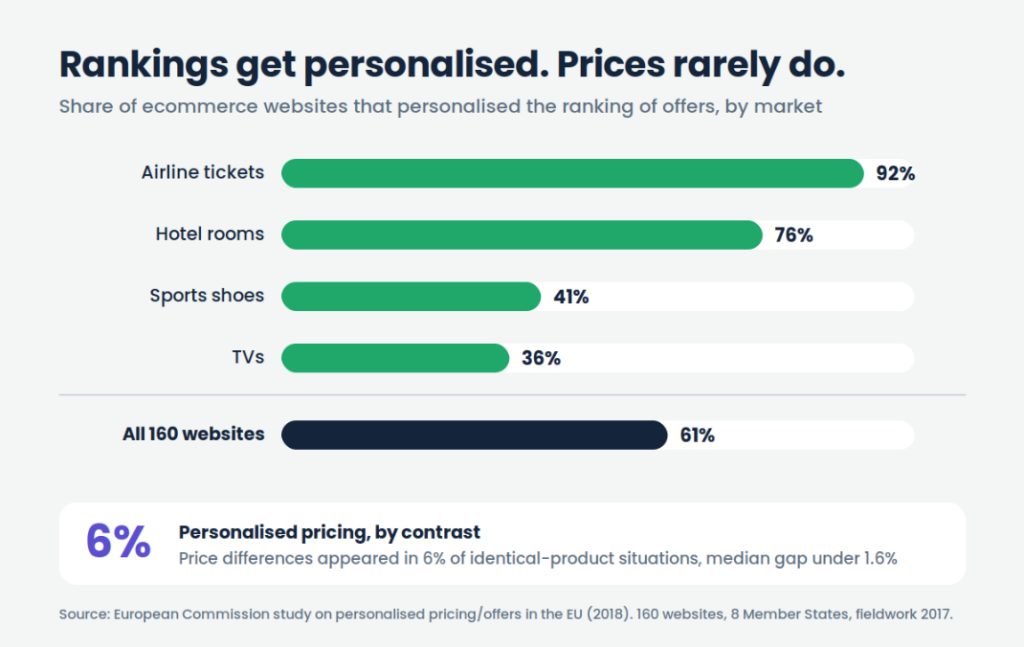
Commission (2018).
The Commission’s 2024 Digital Fairness Fitness Check did not overturn that picture. According to Freshfields’ review of the Fitness Check, the report states that evidence on personalised pricing is still emerging and that the Commission’s 2018 and 2022 studies did not find consistent and systematic personalised pricing. The same report, per Freshfields, cites a 2023 survey in which 70% of respondents were concerned about how their data is used for personalisation. Consumer concern, in other words, runs well ahead of measured practice.
Two caveats matter for pricing leaders. First, the mystery shopping fieldwork is now nine years old, and machine-learning pricing tools have matured since. Second, personalisation is hard to detect from outside, since a mystery shopper cannot reproduce every data point a retailer holds. Regulators know both, which is why the Digital Fairness Act is being drafted on the basis of risk and concern, not only on measured prevalence.
Takeaway: in European retail, personalisation lives mostly in rankings and offers today, but regulators are legislating for where the technology is heading, not where it was measured.
Often: German consumer advocates found that 15 of 16 online retailers they tracked changed prices regularly, and more than a third of observed prices moved within 34 days. Market-based dynamic pricing is not a niche practice in Europe. It is standard in Germany, the region’s largest ecommerce market.
Methodology. The Marktwächter Digitale Welt team at Verbraucherzentrale Brandenburg, as reported by the Federation of German Consumer Organisations (vzbv), observed the prices of selected products at 16 German online retailers for 34 days. The team counted how often each price changed and when changes occurred. The published summary does not state the fieldwork year alongside the headline results, so treat the figures as a benchmark of practice rather than a current snapshot.
The results show how routine repricing has become. The team found fluctuations in 37% of observed prices. Of the prices that varied, just under two thirds changed up to three times, 36% changed four to 15 times, and 4% changed more often, with one product changing 32 times in 34 days. Timing mattered: at auto parts retailer ATU, car batteries and tyres were at times up to 30% more expensive in the morning than the previous afternoon. At online pharmacies DocMorris and Sanicare, price cuts on some days coincided with increases on other items. The vzbv concluded that dynamic price differentiation is a firm part of pricing strategy in German online retail.
Nothing in those findings suggests personalisation. They describe prices moving for everyone, which puts them on the dynamic side of the dynamic pricing vs personalised pricing line. They describe prices moving for everyone. Yet the consumer guidance that Verbraucherzentrale offices publish on dynamic prices groups timing, competitor prices, and, increasingly, the users themselves together as factors that shape what a shopper sees. That is the perception problem pricing teams face: shoppers and some advocates see one blurred category, while the law treats the two practices very differently. Our guide on how often you should update prices in ecommerce covers how to set a repricing cadence that stays defensible.
Takeaway: frequent repricing is normal in Germany, so the risk is not how often your prices move but whether you can show they move for market reasons.
The Digital Fairness Act is expected to tighten rules on unfair personalisation, drip pricing, and misleading headline prices, but no proposal text exists yet, and market-based dynamic pricing is not the target of a ban. On dynamic pricing vs personalised pricing, teams should plan for more transparency obligations around personalisation, not the end of dynamic pricing.
The timeline is well documented. The Commission published the conclusions of its Digital Fairness Fitness Check on 3 October 2024. It ran a public consultation and call for evidence from 17 July to 24 October 2025. The 2030 Consumer Agenda, adopted on 19 November 2025, confirmed the Digital Fairness Act as a flagship initiative, and the European Parliament’s Legislative Train Schedule records that the Commission work programme for 2026 lists the proposal for the fourth quarter of 2026. As of 7 September 2026, compliance advisory Checkmate Experts reports that no proposal text, COM number, or procedure file exists. Sidley Austin expects negotiation in the Parliament and Council through 2026 and 2027, with final adoption possible in late 2027 and implementation deadlines after that.
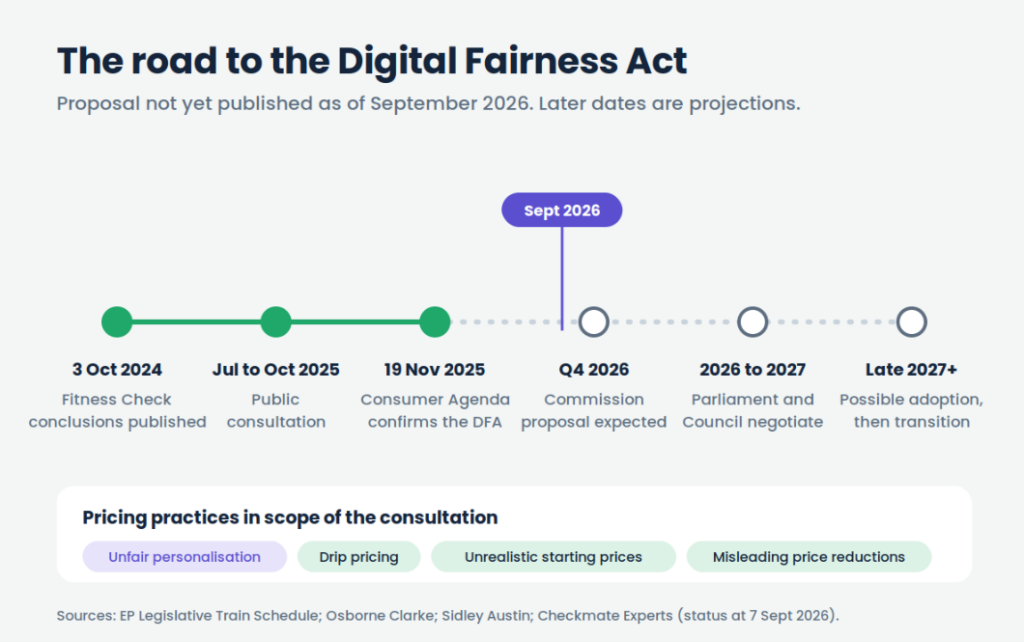
On scope, the Legislative Train Schedule describes the initiative as tackling dark patterns, influencer marketing, addictive design, and unfair personalisation practices, especially where consumer vulnerabilities are exploited for commercial purposes. On pricing specifically, Osborne Clarke identifies three practices the consultation focused on: drip pricing, where mandatory fees appear late; dynamic pricing that advertises attractive starting prices while software raises them in real time; and misleading price reductions built on vague reference prices. One option discussed is restricting starting prices when dynamic pricing makes them unrealistic for most buyers. The Commission also says it wants to simplify some consumer information requirements, so not every change will add burden.
The evidence base behind the proposal is broad. A European Commission presentation of the Fitness Check results to the IMCO committee describes a consumer survey of 10,000 consumers and a business survey of 1,000 businesses across 10 Member States, including Germany, alongside sweeps, case studies, and interviews. One cited data point sets the enforcement mood: the 2024 ICPEN and GPEN sweep of 642 traders’ websites and apps found that 75.7% used at least one dark pattern. Pricing features that create false urgency, such as countdown timers attached to prices, sit in that territory.
The same direction is visible outside Europe. In the US, Covington’s Inside Privacy blog reports a 2026 wave of state bills on personalised algorithmic pricing, ranging from disclosure duties modelled on New York’s 2025 Algorithmic Pricing Disclosure Act to outright restrictions. That is US data, cited here because there is no equivalent enacted EU instrument yet, but it signals that disclosure of algorithmic pricing is becoming a global expectation for retailers selling across markets.
Takeaway: the Digital Fairness Act points toward disclosure and limits on personalisation, so retailers who can prove their prices are market-based will have the least to change.
The Oasis ticketing controversy shows that the label “dynamic pricing” gets attached to any price that feels unfair, even when dynamic pricing was not used, and that regulators respond by demanding transparency. It is a UK case, cited because it is the most prominent recent European enforcement example on the topic, and it shaped the EU debate directly.
When tickets for the Oasis reunion tour went on sale in 2024, prices for concerts in the UK and Ireland ranged from €86 to €400, according to Euronews, and MEPs from across the political spectrum called on the European Commission to curb dynamic pricing for cultural events. NME reported that the Commission confirmed it would also look into the issue. The UK Competition and Markets Authority (CMA) opened an investigation into how Ticketmaster sold the tickets.
The outcome surprised many observers. The CMA found that dynamic pricing, in the sense of prices adjusting in real time to demand, had not in fact been used. Its concerns lay elsewhere: according to ICPEN’s summary of the CMA announcement in September 2025, fans in queues were not told that standing tickets were sold at two price tiers and that prices would jump once the cheaper tier sold out, and some platinum tickets cost almost 2.5 times standard tickets without a clear explanation that they offered no extra benefits. Ticketmaster gave undertakings to announce tiered pricing 24 hours in advance and to show price ranges during queues.
For retail, the dynamic pricing vs personalised pricing lesson carries straight into peak trading. A Black Friday doorbuster that sells out and reverts to full price, a flash price that changes during checkout, or a “from” price available on only one colour variant can all be described by shoppers and journalists as dynamic pricing. What protects the retailer is the same thing the CMA required: clear, upfront information about how the price works. If you are planning peak season now, pair this with our Black Friday strategy that protects your margin.
Takeaway: regulators and shoppers judge pricing by how transparent it feels, so communicate price mechanics before customers discover them.
The drift happens when a price rule uses a signal that describes the shopper rather than the market, such as their device, referral source, location, or loyalty history. When it comes to dynamic pricing vs personalised pricing, most European retailers do not set out to personalise prices, but several common tactics can cross the line without anyone deciding to.
Device and app pricing. An app-only price or a mobile discount can look like channel pricing. But the Commission’s 2018 study found that accessing a site via a mobile device was one of the strongest drivers of personalised rankings, which means regulators already treat device as a signal about the person. If an app price is available to anyone who downloads the app, document it as a channel offer. If it is targeted by device type or operating system, treat it as personalisation.
Comparison-site referral prices. Retailers in Germany, Austria, and the Benelux often compete hard on comparison engines such as idealo, Geizhals, and Google Shopping. Showing a lower price only to visitors arriving from a comparison site ties the price to the shopper’s access route, which the same Commission study counted as a personalisation factor. The safer pattern is a single price that is competitive on the comparison engine because it is your price for everyone.
Location-based pricing. Different prices on your German and Dutch storefronts, reflecting VAT, logistics, and local competition, are normal market pricing. Different prices for shoppers on the same storefront based on detected IP or postcode are harder to defend, particularly under the Geo-blocking Regulation’s shop-like-a-local principle. Our guide to cross-border pricing across VAT, currency, and localisation covers the market-level approach.
Loyalty app discounts. The European Parliament’s 2022 study cites Lidl’s app-based loyalty scheme, which offers registered customers discounts based on their past shopping behaviour, and notes that similar practices have been common at Dutch supermarkets such as Albert Heijn for almost ten years. These are personalised discounts. They are legitimate and popular, but they belong in a clearly labelled loyalty channel, separate from the shelf price your dynamic pricing engine manages.
Machine-learning demand models. A model that forecasts demand per product per day is market-based. A model that scores individual sessions and adjusts the displayed price is personalisation, whatever the vendor calls it. Ask your pricing software provider which features feed the price, and get the answer in writing.
Takeaway: audit every signal your pricing rules use, because a single shopper-level input can turn a dynamic pricing strategy into a personalised one.
The two practices differ in their inputs, their disclosure duties under EU law, and their exposure to the Digital Fairness Act. The table summarises the differences covered above.
| Dimension | Dynamic pricing | Personalised pricing |
|---|---|---|
| What drives the price | Market signals: demand, stock, time, cost, competitor prices | Data about the individual: history, device, location, profile |
| Who sees the price | Every shopper at the same moment | A specific shopper or segment |
| Disclosure under the Consumer Rights Directive | No specific duty, per commentary on the Omnibus recitals | Required when set through automated decision-making |
| Other EU rules that apply | UCPD, Price Indication Directive (30-day rule) | UCPD, GDPR, equal treatment, Geo-blocking Regulation, Price Indication Directive |
| Evidence of prevalence in Europe | Routine: 15 of 16 German retailers repriced regularly (vzbv) | Limited: 6% of identical-product situations (European Commission, 2018) |
| Digital Fairness Act exposure | Indirect: starting prices, urgency tactics | Direct: unfair personalisation is a core target |
| Typical data source | Competitor price monitoring, inventory, sales history | CRM, cookies, app and session data |
Takeaway: dynamic pricing’s compliance burden is mostly about presentation, while personalised pricing’s burden is about the data itself.
The practical job is to prove that your prices are driven by the market, and to fence off any genuine personalisation into disclosed, labelled channels. These steps keep the dynamic pricing vs personalised pricing line clear in your own operation. None of them requires waiting for the Digital Fairness Act text, and each one reduces risk under rules that already apply.
Takeaway: map, log, test, and separate, and you will be ready for the Digital Fairness Act before its text is published.
Price intelligence software supplies the market-level data that legitimate dynamic pricing depends on, and it creates the price history you need to show that your pricing follows the market. tgndata is price intelligence software for retailers and brands, built around exactly that kind of data.
Competitor price monitoring collects the prices, availability, and promotions that competitors display publicly on their webshops, marketplaces, and comparison engines. That is data about the market, not about individual shoppers. When a dynamic pricing engine uses it to reprice a product for everyone, the result sits on the market-based side of the EU’s personalisation line. For a walkthrough of how that collection and matching works in practice, see our guide to competitor price monitoring and tracking competitor prices automatically.
The second role is evidence. A price monitoring platform that stores historical data for your own products alongside competitors’ prices lets you show, for any SKU and date, what the market did and how your price responded. That same record supports the 30-day reference price, helps investigate customer complaints about price changes, and gives legal teams a factual basis for any regulatory question. It also matters as shopping changes: as our research on how AI shopping agents compare your prices shows, more comparisons now happen through automated tools that expose inconsistencies quickly.
[Editorial note: no tgndata proprietary monitoring data or named client results are included in this section. If the team has approved, publishable figures on repricing frequency or price history coverage, add them here with methodology.]
Takeaway: market data in, reason-coded prices out, is the most defensible dynamic pricing setup in Europe.
Yes. EU consumer law does not prohibit dynamic pricing, and traders remain free to set and change their prices as long as consumers are properly informed about the total price. Dynamic pricing can still become an unfair commercial practice under the Unfair Commercial Practices Directive, for example when advertised prices are rarely available or when rapid changes pressure shoppers into buying.
Dynamic pricing changes the price for every shopper at the same moment based on market signals such as demand, stock levels, and competitor prices. Personalised pricing sets a different price for an individual shopper based on data about that person, such as browsing history, device, or purchase history. A quick test is whether two shoppers loading the same product page at the same second see the same price.
Not specifically. The disclosure duty added to the Consumer Rights Directive by the Omnibus Directive applies to prices personalised on the basis of automated decision-making, and legal commentators note it does not cover real-time pricing driven by factors unrelated to a specific user, such as supply and demand. Retailers still need clear total prices and must follow the 30-day lowest price rule whenever they announce a price reduction.
The Digital Fairness Act is not yet law. The European Commission’s 2026 work programme plans the legislative proposal for Q4 2026, after which the European Parliament and Council negotiate it, with commentators suggesting adoption no earlier than late 2027 and a transition period after that. Retailers have time to prepare, but the direction toward tighter rules on unfair personalisation is already clear.
They can be, when the discount a shopper receives is tailored to their individual purchase history. A 2022 European Parliament study cites loyalty schemes such as Lidl’s app-based offers and long-running personalised discounts at Dutch supermarkets like Albert Heijn as examples of personalised discounts in Europe. Retailers should treat these offers as personalisation, keep them clearly labelled, and check national guidance on how loyalty prices interact with price reduction rules.
No. Competitor price monitoring collects publicly displayed prices, availability, and promotions from competitor websites and marketplaces, which is market data rather than data about individual shoppers. Using that market data to reprice a product for everyone is dynamic pricing, and it is the kind of market-based input that keeps a pricing strategy on the undisclosed side of the EU personalisation rules.
We use cookies to provide you with an optimal experience, for marketing and statistical purposes only with your consent, which you may revoke at any time. Please refer to our Privacy Policy for more information.










Missing an important marketplace?
Send us your request to add it!