- Product
- Solution for
For Your Industry
- Partners
- Plans & Pricing
- Resources
For Your Industry
Black Friday price monitoring with tgndata means tracking the right competitors on the right SKUs from October, turning that data into alerts and margin-safe pricing rules before Black Week, and reacting only to real price and stock moves during the event. It matters more in 2026 than in any year so far: the German retail association HDE forecast that Black Friday and Cyber Monday spending in Germany would fall for the first time since its records began in 2016, to about €5.8 billion in 2025, even as 48% of shoppers planned to hunt for deals. More shoppers with tighter budgets means more comparison, and the retailers who win are the ones whose price is right on the products shoppers actually compare.
Because demand is flat, discounts are modest and shoppers compare more than ever, so small price gaps on the right products decide who gets the sale. Three data sets point the same way.
In Germany, HDE forecast about €5.8 billion in Black Friday and Cyber Monday spending for 2025, roughly 2% below 2024 and the first decline since its data collection started in 2016, according to HDE’s own press release. At the same time, 48% of respondents planned to shop for deals on Black Friday, more than in 2024, and about €1.6 billion of spending was expected to go on Christmas gifts. HDE’s deputy chief executive Stephan Tromp put the decline down to persistently weak consumer sentiment.
Methodology: The forecast is based on a survey carried out for HDE by IFH Köln in October 2025 among more than 1,000 online shoppers, combined with HDE’s revenue model. It is a pre-event forecast, not a measured result, and covers the German market only.
Globally, Salesforce reported that Cyber Week 2025 online sales rose 7% to $336.6 billion, while AI and agents influenced about 20% of orders and mobile devices generated 70% of orders, according to Chain Store Age and Salesforce’s results release. The average global discount rate was about 27%. Methodology: Salesforce analysed aggregated activity from more than 1.5 billion shoppers across 89 countries, with 18 focus markets that include Germany, the Netherlands and Belgium; the figures are global and not a European breakdown, which Salesforce does not publish in that release.
The third data set shows how much prices really move. idealo’s analysis of Black Friday 2024 found that 73% of products were cheaper on Black Friday than their average October price, as reported by t3n, but the average saving was only 7%, according to Finanztip. Prices typically started falling in early November and reached their low during Black Week, and more than half of the products were cheaper on another November day than on Black Friday itself. Methodology: idealo compared the Black Friday price of more than 10,000 products from the 100 most popular Black Friday categories, across offers from about 1,800 online shops, with each product’s average price in October 2024.
Put together, a flat market plus narrow real discounts plus AI-assisted comparison means shoppers find the gap quickly. tgndata looked at how that comparison works in AI Shopping Agents: How They Compare Your Prices.
In a flat Black Friday, you win share by being right on the compared products, not by being cheapest on everything.
It runs in five phases, each tied to a date on the 2026 calendar and to specific tgndata features. Black Friday falls on 27 November 2026 and Cyber Monday on 30 November, and many retailers and marketplaces start Black Week offers a week earlier.
| Phase | Dates (2026) | Goal | tgndata features used |
|---|---|---|---|
| 1. Baseline | Now to 16 October | Right SKUs, right competitors, clean matches, price baseline | Automated product matching, Competition Magic Quadrant, Shops Insights, Price History |
| 2. Rules | 17 to 31 October | Margin floors, alerts and repricing rules set before the 30-day window | Dynamic pricing rules, Alerts & Notifications, Report Scheduling |
| 3. Early moves | 1 to 19 November | See who moves first, how deep and when | Price Trends, Pricing Strategy (hour and weekday patterns), Price & Availability logs |
| 4. Black Week | 20 to 30 November | Decide fast on real moves only | Instant alerts, live change log, stock availability, marketplace monitoring |
| 5. Review | 1 December to January | Learn what worked, keep the data for next year | Exports, API, Price History, Brands Intelligence |
The operational checklist behind these phases is in Black Friday Pricing Prep 2026. This article focuses on how to run each phase inside the platform.
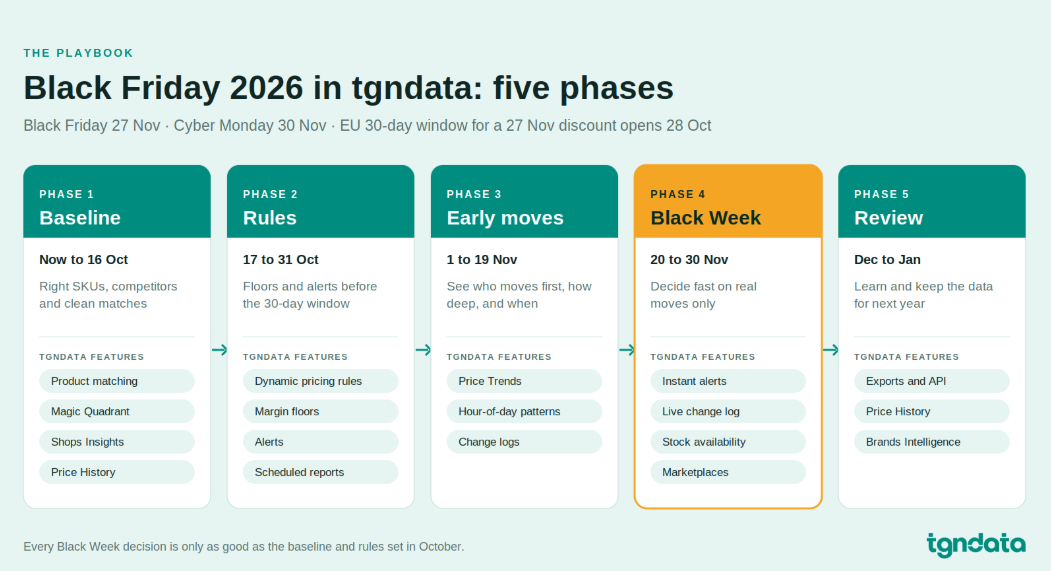
The phases matter more than the features: every Black Week decision is only as good as the baseline and rules set in October.
Choose priority SKUs and competitors, confirm product matches, and capture a clean price baseline, because everything later depends on comparing like with like. This is the least visible phase and the one that most often decides whether Black Week goes smoothly.
Pick the SKUs that matter. Start with traffic drivers, margin contributors and the products shoppers compare most, following the logic in How to Prioritize SKUs for Competitive Monitoring. For most retailers this is a few hundred hero products per category, not the full catalogue.
Pick competitors with data, not memory. tgndata’s Competition Magic Quadrant places competitors by assortment overlap and price index, and shows how active each one is by the number of price changes it makes. A competitor with high overlap and frequent price changes needs a tighter watch in November than a large but passive one. Shops Insights shows how many products each competitor has in common with you, by category and brand, which also flags new marketplace sellers that entered your categories this year.
Audit matches on priority SKUs. tgndata matches your products to competitor listings automatically, and states 99%+ matching accuracy on its price intelligence page. Even so, check variants, bundles and pack sizes on the products you will actually reprice, as explained in How Product Matching Works in Price Monitoring. A “set of 3” matched to a single unit creates a fake price gap that will look urgent at 06:00 on Black Friday.
Capture the baseline. Price History with AVG lets you compare your price and availability history with the rest of the market over a chosen date range, excluding shops you do not need. If you tracked the same SKUs last year, pull the October to December 2025 curve for each priority category: it shows who moved first, how deep, and whether prices recovered after Cyber Monday. If you did not, the baseline you capture now becomes next year’s benchmark.
Scale is manageable when matching is automated. tgndata’s published case study with Biker-Boarder, a German cycling and winter sports retailer, describes daily monitoring of 23,881 products across 50 competitors, which shows the kind of coverage a specialty retailer can run without manual checks. See How Biker-Boarder Optimized Competitive Pricing.
If a match is wrong in October, every alert and rule built on it will be wrong in November.
Margin floors, match-or-hold rules by competitor, stock-aware repricing rules and segmented alerts should all be live by 31 October, because the EU 30-day window for a Black Friday discount opens on 28 October. Setting rules early also means testing them while the market is still quiet.
Set margin floors first. tgndata’s dynamic pricing rules can be built on competitor prices, availability and margin, and applied per category, brand or specific product. Define a minimum price for every priority SKU before defining any match logic. The margin reasoning behind discount depth by product role is covered in A Black Friday Strategy That Protects Your Margin.
Decide who you match. Not every competitor deserves an automatic response. A typical setup matches two or three named competitors on hero SKUs within a margin floor, holds against marketplace sellers with poor ratings, and sends everything else to manual review. Guardrail design is covered in more depth in Dynamic Pricing Guardrails and MAP Compliance.
Make rules stock-aware. A competitor that is out of stock is not really cheaper. Because tgndata records availability alongside price, rules can ignore or discount the weight of competitors without stock, the dynamic covered in Buy Box Stock Availability: Why You’re Losing It.
Segment alerts so the right person sees the right move. tgndata alerts can be set for groups of products such as brands, categories or just the products one manager owns, with either instant or daily notifications. A workable Black Friday split is instant alerts for hero SKUs and named competitors, daily digests for the rest. Price Monitoring Alerts: Which Alerts Ecommerce Teams Need Now explains how to avoid alert fatigue.
Protect your 30-day reference price. Under the EU Omnibus Directive, any announced discount must be calculated from your own lowest price in the previous 30 days. For a Black Friday reduction starting on 27 November, that window opens on 28 October, and for a Black Month starting on 1 November it opened on 2 October. An overnight repricing undercut in late October can quietly lower the reference for your Black Friday banner, so add guardrails that pause aggressive rules on promoted SKUs. Details are in 30-Day Lowest Price Rule: Prove Every EU Discount.
Schedule the reports. Report Scheduling sends saved views to the team’s inbox, so category managers see the same competitive picture every morning in November without logging in.
Rules set in October are decisions made calmly; rules set in Black Week are decisions made under pressure.
Watch the direction of the market daily, learn when each competitor changes prices, and track moves at the product level, since idealo’s data shows prices usually start falling in early November. This phase tells you whether the market is moving early, and who is leading.
Read the market direction. tgndata’s Price Trends view shows, per day, how many products had increased or decreased prices, by competitor and category. A rising count of decreases in one category two weeks before Black Friday is an early signal that a competitor has started its campaign, and whether the market is in a falling or rising run.
Learn competitor timing. The Pricing Strategy view analyses competitors’ price changes over previous weeks by hour of day and by increase or decrease pattern, so you can anticipate the day and hour future changes are likely to happen and spot promotions launched outside business hours. If a key competitor typically reprices at 23:00 on Thursdays, that is when your alert coverage and on-call owner need to be ready.
Follow product-level changes. Price & Availability logs record each price and availability change with product, competitor and timing, and can be used as a live monitoring screen. Check early discounts against the competitor’s own history: a price that dropped 15% but was raised a week earlier is not a real market move.
Mind the side events. Singles Day on 11 November and marketplace Black Week launches often trigger the first visible moves. tgndata covered why the season keeps starting earlier in Black Friday Starts Earlier: Why Pricing Teams Must Too.
Early November shows you the playbook your competitors will run in Black Week, if you are watching the right signals.
Run Black Week from one live view with pre-agreed decision rules: match, hold or ignore, based on competitor relevance, stock, product match and margin floor. Speed matters, but only on moves that are real.
A practical war-room routine looks like this:
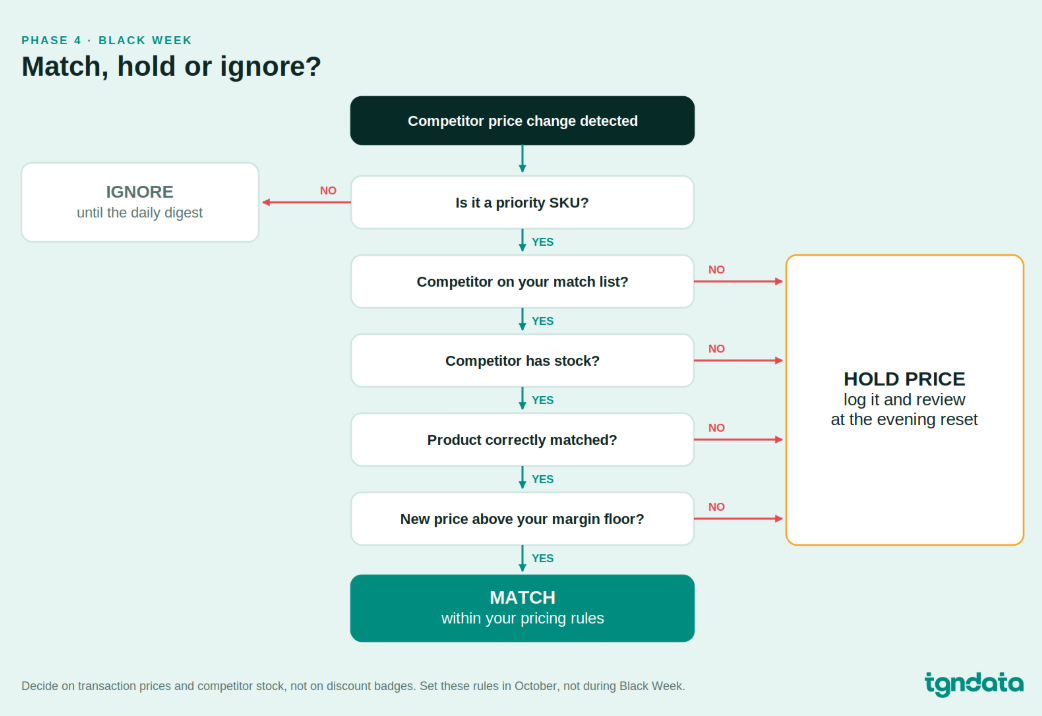
Consider a consumer electronics retailer tracking a flagship TV against four competitors. On Black Friday morning, one competitor drops the TV by 12%. The live log shows that the same competitor went out of stock on the model 40 minutes later, and the other three have not moved. Under the rules, the retailer holds price, keeps its margin, and captures the demand that spills over. Without stock data, it would have matched a price nobody could buy at. This scenario is illustrative, not a client example.
For a framework to rank competitor moves by urgency, see Market Activity Data: How Pricing Teams Prioritize Actions Fast.
The best Black Week decision is often not to move, and the data is what gives a team the confidence to hold.
Keep monitoring through Sinterklaas and Christmas, then run a structured review while the data is fresh, because the post-Black Friday period shapes your December margin and next year’s plan. Back-to-back campaigns also affect your EU reference prices: a Black Friday price can become the 30-day low for any December promotion.
Keep watching into December. In the Netherlands and Belgium, Sinterklaas on 5 December follows Black Friday within days. Track whether competitors restore prices after Cyber Monday or hold them into December, which tells you whether it is safe to recover your own.
Review with exports and the API. tgndata data can be exported or pulled through its REST API into BI tools for analysis. Useful questions include: which competitors moved first and deepest, which of your matches won volume and which only gave away margin, where stock-outs created opportunities, and how your price index moved by category across November.
Store the curve for next year. The October to December 2026 history becomes next year’s Phase 1 baseline. January Retail Pricing Reset covers how to clean holiday data so it does not distort January pricing and elasticity.
A Black Friday you review properly is a head start on next year’s Black Friday.
Brands use tgndata to see how their products are priced and promoted at every retailer and marketplace, how they compare with competing brands, and where unauthorized sellers appear. The Brands Intelligence view shows, per brand and per competitor, how many products sit at a lower, equal or higher price, with drill-down to the product level.
During Black Week, that answers the questions brand teams care about most: how far the market has moved on your hero products, whether competing brands are discounting harder, which retailers are gaining visibility, and whether new sellers appeared on marketplaces. tgndata’s MAP & MSRP monitoring adds tracking against your reference prices and RRPs.
Brands selling in the EU should use this data for their own pricing, promotion and distribution decisions. EU competition law treats minimum resale prices, and minimum advertised prices, as hardcore restrictions, so the data should not be used to pressure retailers to raise prices. The broader brand toolkit is covered in MAP Monitoring: How Brands Protect Retail Pricing, which should be read with that EU context in mind.
For brands, Black Friday price monitoring is market intelligence: it shows where to invest in your own channels and promotions.
Use the next two weeks to finish Phase 1, because the 30-day window and the first competitor moves are closer than they look. Here is the short list by role.
Pricing Managers
Ecommerce Managers
Category Managers
Commercial Directors and Revenue Managers
Marketplace Managers
The retailers that win Black Friday 2026 will be the ones who finished their setup in October and spent Black Week making a few good decisions, not hundreds of fast ones.
Black Friday price monitoring is the automated tracking of competitor prices, promotions and stock levels on your priority products across webshops and marketplaces in the weeks around Black Friday. It gives pricing teams the data to decide when to match, hold or ignore a competitor move, instead of reacting to banners or manual checks.
Retailers should have monitoring running by early October at the latest. Product matching and a price baseline need to be in place before prices start moving in early November, and in the EU the 30-day reference window for a Black Friday discount starting on 27 November 2026 opens on 28 October.
Priority SKUs in fast-moving categories such as electronics should be tracked at least several times a day during Black Week, with instant alerts for significant moves, while the rest of the catalogue can stay on a daily cycle. The right frequency depends on how often your competitors actually change prices, which tgndata’s hour-of-day analysis shows.
No. Match only when the competitor is relevant, the product is truly identical, the competitor has stock and the new price stays above your margin floor. Many Black Friday drops are temporary, out-of-stock or on mismatched products, and matching them gives away margin without winning sales.
tgndata matches your products to competitor listings automatically, records every price and availability change, sends instant or daily alerts by category, brand or owner, shows when competitors typically change prices, and runs dynamic pricing rules based on competitor prices, stock and margin. Data can be exported or pulled through the REST API into BI and pricing systems.
Yes. Brands use tgndata to see how their products are priced against the market and against competing brands at each retailer and marketplace, to spot unauthorized sellers and to benchmark promotion depth. In the EU, brands should use this data for their own pricing and distribution decisions, not to pressure retailers on resale prices, which competition law prohibits.
tgndata is price intelligence software for retailers and brands. Our price monitoring platform tracks competitor prices, promotions and stock across webshops and marketplaces in Germany, Benelux, Greece and beyond, with automated product matching, instant alerts, full price and availability history, and dynamic pricing rules with margin guardrails. Book a demo to map this playbook to your categories and competitors before the 30-day window opens on 28 October.
We use cookies to provide you with an optimal experience, for marketing and statistical purposes only with your consent, which you may revoke at any time. Please refer to our Privacy Policy for more information.










Missing an important marketplace?
Send us your request to add it!